How to Choose a Night Cream for Oily Skin
Oily skin often skips night cream on the logic that it makes enough oil already — but sebum is not the same as the barrier lipids and water the skin loses overnight. The right night cream for oily skin is a light gel-cream that hydrates and supports repair without adding grease or feeling suffocating on the pillow. Done well, it can actually steady oil production, because dehydrated oily skin overproduces to compensate. This guide describes the texture, finish and ingredients that suit shiny skin after dark, so you can judge any product by its formula rather than by whether it calls itself 'mattifying'.
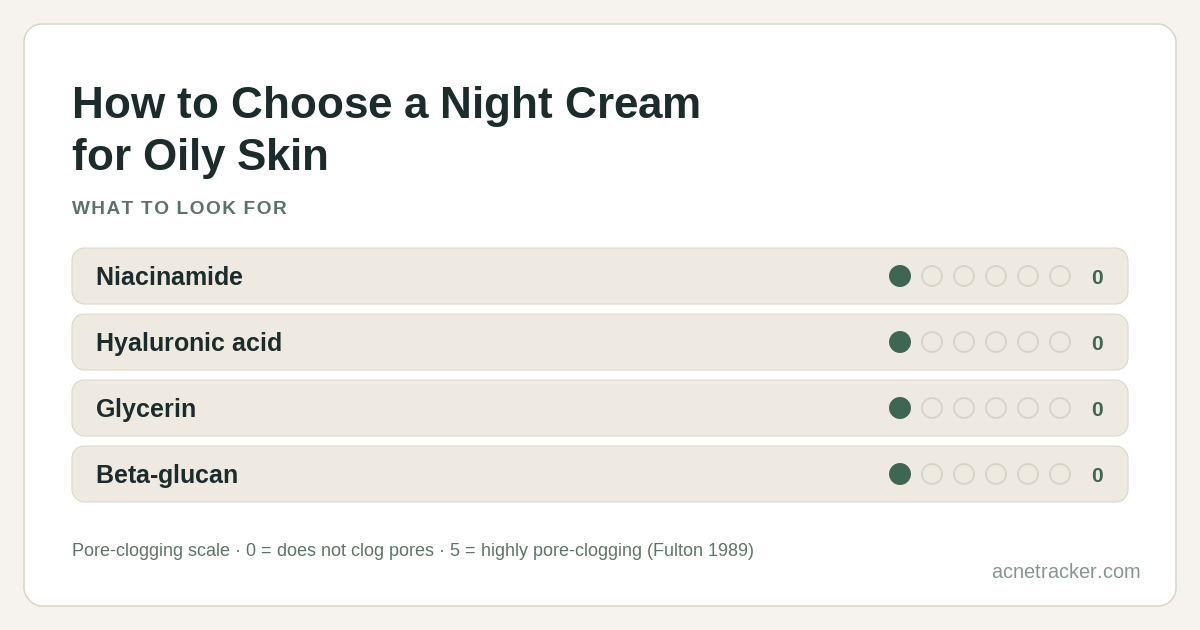
Ingredients to look for
| Ingredient | Why it matters |
|---|---|
| Niacinamide | The standout for oily skin at night: it helps moderate the look of oil and refine pores while supporting the barrier. |
| Hyaluronic acid | Delivers lightweight overnight hydration so the skin has no dehydration signal to overproduce oil against. |
| Glycerin | A weightless humectant that hydrates without the heaviness of butters or rich plant oils. |
| Beta-glucan | Soothes and hydrates with a light, water-based feel that layers well under nothing and over serums. |
| Dimethicone | A breathable silicone that gives a smooth, non-greasy finish and blurs shine without a heavy occlusive seal. |
Ingredients to avoid
| Ingredient | Why it matters |
|---|---|
| Rich butters and heavy plant oils (shea, cocoa, coconut) | They leave a greasy film that feels suffocating on oily skin overnight and can contribute to congestion. |
| Petrolatum-led heavy balms | The occlusive seal oily skin least needs; it traps sebum on an already-shiny surface through the night. |
| Alcohol-heavy 'mattifying' formulas | A denatured-alcohol matte effect dissolves surface oil briefly, then triggers rebound shine and irritation. |
| Fragrance layered into a rich base | Irritation from fragrance can nudge oil glands to overproduce, the opposite of what oily skin wants at night. |
How to choose
Texture is the whole game for oily skin: choose a gel-cream or light fluid that sinks in fast and leaves a matte-to-satin finish, never a balm. Look for humectants (glycerin, hyaluronic acid) and niacinamide high on the list, with dimethicone rather than heavy oils doing the smoothing. Read the finish claims sceptically: 'mattifying' often just means alcohol or absorbent powders that wear off, while what actually keeps skin calm overnight is steady hydration. Ask whether you need a separate night cream at all — many oily-skinned people are well served by using their light daytime gel moisturiser again at night. Buy a dedicated one only if you want more barrier support after an evening active, or if your skin feels tight after cleansing. Skip anything promising to 'control oil for 24 hours'; no leave-on cream regulates sebum that reliably.
How to apply
After cleansing and any evening treatment, smooth a thin layer of gel-cream over the face while skin is still slightly damp to lock in water. Oily skin needs less than it thinks — a light layer is enough, and over-applying leaves you shiny by morning. Concentrate it where skin feels tight rather than on the oily T-zone. If you use a serum, the cream goes on last to seal it. On nights you use a retinoid, the added hydration helps offset the dryness it can cause, and you still finish with sunscreen in the morning.
Frequently asked questions
Does oily skin actually need a night cream?
Not always a dedicated one. Oily skin still loses water overnight, so it needs hydration, but a light daytime gel used again at night often covers it. A separate night cream helps mainly if skin feels tight or you use evening actives.
Will a night cream make oily skin greasy by morning?
Only if it is too rich. A light gel-cream absorbs and leaves a matte-to-satin finish; balms and heavy oils are what leave you shiny. Match the texture to your skin and morning grease is not the outcome.
What night cream texture is best for oily skin?
A gel-cream or light fluid that sinks in quickly. It gives water and barrier support without the occlusive film of a balm, which oily skin does not need and often reacts to with congestion.
Can a night cream help control oil overnight?
Indirectly. Keeping skin hydrated stops the dehydration-driven oil rebound, and niacinamide can moderate how oily skin looks over time. No cream switches sebum glands off, so treat 'oil control' claims cautiously.
Sources & further reading
There is no single study of this exact question. The guidance here is reasoned from the ingredient profiles below, each of which carries its own references:
- Niacinamide2 refs
- Hyaluronic Acid7 refs
- Glycerin10 refs
- Beta-Glucan6 refs
- Dimethicone9 refs
Show every reference behind this page (28)
- Niacinamide: mechanisms of action and its topical use in dermatology (PubMed)cited by Niacinamide
- European Commission CosIng database — Niacinamidecited by Niacinamide
- PubChem — Hyaluronic acid compound summarycited by Hyaluronic Acid
- hyaluronsyre – Store medisinske leksikoncited by Hyaluronic Acid, Beta-Glucan
- Hyaluronic acid and HA-modified cationic liposomes for promoting skin penetration and retention. – PubMedcited by Hyaluronic Acid
- Bloomage – Wikipediacited by Hyaluronic Acid
- Moisturizers: The Slippery Road - PMCcited by Hyaluronic Acid, Glycerin
- The Role of Moisturizers in Addressing Various Kinds of Dermatitis: A Review - PMCcited by Hyaluronic Acid, Glycerin
- Emollients and Moisturizers (Moisturisers) — DermNetcited by Hyaluronic Acid, Glycerin
- PubChem — Glycerol compound summarycited by Glycerin
- glyserol – Store norske leksikoncited by Glycerin
- Fulton JE. Comedogenicity and irritancy of commonly used ingredients in skin care products. J Soc Cosmet Chem 40:321-333 (1989) — Table I, pp. 324-326cited by Glycerin, Dimethicone
- Topical supplementation with physiological lipids rebalances the stratum corneum ceramide profile and strengthens skin barrier function in adults predisposed tocited by Glycerin
- akne – Store medisinske leksikoncited by Glycerin, Dimethicone
- Acne managementcited by Glycerin
- www.cir-safety.orgcited by Glycerin
- PubMed — Improving skin function with CM-glucan, a biological response modifier from yeast (Int J Cosmet Sci, 1998)cited by Beta-Glucan
- betaglukan – Store medisinske leksikoncited by Beta-Glucan
- Beta-Glucan – PubChemcited by Beta-Glucan
- Administration of skin care regimens containing β-glucan for skin recovery after fractional laser therapy: A split-face, double-blinded, vehicle-controlled studcited by Beta-Glucan
- Administration of skin care regimens containing β-glucan for skin recovery after fractional laser therapy: A split-face, double-blinded, vehicle-controlled studcited by Beta-Glucan
- Final report on the safety assessment of stearoxy dimethicone, dimethicone, methicone, amino bispropyl dimethicone, aminopropyl dimethicone, amodimethicone, amocited by Dimethicone
- silikon – Store norske leksikoncited by Dimethicone
- Polydimethylsiloxane – Wikipediacited by Dimethicone
- Effects of moisturization on epidermal homeostasis and differentiation. – PubMedcited by Dimethicone
- Silicones as nonocclusive topical agents. – PubMedcited by Dimethicone
- Volume 40 No 6 page 14cited by Dimethicone
- Cosmetic Ingredient Review – Wikipediacited by Dimethicone
Medical disclaimer
Ingredients mentioned on this page
Find your personal acne triggers
Our free Acne Tracker lets you log breakouts, sleep, stress and diet, and shows you which factors correlate with your flare-ups.