Isotretinoin for Acne: How It Works, and What It Costs You
Isotretinoin clears acne that nothing else clears. It is also the only acne drug with a pregnancy prevention programme attached to it. Here is what the published evidence says about both halves of that sentence.
Key takeaways
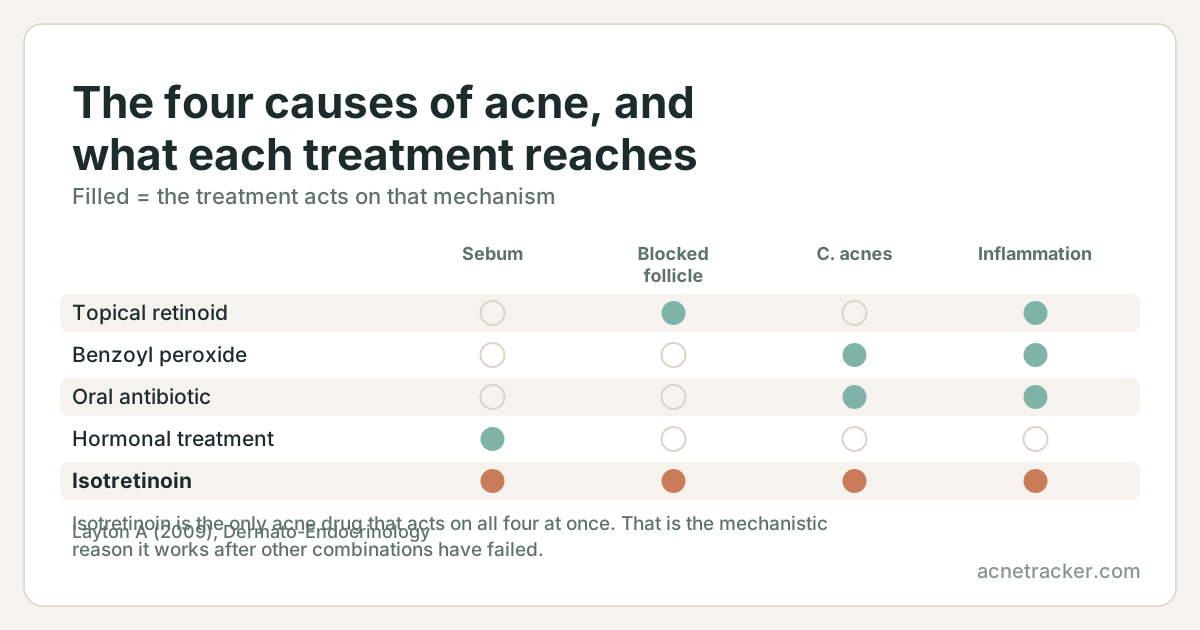
- Isotretinoin is the only acne treatment that acts on all four things that cause acne at once — oil production, blocked follicles, Cutibacterium acnes and inflammation — which is why it works when combinations of other drugs have not.
- The 2024 American Academy of Dermatology guideline gives it a strong recommendation for severe acne, and for acne that is scarring, causing psychosocial harm, or failing standard oral and topical therapy.
- Almost everyone gets dry lips, dry skin and dry eyes. These are dose-related and expected, not a sign that something has gone wrong.
- It causes severe birth defects. Every country that licenses it attaches a pregnancy prevention programme — monthly pregnancy tests, two forms of contraception, short prescription validity — and those rules are not negotiable.
- The depression link is the most argued-over question in dermatology. Two meta-analyses found no increase in depression risk at group level, and a 2023 global study found no overall signal, but none of that rules out an individual reacting badly. Report mood changes rather than waiting them out.
- Roughly a fifth to a third of people relapse and some need a second course. Reaching an adequate cumulative dose lowers that risk but does not remove it.
What isotretinoin actually is
Isotretinoin is 13-cis-retinoic acid — a vitamin A derivative taken as a capsule, usually with food, over a course of several months. It has been licensed for acne since 1982 and is sold under a long list of names; Roaccutane and Accutane are the ones most people have heard, and the generic capsules dispensed in most European pharmacies today are the same molecule.
It is not an antibiotic and it is not a hormone. It works on the sebaceous gland itself. Over a course, the glands shrink dramatically and sebum output falls to a fraction of what it was, and unlike every other acne treatment that effect persists after the drug is stopped. That single mechanism is why isotretinoin behaves so differently from everything else on the shelf: other treatments manage acne while you use them, isotretinoin changes the skin that was producing it.
That is also why it is reserved rather than offered first. A drug that permanently remodels a gland is a bigger intervention than a cream, and the side-effect profile follows from the same mechanism — if you suppress oil production across the whole body, the whole body gets drier.
Why it works when other treatments have not
Acne has four recognised drivers: too much sebum, abnormal keratinisation blocking the follicle, colonisation by Cutibacterium acnes, and inflammation. Nearly every other treatment addresses one or two of them. A topical retinoid works on keratinisation. Benzoyl peroxide works on C. acnes. An antibiotic works on C. acnes and inflammation. Hormonal treatment works on sebum, indirectly, by acting on androgens.
Isotretinoin is the only agent that acts on all four. Reducing sebum removes the substrate C. acnes lives on, so the bacterial population falls without an antibiotic being involved; normalising follicular keratinisation stops new comedones forming; and the drug has direct anti-inflammatory effects on top of that. When someone has been through a topical retinoid, benzoyl peroxide, two oral antibiotics and a hormonal treatment without clearing, this is the mechanistic reason isotretinoin is the next step rather than a sixth variation on the same theme.
The 2024 AAD guideline reflects that with a strong recommendation, and it is deliberately broader than 'severe acne'. It also covers acne that is scarring, acne that is causing psychosocial burden, and acne that has failed standard oral and topical therapy — three situations where the acne might not look dramatic in a photograph but is doing real damage.
Dose, duration and the cumulative-dose question
Isotretinoin is dosed by body weight, and courses have conventionally aimed at a total cumulative exposure in the region of 120–150 mg per kilogram, reached over roughly four to eight months. The logic is that response tracks the total amount taken rather than the daily dose, so a lower daily dose taken for longer can reach the same place as a higher one taken for a shorter time.
That target is a convention derived from observational work rather than a threshold established by trial, and it is genuinely contested. A retrospective analysis of high-dose courses found that pushing cumulative dose above the conventional target reduced relapse and retrial rates, at the cost of more short-term side effects — mostly the dryness ones — without a rise in serious adverse events. Low-dose regimens, at the other end, are better tolerated and are increasingly used for moderate acne, with the trade-off that relapse is more likely.
None of this is something to optimise on your own. It is written here because the numbers get quoted in forums as though there were one correct dose, and there is not: the choice between a fast, well-tolerated, higher-relapse course and a long, drier, more durable one is a real clinical trade-off that depends on how severe the acne is, how much scarring is at stake, and what the person taking it can live with.
The side effects nearly everyone gets
The mucocutaneous side effects are close to universal and they are the direct consequence of the mechanism. Cheilitis — cracked, peeling, painful lips — is the most common and in large reviews affects the large majority of people on treatment. Dry skin, dry nasal passages with nosebleeds, dry eyes with contact-lens intolerance, and increased sun sensitivity are all in the same family.
A retrospective review of 1,743 patients started on isotretinoin found this pattern clearly: the dryness effects dominate, they are dose-related, and they resolve after the course ends. They are also the reason people abandon treatment early, which matters, because a course stopped at three months usually has to be repeated.
Practical consequences worth knowing before starting rather than after: waxing and other epilation are avoided during and for a period after treatment because the skin tears more easily; elective cosmetic procedures are usually postponed; sun protection stops being optional; and a heavy occlusive lip balm becomes something you carry everywhere. Skin on isotretinoin is fragile in a way that is temporary but genuinely limiting while it lasts.
- Cheilitis (dry, cracked lips) — the most common effect by a wide margin
- Generalised dry skin, sometimes with eczema-like patches
- Dry eyes and contact-lens intolerance
- Nosebleeds from a dry nasal lining
- Photosensitivity — burning faster in the sun than usual
- Muscle and joint aches, particularly with exercise
What gets monitored, and why
Isotretinoin raises blood lipids — triglycerides most notably — and can raise liver transaminases. Both are usually modest, both are reversible, and both are the reason for blood tests before starting and periodically during a course. Marked triglyceride elevation is uncommon but is one of the few findings that leads to a dose reduction or a stop.
The monitoring schedule has been loosened over the last decade as the data accumulated: the frequent testing that used to be routine turned out to detect very few clinically meaningful abnormalities in otherwise healthy young people, and current guidance is correspondingly lighter than what many people remember from a decade ago. It is not zero, though, and the tests that remain are the ones that earned their place.
Two other associations are worth naming honestly because they get discussed. Isotretinoin is not compatible with tetracycline antibiotics — the combination is associated with raised intracranial pressure — so those are stopped before starting. And hair thinning occurs in a minority; it is usually a telogen effluvium that recovers after the course, but it is a real effect and not a myth.
Sources1. Reynolds RV 20244. Rademaker M 20102. Layton A 2009
Pregnancy: the part that is not negotiable
Isotretinoin is one of the most potent human teratogens in routine medical use. Exposure during pregnancy causes a characteristic pattern of severe birth defects affecting the face, skull, heart and central nervous system, and substantially raises the risk of miscarriage. The risk is present at ordinary therapeutic doses and from very early in pregnancy — often before a pregnancy would be recognised.
Because of that, every regulator that licenses isotretinoin attaches a pregnancy prevention programme to it. The details differ by country but the shape is identical: pregnancy testing before, during and after treatment; effective contraception, usually two methods, started before treatment and continued for a period after it; prescriptions with a deliberately short validity so that a supply cannot outlive a negative test; and no blood donation during or shortly after a course. In the United States this is administered through the FDA's iPLEDGE programme.
It also applies to people using long-acting contraception. The programme treats someone with an implant or a coil as still requiring the full protocol, because the protocol is designed around the consequence of failure rather than around the probability of it. That looks excessive until you look at what an exposed pregnancy involves, which is the reason the programmes exist in the form they do.
Sources9. Direktoratet for medisinske produkter 202410. Direktoratet for medisinske produkter 202312. U.S. Food and Drug Administration 202511. Felleskatalogen 2026
Depression and mood: what the evidence actually shows
This is the question people most want a straight answer to, and the honest answer has two halves that both need saying.
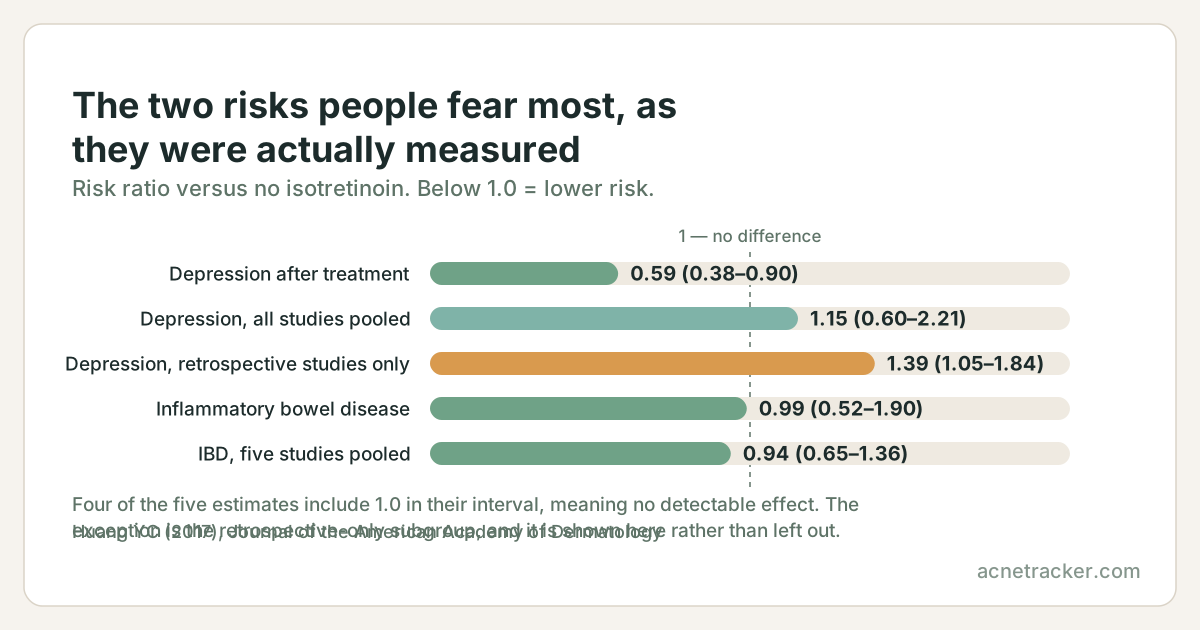
At group level, the studies do not show isotretinoin increasing depression. A 2017 systematic review and meta-analysis of 31 studies found the prevalence of depression after treatment fell rather than rose — a relative risk of 0.59 (95% CI 0.38–0.90) — with mean depression scores decreasing from baseline. A separate 2019 meta-analysis found no overall association either, at a pooled relative risk of 1.15 with a confidence interval running from 0.60 to 2.21, which is a statistical way of saying the data cannot distinguish this from no effect at all. A large 2023 global study using population-scale health records again failed to find the psychiatric signal the drug's reputation would predict. The most likely explanation for the direction of travel is straightforward: severe acne is itself strongly associated with depression, and clearing it helps.
The 2019 meta-analysis contains one result that deserves to be quoted rather than buried. When its retrospective studies were pooled on their own, they did show an association — a relative risk of 1.39 (95% CI 1.05–1.84) — while the prospective studies did not. Retrospective designs are more vulnerable to exactly the bias you would expect here, since a person whose mood changed is more likely to have it recorded and remembered. But the honest summary is that the evidence is not uniformly reassuring; it is mostly reassuring, with one subgroup that is not.
None of that rules out an individual reacting badly. A group-level null result is compatible with a small number of people having a real idiosyncratic reaction, and the studies are not designed to detect that. There are also documented cases of mood change that resolved on stopping and returned on rechallenge, which is the pattern that makes clinicians take individual reports seriously even while the population data stay flat.
The practical conclusion is not 'the risk is disproven'. It is that the population risk does not look like the folklore, that the depression which acne itself causes is real and often improves with treatment, and that anyone starting the drug should treat a change in mood as something to report promptly rather than something to wait out or feel embarrassed by. If you have a history of depression that is a reason for closer monitoring, not automatically a reason to be refused the drug.
Inflammatory bowel disease: a claim that did not hold up
The suggestion that isotretinoin causes inflammatory bowel disease drove a wave of litigation and a great deal of alarm. The epidemiology since has not supported it. A 2013 nested case-control study of 2,159 IBD cases matched against 43,180 controls found an adjusted risk ratio of 0.99 (95% CI 0.52–1.90) — no association in either direction. Broken out by disease, ulcerative colitis came to 1.10 and Crohn's disease to 0.91, both with intervals wide enough to include no effect. The same paper pooled five studies in a meta-analysis and got 0.94 (95% CI 0.65–1.36).
There is a plausible confounder that explains much of the original signal. People who end up on isotretinoin have usually taken long courses of oral antibiotics first, and antibiotic exposure is itself associated with IBD. Studies that do not account for the treatment that preceded the drug will attribute that association to the drug.
Some later analyses have reported small associations, particularly for ulcerative colitis, so it would be overstating things to say the question is entirely closed. What can be said is that the strongest evidence does not show a causal link, and that IBD is not among the risks that should dominate a decision about whether to take isotretinoin.
Sources8. Etminan M 2013
What a course actually feels like
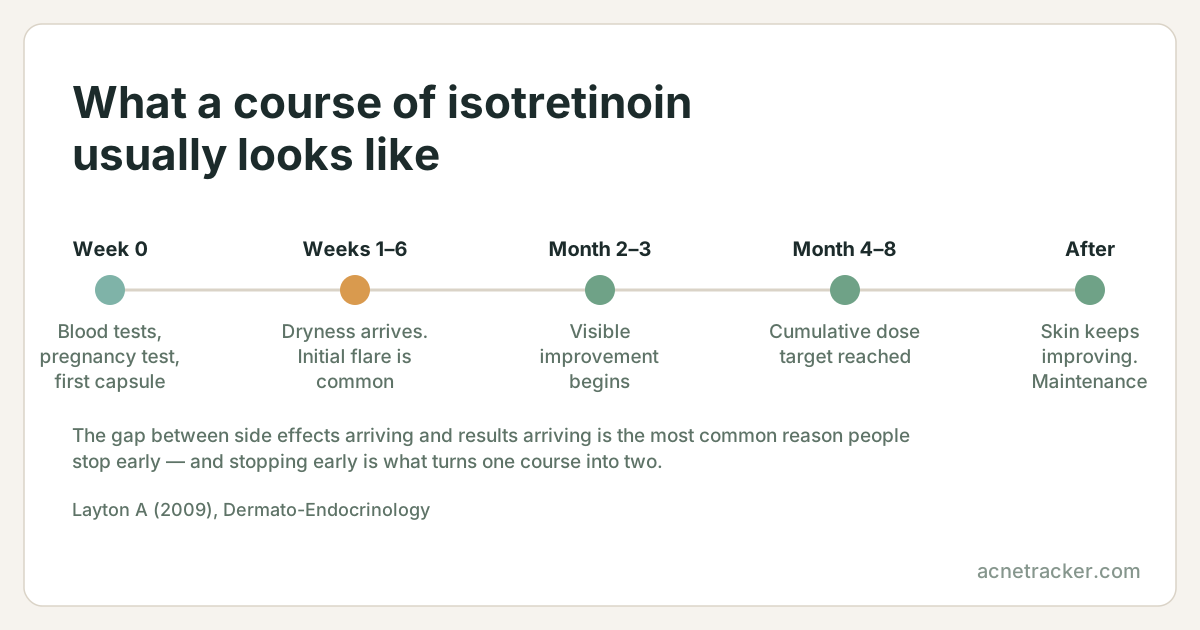
Many people get worse before they get better. An initial flare in the first four to six weeks is common enough that it should be expected rather than treated as failure, and it is more likely with a higher starting dose and with more inflammatory acne. Some prescribers deliberately start low for that reason.
The dryness arrives early — usually within the first two to three weeks — and then plateaus. Visible improvement typically begins somewhere in the second month and continues throughout, and skin often keeps improving for several months after the last capsule, which is why response is not judged at the moment a course ends.
The psychological arc is less discussed and worth naming. The first six weeks can be discouraging: the side effects have arrived and the results have not. That gap is the single most common reason people stop early, and stopping early is what turns one course into two.
Sources2. Layton A 20094. Rademaker M 2010
After the course: relapse and second rounds
Isotretinoin is not guaranteed to be permanent. A substantial minority relapse — reported rates vary widely with dose, severity and follow-up length, and a fifth to a third is a fair summary of the literature. Relapse is more likely in people who were younger at treatment, who had truncal as well as facial acne, who have a hormonal driver such as polycystic ovary syndrome, and who received a lower cumulative dose.
A second course is common, effective, and not a sign that the first one failed. What matters more for most people is what happens in the year after: maintenance with a topical retinoid is the standard approach to holding the result, and abandoning all treatment on the day the capsules stop is a good way to watch the acne come back.
Where a hormonal driver is present, the more useful question after a course is often not 'more isotretinoin?' but 'what is driving the sebum?' — which is where combined oral contraceptives and spironolactone enter the picture, both of which are covered in their own articles here.
The bottom line
Isotretinoin is the most effective acne treatment that exists, and it earns its reputation in both directions. If you have scarring, nodular, or treatment-resistant acne, the evidence supports it strongly and the two risks people fear most — depression and inflammatory bowel disease — are, at population level, not what the folklore says they are. The risk that is exactly as serious as it sounds is the one in pregnancy, and that is why the prescribing rules around it are as strict as they are. The rest of the trade-off is dryness, blood tests and several months of patience. Whether that trade is worth it is a conversation to have with a prescriber who can see your skin, not a decision to make from an article.
Frequently asked questions
How long does isotretinoin take to work?
Most people see the first real improvement in the second month, with continued improvement through the course and often for several months after the last capsule. An initial flare in the first four to six weeks is common and does not mean the treatment is failing.
Does isotretinoin cure acne permanently?
For many people it produces long-lasting remission, but not for everyone. A fifth to a third relapse, and relapse is more likely with a lower cumulative dose, younger age at treatment, truncal acne, or an underlying hormonal driver. A second course is common and effective.
Does isotretinoin cause depression?
At group level the evidence does not show that it does — two meta-analyses found depression prevalence falling rather than rising after treatment, and a large 2023 global study found no overall psychiatric signal. That does not rule out an individual reacting badly, so any change in mood should be reported to the prescriber promptly rather than waited out.
Why do I need pregnancy tests every month?
Isotretinoin causes severe birth defects at ordinary doses and from very early in pregnancy, often before a pregnancy would be noticed. The monthly testing, the two forms of contraception and the short prescription validity all exist so that no supply of the drug outlives a negative test. The rules apply even to people using an implant or a coil.
Can I drink alcohol on isotretinoin?
Isotretinoin can raise liver enzymes and blood lipids, and alcohol pushes in the same direction, so prescribers generally advise limiting or avoiding it during a course. This is one to settle with the person ordering your blood tests, since the answer depends on your own results.
Can I use retinol or exfoliating acids while taking it?
Generally no. Skin on isotretinoin is already dry, fragile and photosensitive, and adding a topical retinoid, an AHA or a BHA on top of that usually produces irritation without adding benefit. A gentle cleanser, a bland moisturiser, a heavy lip balm and sunscreen is the routine that most dermatologists recommend during a course.
References
Every claim on this page traces to one of the works below. Links open the original paper, guideline or regulator page — not a summary of it.
- (2024). Guidelines of care for the management of acne vulgarisJournal of the American Academy of Dermatology.
- (2009). The use of isotretinoin in acneDermato-Endocrinology.
- (2013). High-dose isotretinoin treatment and the rate of retrial, relapse, and adverse effects in patients with acne vulgarisJAMA Dermatology.
- (2010). Adverse effects of isotretinoin: A retrospective review of 1743 patients started on isotretinoinAustralasian Journal of Dermatology.
- (2017). Isotretinoin treatment for acne and risk of depression: A systematic review and meta-analysisJournal of the American Academy of Dermatology.
- (2019). Use of isotretinoin and risk of depression in patients with acne: a systematic review and meta-analysisBMJ Open.
- (2023). Isotretinoin and the risk of psychiatric disturbances: A global study shedding new light on a debatable storyJournal of the American Academy of Dermatology.
- (2013). Isotretinoin and risk for inflammatory bowel disease: a nested case-control study and meta-analysis of published and unpublished dataJAMA Dermatology.
- (2024). Isotretinoin skal ikke brukes av gravide kvinnerNorwegian Medical Products Agency (DMP).
- (2023). Påminnelse om graviditetsforebyggende tiltak ved bruk av orale retinoiderNorwegian Medical Products Agency (DMP).
- (2026). Isotretinoin Orifarm — preparatomtale og pasientinformasjonFelleskatalogen (Norwegian drug formulary).
- (2025). iPLEDGE REMS — risk evaluation and mitigation strategy for isotretinoinFDA.
Medical disclaimer
Find your personal acne triggers
Our free Acne Tracker lets you log breakouts, sleep, stress and diet, and shows you which factors correlate with your flare-ups.