How to Choose a Sunscreen for Oily Skin
Oily skin abandons sunscreen for one reason above all: the wrong texture. A heavy, greasy formula slides, pills under makeup and feels suffocating by midday, so it gets skipped — which is the worst outcome, because daily broad-spectrum protection is the single most effective anti-ageing and pigment-prevention step there is. The fix is not to avoid sunscreen but to match the base to your skin. This guide describes the filters, finish and supporting ingredients that make a fluid sit comfortably on shiny skin, so you can judge any product by its formula rather than by a 'for oily skin' banner on the front.
Ingredients to look for
| Ingredient | Why it matters |
|---|---|
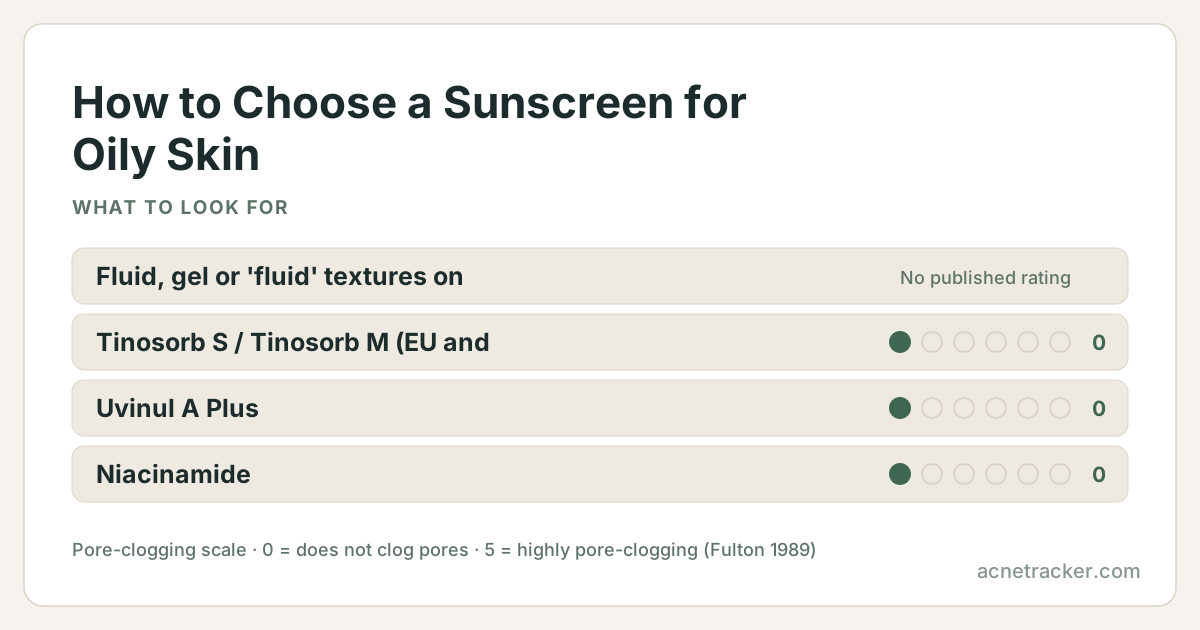
| Fluid, gel or 'fluid' textures on a water or alcohol-light base | A thin, fast-absorbing vehicle leaves far less shine than a rich cream and is the biggest factor in daily wear for oily skin. |
| Tinosorb S / Tinosorb M (EU and non-US markets) | Modern broad-spectrum filters that formulate elegantly into light, non-greasy bases with strong UVA cover. |
| Uvinul A Plus | A photostable UVA filter that pairs well in lightweight fluids without the oily feel of older UVA absorbers. |
| Niacinamide | A common supporting ingredient that helps regulate visible oil and calms the skin under daily SPF. |
| A stated matte or 'dry-touch' finish with silica or similar mattifiers | Absorbent powders soak up surface oil and keep the finish shine-free for longer between touch-ups. |
Ingredients to avoid
| Ingredient | Why it matters |
|---|---|
| Heavy occlusive bases (rich butters, high mineral-oil content) | They leave a greasy film on skin that already produces enough oil, encouraging shine and clogged pores. |
| Coconut oil and isopropyl myristate high on the list | These are known pore-clogging ingredients that undermine an otherwise good sunscreen for oil-prone skin. |
| Fragrance-heavy 'beach' formulas | They are built for water resistance and slip, not daily facial wear, and often feel thick and greasy. |
| Skipping SPF because 'it makes me oily' | The finish, not the protection, is the problem — the answer is a lighter base, not less sunscreen. |
How to choose
Start with the texture word on the label: 'fluid', 'gel', 'dry-touch' and 'matte' signal a base built for oily skin, while 'nourishing', 'rich' and 'hydrating cream' point the other way. Then check the filter system — in Europe and much of the world you can access Tinosorb and Uvinul filters that formulate into genuinely weightless fluids, so oily skin is not stuck with thick options. Aim for at least SPF 30, and look for the UVA circle or a 'broad-spectrum' claim, because UVA drives ageing and pigment regardless of your skin type. Scan the first few ingredients for heavy oils; a good oily-skin formula keeps those low. Finally, ignore 'oil-free' as a guarantee — it is unregulated, and some oil-free formulas still feel heavy — and trust the wear test: reapply once and see whether the finish stays comfortable.
How to apply
Use about two fingers' length of product for the face and neck; under-applying is the most common reason real-world protection falls short of the SPF on the box. Apply as the last skincare step in the morning, before makeup, and let it set for a couple of minutes so it does not pill. Reapply every two hours of meaningful sun exposure — a mattifying powder or fluid SPF over makeup makes this realistic for oily skin. On indoor days with little window light, a single morning application is usually enough.
Frequently asked questions
Will sunscreen make oily skin break out?
Not on its own. Breakouts come from specific comedogenic ingredients, not from SPF itself. Choose a light fluid without heavy oils and the protection will not clog pores.
Is a mattifying sunscreen enough to control shine all day?
It reduces shine but rarely eliminates it for a full day. A translucent powder or an SPF-containing setting product at midday keeps the finish matte and tops up protection at the same time.
Chemical or mineral sunscreen for oily skin?
Both can work, but modern chemical and hybrid fluids usually feel lighter and leave no white cast, which suits oily skin. Mineral formulas can be excellent too if they use a light, non-greasy base.
Do I need a separate moisturizer under sunscreen if my skin is oily?
Often not — many facial sunscreens are hydrating enough to double as your morning moisturizer. If your skin feels tight, a light gel underneath is fine and will not necessarily add shine.
Sources & further reading
There is no single study of this exact question. The guidance here is reasoned from the ingredient profiles below, each of which carries its own references:
- Tinosorb S2 refs
- Uvinul A Plus2 refs
- Niacinamide2 refs
- Silica3 refs
Show every reference behind this page (5)
- European Commission CosIng — Bis-Ethylhexyloxyphenol Methoxyphenyl Triazinecited by Tinosorb S, Uvinul A Plus, Niacinamide, Silica
- SCCS opinions on organic UV filterscited by Tinosorb S, Uvinul A Plus
- Niacinamide: mechanisms of action and its topical use in dermatology (PubMed)cited by Niacinamide
- PubChem — Silicon dioxidecited by Silica
- Fulton JE. Comedogenicity and irritancy of commonly used ingredients in skin care products. J Soc Cosmet Chem 40:321–333 (1989) — Table I, pp. 324–326 (source of the comedogenic rating)cited by Silica
Medical disclaimer
Ingredients mentioned on this page
Find your personal acne triggers
Our free Acne Tracker lets you log breakouts, sleep, stress and diet, and shows you which factors correlate with your flare-ups.