Spironolactone for Acne: The Evidence Finally Caught Up
For three decades spironolactone was the acne drug dermatologists swore by and could not point to a trial for. The SAFA trial changed that in 2023 — and its most useful finding is about timing, not effectiveness.
Key takeaways
- SAFA, published in the BMJ in 2023, randomised 410 adult women to spironolactone or placebo. It is the first properly powered trial of a drug that had been used off-label for acne since the 1980s.
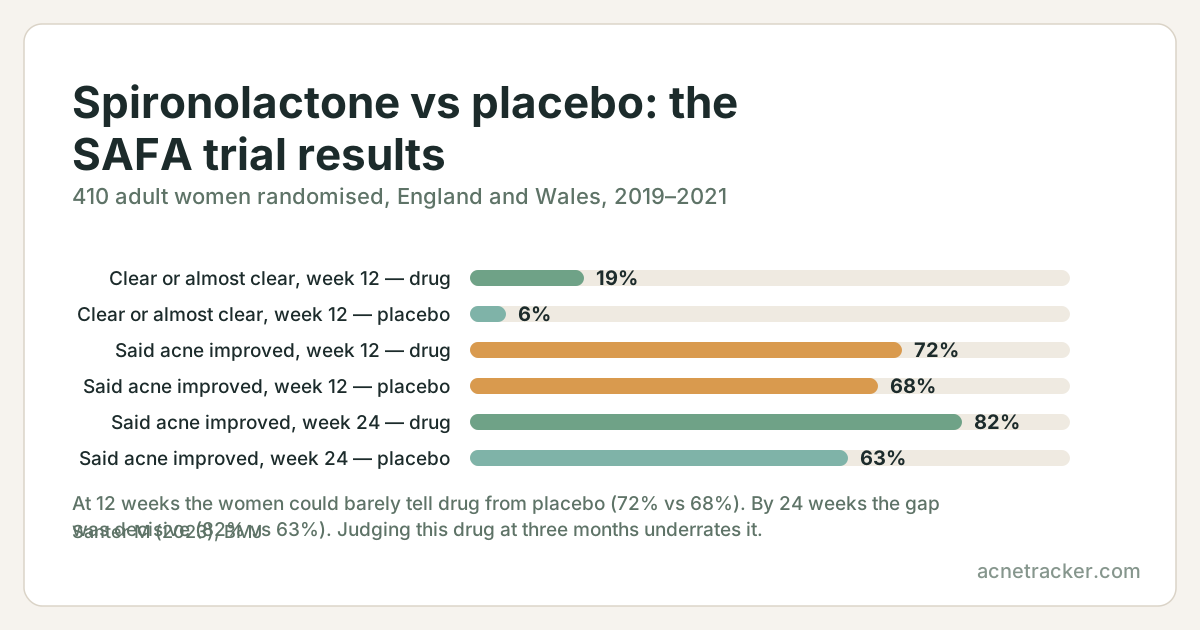
- At 12 weeks the difference in how women rated their own acne was not statistically significant (72% vs 68% improved). At 24 weeks it clearly was (82% vs 63%, odds ratio 2.72). This drug is slow, and quitting at three months is quitting too early.
- Objective assessment moved earlier: at week 12, 19% on spironolactone were rated clear or almost clear versus 6% on placebo.
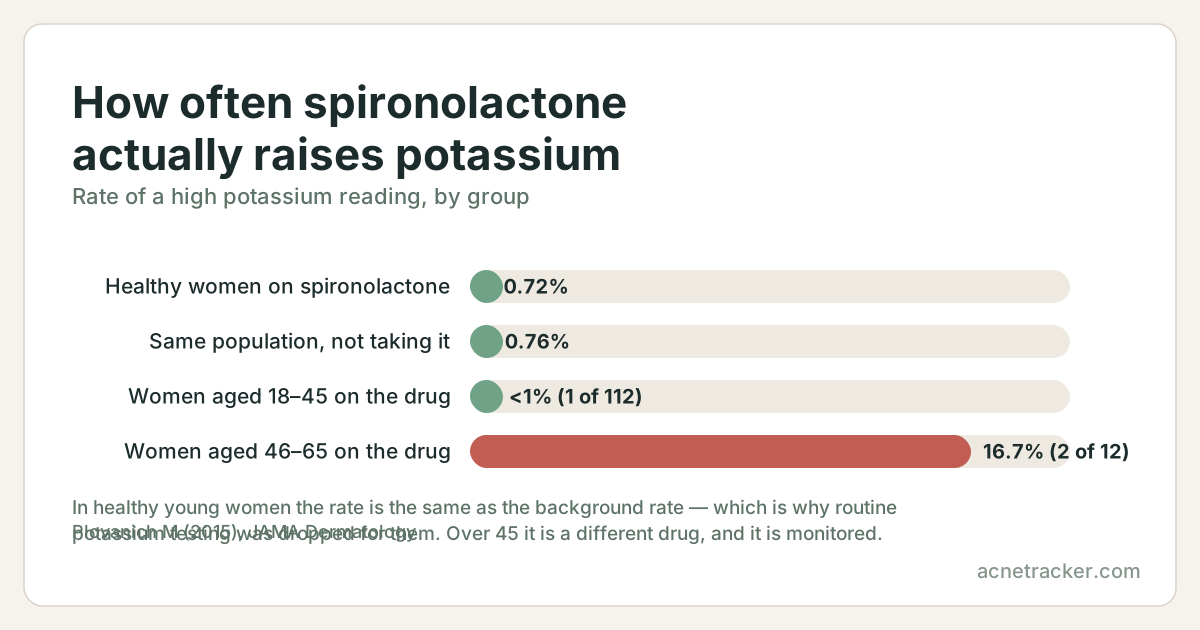
- The hyperkalaemia fear is largely misplaced in healthy young women. In 974 of them the rate of a high potassium reading was 0.72% — identical to the 0.76% background rate — so routine testing is no longer recommended for that group. Over 45, it is a different picture and monitoring is warranted.
- It is not a contraceptive and must not be taken in pregnancy, because of a theoretical risk of feminising a male fetus. That is why it is usually taken alongside contraception rather than instead of it.
- In Norway it is licensed for heart failure, oedema and nephrotic syndrome — acne is an off-label use here, which affects both how it is prescribed and whether it is reimbursed.
What spironolactone is, and how it ended up treating acne
Spironolactone is a potassium-sparing diuretic, developed and licensed for heart failure and fluid overload. Its use in dermatology is an accident of pharmacology: alongside blocking the mineralocorticoid receptor, it also blocks the androgen receptor and inhibits androgen synthesis. That second activity is a side effect in a cardiology patient and the entire point in a dermatology one.
Because acne is driven by androgens acting on the sebaceous gland, a drug that occupies the androgen receptor lowers sebum production without touching oestrogen at all. That is a meaningfully different mechanism from a combined pill, which works upstream by suppressing how much androgen the ovaries make and by raising the binding protein that mops up what is left.
The practical consequence of blocking the receptor rather than the production is that spironolactone works in women who cannot take oestrogen — a history of clot, migraine with aura, smoking over 35 — and in women who simply do not want a contraceptive. It also means it does nothing at all for contraception, which is the single most commonly missed fact about it.
Thirty years of use without a trial
Dermatologists have prescribed spironolactone for adult female acne since the 1980s, and prescribing rose steadily through the 2000s and 2010s. What did not exist for most of that period was randomised evidence. The literature consisted of retrospective series, open-label cohorts and clinical experience — enough to convince the people prescribing it, not enough to put it into a guideline.
That gap had a real cost. NICE's acne guidance for England and Wales did not mention spironolactone at all, and prescribers outside dermatology had no basis on which to offer it, so a woman's chance of being offered a drug that might have suited her depended largely on which specialty she happened to reach. Meanwhile the default alternative — a long course of an oral antibiotic — carried its own well-documented problems.
This is a recurring failure mode in medicine, and it is worth naming: an old, cheap, off-patent drug has no commercial sponsor to fund the trial that would legitimise it. SAFA exists because a public research funder paid for it, not because a company did.
SAFA: what the trial actually did
The Spironolactone for Adult Female Acne trial recruited from primary and secondary care and from community advertising across England and Wales between June 2019 and August 2021. It enrolled women aged 18 and over with facial acne of at least six months' standing that a clinician judged severe enough to warrant oral antibiotics.
410 women were randomised — 201 to spironolactone, 209 to placebo — and 342 were included in the primary analysis. Mean age was 29.2 years. Acne severity at entry was 46% mild, 40% moderate and 13% severe, which is worth noting: this was not a trial of severe cystic acne, it was a trial of the persistent adult acne that fills dermatology clinics.
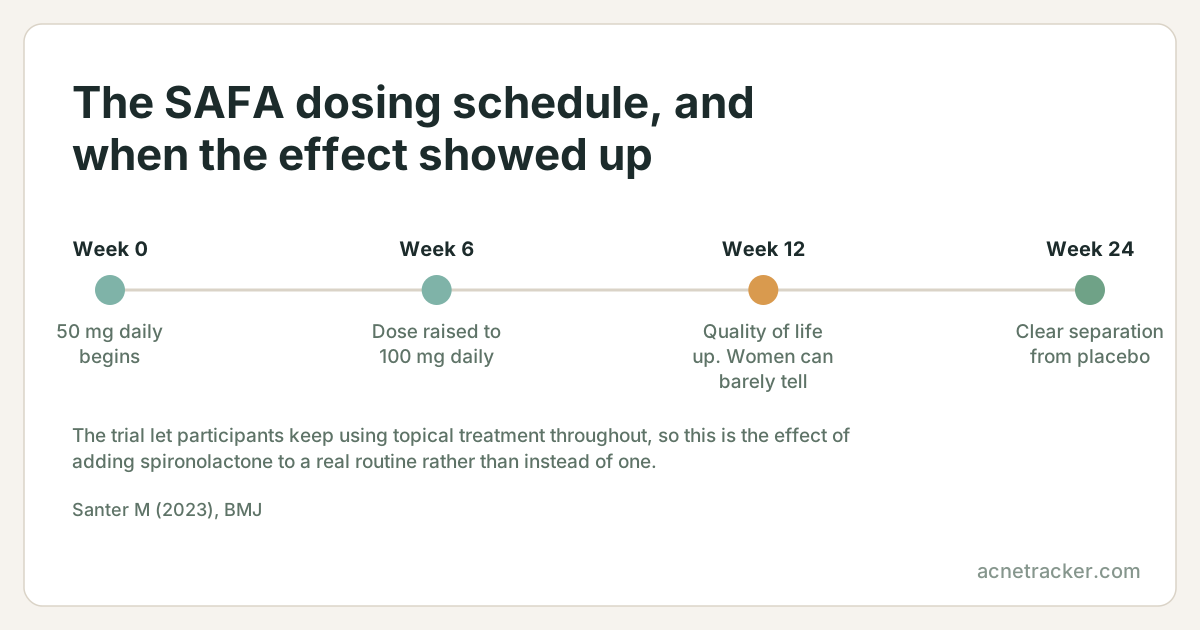
Dosing was 50 mg a day for the first six weeks, rising to 100 mg a day through to week 24. Crucially, participants were allowed to keep using topical treatments throughout. So the trial answers a realistic question — what does adding spironolactone to an existing routine do? — rather than an artificial one.
Sources1. Santer M 2023
The results, and the timing that matters
On the primary outcome — an acne-specific quality of life symptom score at week 12 — spironolactone beat placebo by 1.27 points (95% CI 0.07 to 2.46). That is a real difference, but a narrow one, with a confidence interval that only just clears zero. At week 24 the same measure showed a difference of 3.45 points (95% CI 2.16 to 4.75): much larger and far more certain.
The women's own verdict follows the same shape and states it more starkly. At week 12, 72% on spironolactone said their acne had improved against 68% on placebo — an odds ratio of 1.16 with a confidence interval from 0.70 to 1.91, meaning no detectable difference at all. At week 24 it was 82% versus 63%, an odds ratio of 2.72 (95% CI 1.50 to 4.93).
Investigator-rated treatment success moved earlier than the women's own perception: by week 12, 19% of those on spironolactone were rated clear or almost clear against 6% on placebo, an odds ratio of 5.18 (95% CI 2.18 to 12.28).
Put together, this is the single most useful thing the trial produced. Spironolactone is a slow drug, and at the three-month mark a woman taking it cannot reliably tell it apart from a placebo by how her skin feels — even though an assessor looking at her face already can. Three months is exactly when most people decide a treatment has failed. Knowing in advance that the honest review point is six months is, for a lot of people, the difference between the drug working and the drug being abandoned.
Sources1. Santer M 2023
Side effects: what the trial found
SAFA's safety result is reassuringly boring. Adverse reactions were slightly more common on spironolactone than placebo, with headache the one that reached significance: 20% versus 12%. No serious adverse reactions were reported in either arm.
Outside the trial, the effects that come up most in practice follow from the drug's two activities. As a diuretic it causes increased urination, particularly early on, and can cause light-headedness. As an anti-androgen it causes menstrual irregularity in a substantial minority — this is the most common reason women stop it, and it is markedly less of a problem in women who are also on a combined pill, which is part of why the two are so often prescribed together. Breast tenderness and, less often, breast enlargement are reported.
None of these are dangerous. They are the kind of side effects that people tolerate readily if warned and abandon treatment over if not, which makes the counselling as important as the prescription.
- Headache — 20% on spironolactone vs 12% on placebo in SAFA
- Increased urination and light-headedness, mostly in the first weeks
- Menstrual irregularity — common, and much reduced if a combined pill is taken alongside
- Breast tenderness or enlargement — less common
Sources1. Santer M 2023
The potassium question, settled
Spironolactone is potassium-sparing, so raised serum potassium is a genuine risk of the drug — in the population it was designed for. The question that mattered for dermatology was whether it is a risk in healthy young women taking a much lower dose.
A 2015 study of 974 healthy young women taking spironolactone for acne found 13 abnormal potassium readings out of 1,802 measurements, a rate of 0.72%. The baseline rate of an abnormal reading in the same population not taking the drug was 0.76%. In other words, the testing was detecting the background noise of blood chemistry rather than an effect of the medication. Six of the thirteen were normal on a repeat test, and no action was taken in the remaining seven.
That study is the reason routine potassium monitoring was dropped for healthy young women, and it is a good example of a monitoring ritual outliving its evidence. But it does not generalise. A separate analysis found that among women aged 46 to 65 the rate of new hyperkalaemia was 16.7% (2 of 12) against under 1% (1 of 112) in women aged 18 to 45. Age, kidney function, and any drug that also affects the renin-angiotensin-aldosterone system all change the answer — so 'no blood tests needed' is a statement about healthy women under about 45, not about the drug.
Sources2. Plovanich M 20153. Thiede RM 2019
Pregnancy, contraception and the breast cancer question
Spironolactone must not be taken in pregnancy. The concern is theoretical rather than demonstrated in humans — an anti-androgen crossing the placenta could interfere with the genital development of a male fetus — but it is a serious enough theoretical risk that it is treated as an absolute contraindication.
This has a consequence people frequently miss: spironolactone is not a contraceptive and provides no protection whatsoever. A drug that must not be taken in pregnancy and does nothing to prevent one is a combination that requires reliable contraception alongside it, which is a large part of why spironolactone and a combined pill are so commonly prescribed as a pair.
The other recurring worry is cancer, and it comes from the drug's label carrying a tumorigenicity warning based on high-dose rat studies. The human data do not support that concern at the doses used here. A retrospective matched cohort study in the BMJ examining incident breast cancer in women older than 55 taking spironolactone found no increased risk. The population studied was older and generally sicker than a dermatology patient, which if anything makes the null result more reassuring for a 28-year-old taking 100 mg for her skin.
Where it fits: not first, and not last
Spironolactone is not a first-line acne treatment and nothing in SAFA suggests it should be. Topical treatment — a retinoid, benzoyl peroxide, or a fixed combination of the two — remains where treatment starts, and SAFA's participants stayed on theirs.
Where it fits is the slot that oral antibiotics have historically occupied: adult female acne that has not responded to topicals and is persistent enough to warrant something systemic. SAFA's own conclusion says exactly this — that spironolactone is a useful alternative to oral antibiotics for women with acne. That framing matters, because a three- to six-month course of doxycycline for acne contributes to antibiotic resistance in a way that spironolactone simply does not.
It is not a replacement for isotretinoin either. Nodular, scarring or severe acne is a different problem with a different answer, and the 2024 AAD guideline's strong recommendation for isotretinoin in that setting stands regardless of what spironolactone can do for milder disease.
What this means in Norway
Spironolactone is available in Norway as Spirix and Spironolactone Orion, but the marketing authorisations cover heart failure, oedema in liver disease and nephrotic syndrome, and suspected primary aldosteronism. Acne is not among the approved indications.
Using a licensed drug outside its approved indication is legal and routine, and dermatologists do it. But it changes the conversation in three practical ways. The prescriber carries the responsibility for the off-label choice rather than leaning on the label, so it is more likely to come from a dermatologist than from a GP. Reimbursement is unlikely to follow an off-label indication, so the cost is usually the patient's — though spironolactone is an old generic and inexpensive. And the patient information leaflet in the box will describe a heart failure drug, which is disconcerting if nobody has explained why it is in your hand.
None of that is an argument against it. It is an argument for asking directly, because a treatment nobody mentions is not the same as a treatment that would not work for you.
Sources8. Felleskatalogen 2026
The bottom line
Spironolactone spent thirty years in the awkward position of being obviously useful and formally unevidenced. SAFA closed that gap: in adult women with persistent facial acne, it beats placebo, the effect is clear by six months, and the safety profile in healthy young women is undramatic enough that the routine blood test most people expect is no longer recommended for them. Its real limitations are that it is slow, that it causes menstrual irregularity in a fair number of women, that it cannot be taken in pregnancy while doing nothing to prevent one, and that in Norway you will have to ask for it rather than be offered it. For adult female acne that has outlasted topical treatment, it is now a better-evidenced option than the antibiotic course it usually replaces.
Frequently asked questions
How long does spironolactone take to work for acne?
Longer than most people expect. In the SAFA trial the difference in how women rated their own acne was not significant at 12 weeks (72% vs 68% improved) but clearly was at 24 weeks (82% vs 63%). An assessor could see a difference by week 12, but the honest personal review point is around six months.
Do I need blood tests on spironolactone?
For a healthy woman under about 45, current evidence says routine potassium monitoring is unnecessary — the rate of a high reading was 0.72% against a 0.76% background rate. Over 45, with kidney problems, or on other drugs affecting the renin-angiotensin-aldosterone system, monitoring is warranted. Your prescriber decides based on your own risk factors.
Is spironolactone a contraceptive?
No. It provides no contraceptive protection at all, and it must not be taken in pregnancy because of a theoretical risk to a male fetus. Those two facts together are why it is usually prescribed alongside reliable contraception.
Can men take spironolactone for acne?
It is rarely used in men. At the doses that help acne it commonly causes breast tenderness and gynaecomastia, which most men find unacceptable, so other systemic options are used instead.
Does spironolactone cause weight gain?
It is a diuretic, so if anything it moves fluid the other way, and weight gain is not among the effects the trial found. Some people report bloating or appetite change; the trial's one statistically significant adverse effect was headache, at 20% versus 12% on placebo.
Is spironolactone approved for acne in Norway?
No. Norwegian marketing authorisations cover heart failure, oedema and nephrotic syndrome, so prescribing it for acne is off-label. That is legal and done, but it usually means a dermatologist rather than a GP, no reimbursement for that indication, and a package leaflet describing a heart medicine.
References
Every claim on this page traces to one of the works below. Links open the original paper, guideline or regulator page — not a summary of it.
- (2023). Effectiveness of spironolactone for women with acne vulgaris (SAFA) in England and Wales: pragmatic, multicentre, phase 3, double blind, randomised controlled trialBMJ.
- (2015). Low Usefulness of Potassium Monitoring Among Healthy Young Women Taking Spironolactone for AcneJAMA Dermatology.
- (2019). Hyperkalemia in women with acne exposed to oral spironolactone: A retrospective study from the RADAR (Research on Adverse Drug Events and Reports) programInternational Journal of Women's Dermatology.
- (2012). Spironolactone and risk of incident breast cancer in women older than 55 years: retrospective, matched cohort studyBMJ.
- (2024). Guidelines of care for the management of acne vulgarisJournal of the American Academy of Dermatology.
- (2017). Trends in prescribing behavior of systemic agents used in the treatment of acne among dermatologists and nondermatologists: A retrospective analysis, 2004-2013Journal of the American Academy of Dermatology.
- (2012). Combined oral contraceptive pills for treatment of acneCochrane Database of Systematic Reviews.
- (2026). Spironolactone Orion — preparatomtale (godkjente indikasjoner i Norge)Felleskatalogen (Norwegian drug formulary).
Medical disclaimer
Find your personal acne triggers
Our free Acne Tracker lets you log breakouts, sleep, stress and diet, and shows you which factors correlate with your flare-ups.