Diet and Acne: What the Evidence Supports, and What It Doesn't
For decades dermatology said diet had nothing to do with acne. That was wrong, but the correction has been oversold in the other direction. Here is what the actual studies found, and how much confidence each one earns.
Key takeaways
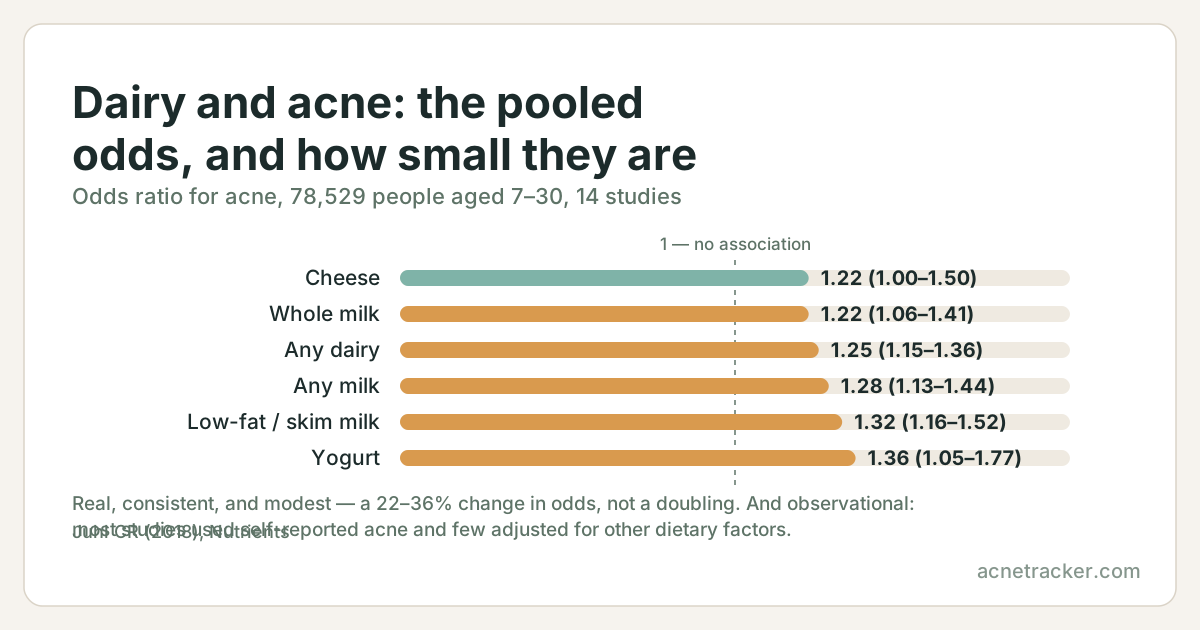
- A meta-analysis of 78,529 people found a consistent association between dairy and acne: odds ratio 1.25 for any dairy, 1.28 for any milk, 1.32 for low-fat or skim milk. Real, replicated, and modest — a change in odds of roughly a quarter, not a doubling.
- Skim and low-fat milk show a stronger association than whole milk in study after study, which rules out fat as the mechanism and points at milk's hormonal and growth-factor content instead.
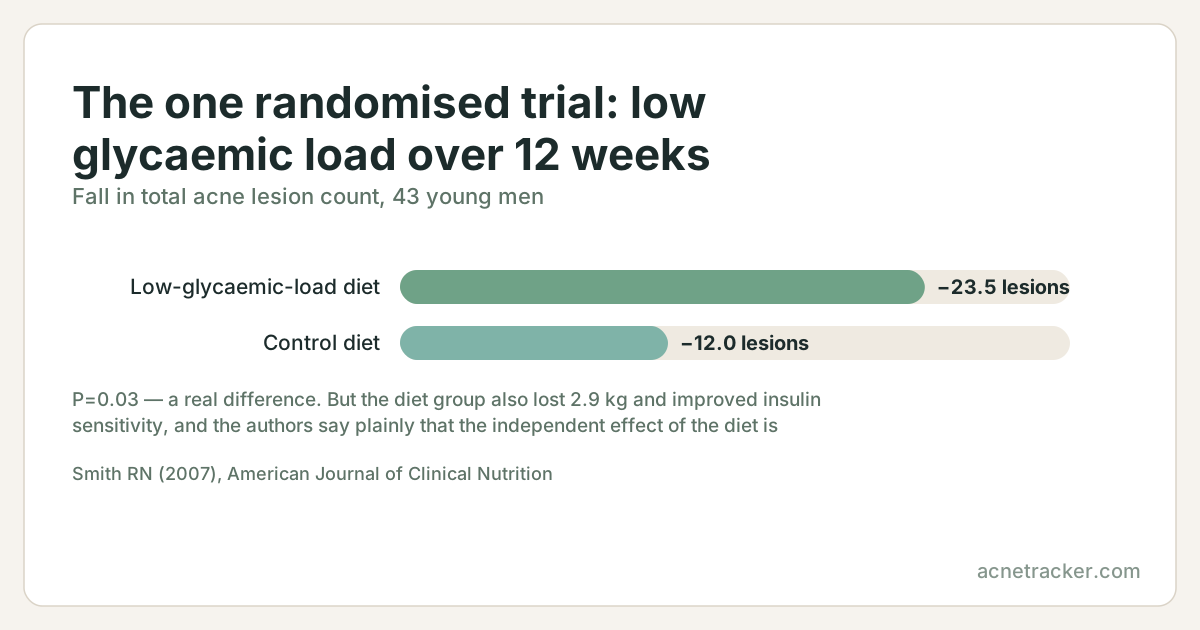
- The strongest evidence for the glycaemic hypothesis is a 12-week randomised trial in 43 young men: total lesion counts fell by 23.5 on a low-glycaemic-load diet against 12.0 on the control diet.
- That trial's own authors flag the problem with it — the diet group also lost 2.9 kg and improved insulin sensitivity, so the independent effect of the carbohydrate change is unresolved.
- The classic observation that acne is essentially absent in some non-Westernised populations is real: no case was found among 1,200 Kitavan Islanders or 115 Aché hunter-gatherers. It cannot tell you which part of a Western diet is responsible.
- Diet is a modifier, not a cause. Nobody's cystic acne is purely a milk problem, and no dietary change in the literature performs anything like a topical retinoid, benzoyl peroxide, or the systemic treatments.
Why dermatology said 'diet doesn't matter' for so long
The received wisdom that food has nothing to do with acne traces to a small number of studies from the 1960s and 1970s — most famously a chocolate-bar trial — which were underpowered, poorly controlled, and in at least one case industry-funded. Those studies did not show that diet is irrelevant. They failed to show that one specific food mattered, which is a different result.
The profession then over-corrected, partly for a good reason. Blaming acne on what a teenager eats has a long history of being used to imply that acne is a personal failure of cleanliness or discipline, which is both false and harmful. Saying firmly that diet is not the cause was a defence against that, and it did real good.
The problem is that it is no longer accurate, and defending it now costs credibility. There is genuine evidence of dietary associations. The task is to describe them at the size they actually are, rather than swinging from 'diet is irrelevant' to 'cut out dairy and sugar and your skin will clear', which the evidence does not support either.
The dairy association, and how big it actually is
The best synthesis is a 2018 meta-analysis of 14 studies covering 78,529 people aged 7 to 30 — 23,046 with acne and 55,483 without. Pooled, it found an odds ratio of 1.25 (95% CI 1.15–1.36) for any dairy intake, 1.28 (1.13–1.44) for any milk, 1.22 (1.06–1.41) for whole milk, 1.32 (1.16–1.52) for low-fat or skim milk, 1.36 (1.05–1.77) for yogurt and 1.22 (1.00–1.50) for cheese.
A second, independent meta-analysis published the following year in Clinical Nutrition found the same direction with somewhat larger estimates: total milk at 1.48 (1.31–1.66) and skim milk at 1.82 (1.34–2.47), with no significant association for yogurt or cheese. Two teams, different methods, same signal.
It is worth translating an odds ratio of 1.25 into something intuitive, because it is routinely reported as though it were dramatic. It means the odds of having acne among higher dairy consumers are about a quarter higher than among lower consumers. It does not mean a quarter of acne is caused by dairy, and it does not mean that cutting dairy reduces anyone's acne by 25%.
The prospective cohort data are more modest still. In 4,273 teenaged boys followed with repeated food questionnaires, the prevalence ratios comparing the highest with the lowest intake were 1.16 for total milk, 1.10 for whole or 2% milk, 1.17 for low-fat milk and 1.19 for skim milk — the last two being the ones that reached significance.
The skim milk clue
One detail recurs across all of these studies and it is the most informative thing in the whole dairy literature: skim and low-fat milk are consistently associated with acne at least as strongly as whole milk, and often more strongly.
That single fact eliminates the intuitive explanation. If milk fat were the problem — 'greasy food causes greasy skin' — whole milk would show the strongest association and skim the weakest. The data say the opposite, repeatedly, in independent datasets.
The remaining candidate mechanisms all concern what milk contains besides fat. Milk carries hormones and growth factors from the cow, and it stimulates insulin-like growth factor 1 in the person drinking it. IGF-1 acts on the sebaceous gland and increases sebum production, which is a plausible route from a glass of milk to a blocked follicle. Skimming removes fat while concentrating the whey protein fraction, which may explain the direction of the difference.
This is a hypothesis with a mechanism, not a demonstrated causal chain — no trial has randomised people to milk and measured what happens. But it is the reason the dairy association is taken seriously rather than dismissed as confounding, because it predicted the skim-versus-whole pattern that the data then showed.
Sugar and glycaemic load: the better-designed evidence
The glycaemic hypothesis has something the dairy question does not: randomised trials. They are small, but they exist.
The main one recruited 43 male acne patients aged 15 to 25 into a 12-week parallel-design intervention with investigator-blinded dermatology assessment. One group ate a low-glycaemic-load diet — 25% of energy from protein, 45% from low-glycaemic-index carbohydrates. The control group ate carbohydrate-dense foods with no reference to glycaemic index. Total lesion counts fell by 23.5 in the low-glycaemic-load group against 12.0 in the control group (P=0.03).
A second randomised trial, in 32 Korean patients over 10 weeks, added something the first did not: histology. It reported both clinical and histological changes in acne lesions on a low glycaemic load diet, which is a meaningfully stronger form of evidence than a lesion count alone, because it shows a change in the tissue rather than only in what an assessor counts on the surface.
The mechanism is coherent and connects to the dairy story. High-glycaemic-load meals raise insulin, insulin raises free IGF-1 and lowers the binding protein that sequesters it, and IGF-1 drives both sebum production and follicular keratinisation — the two mechanical preconditions for a comedone. Milk pushes the same lever from a different direction, which is why the two dietary hypotheses are usually discussed together.
The confounder that the trial could not remove
The low-glycaemic-load trial deserves credit for reporting the thing that undermines it. Alongside the improvement in acne, the intervention group lost 2.9 kg while the control group gained 0.5, and their insulin sensitivity improved significantly relative to controls.
That is a problem, and the authors say so: further studies are needed to isolate the independent effects of weight loss and dietary intervention. Weight loss improves insulin sensitivity by itself, insulin sensitivity is the proposed mechanism, and the study cannot separate 'this diet' from 'losing weight on this diet'.
This does not make the finding worthless. It makes it a finding about a dietary pattern rather than about a nutrient — which is arguably the more useful result anyway, since nobody eats a nutrient. But it does mean that anyone quoting the lesion counts as proof that sugar causes acne is quoting past what the study established.
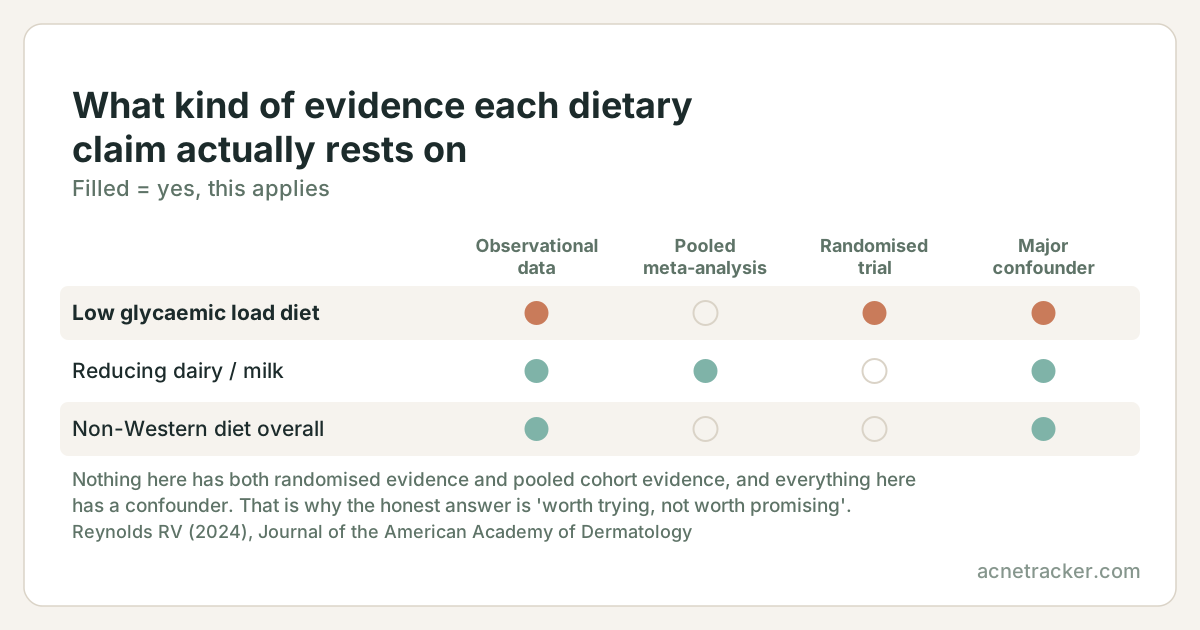
It is also why the total quantity of randomised evidence here should be stated honestly: two small trials, in specific populations, one of which has an unresolved confounder. That is enough to justify trying a change. It is not enough to justify promising a result.
Sources4. Smith RN 20075. Kwon HH 2012
The populations with no acne at all
The observation that started the modern interest in this is striking enough to be worth stating precisely. Researchers examined 1,200 Kitavan Islanders in Papua New Guinea, including 300 aged 15 to 25 — the peak age for acne — and found not one case. Among 115 Aché hunter-gatherers in Paraguay observed over 843 days, they found no case of active acne either.
For comparison, acne affects something like 79 to 95% of adolescents in Westernised populations. A difference of that magnitude cannot plausibly be genetic, and the authors argue it points to environment.
But 'environment' is doing enormous work in that sentence. The Kitavan and Aché diets differ from a Western diet in glycaemic load, in dairy content, in fat composition, in fibre, in processing and in total energy — and those populations also differ in sun exposure, physical activity, body composition, medication use and pretty much everything else. The study is powerful as an existence proof that something environmental matters, and close to useless for identifying which thing.
It gets cited as evidence for whichever dietary theory the person citing it already holds, which is a reliable sign that it does not distinguish between them.
Sources6. Cordain L 2002
What this justifies actually doing
A reasonable reading of all of this supports a specific and fairly modest set of actions.
If you drink a lot of milk — and particularly skim or low-fat milk — cutting back is a low-cost experiment with real observational support behind it. Give it eight to twelve weeks, because the acne cycle from microcomedone to visible lesion runs over weeks, and a two-week trial measures nothing. Cheese and yogurt showed weaker and less consistent associations, so a blanket elimination of all dairy is doing more than the evidence asks for.
Shifting the overall pattern of what you eat away from high-glycaemic-load foods has the best-designed evidence of anything in this article, with the caveat about weight loss attached. Notably, this is not the same as 'cut out sugar' — the trials changed a whole dietary pattern, not one ingredient.
What none of this justifies is elimination dieting, treating food as the cause of a medical condition, or delaying effective treatment while you experiment with your diet. That last one is the real risk. Acne scars, scarring is permanent, and the months spent testing dietary theories are months not spent on a treatment with a much larger effect size.
- Worth trying: reducing milk, especially skim and low-fat, for 8–12 weeks
- Worth trying: a lower-glycaemic-load overall eating pattern
- Not supported: eliminating all dairy, or blaming chocolate or fatty food specifically
- Not supported: dietary change instead of treatment, at any severity
Sources1. Juhl CR 20184. Smith RN 20077. Reynolds RV 2024
Keeping the effect size in proportion
The single most useful thing to hold on to is the relative size of these effects compared with the treatments they are sometimes offered as an alternative to.
The dairy association is an odds ratio around 1.25 in observational data. The randomised dietary trial produced roughly twice the lesion reduction of a control diet in 43 people, with a confounder. Against that, benzoyl peroxide produced at least moderate improvement in 60% of a 649-person randomised trial, spironolactone beat placebo decisively at 24 weeks in 410 women, and isotretinoin routinely clears acne that has resisted everything else.
Diet belongs in the same category as sleep and stress: a genuine modifier of a condition it does not cause, worth attending to, and not a substitute for treating the condition. The most defensible position is also the least satisfying one — try the dietary changes, keep them if they help you, and do not put off the treatment while you find out.
The bottom line
Diet does affect acne, and the profession was wrong to say otherwise for as long as it did. But the correction has been sold at several times its actual size. The dairy association is real, replicated across nearly 80,000 people, and modest — an odds ratio around 1.25, strongest for skim milk, which points at hormones rather than fat. The glycaemic evidence is better designed and smaller, and its best trial cannot separate the diet from the weight loss that came with it. Cutting back on milk and lowering the glycaemic load of what you eat are both reasonable eight-to-twelve-week experiments. Neither is a treatment, and neither is a reason to postpone one.
Frequently asked questions
Does milk cause acne?
Milk is consistently associated with acne — an odds ratio of about 1.28 across 78,529 people — but association is not causation, and no trial has randomised people to milk. The association is real and replicated in two independent meta-analyses, and it is modest: roughly a quarter higher odds, not a doubling.
Why is skim milk worse than whole milk for acne?
That pattern appears in study after study and it is the main clue to the mechanism. If fat were the problem, whole milk would be worst. Because skim is at least as strongly associated, attention falls on milk's hormone and growth-factor content and on its effect on IGF-1, which drives sebum production.
Does sugar cause acne?
A 12-week randomised trial found total lesion counts fell by 23.5 on a low-glycaemic-load diet against 12.0 on a control diet, and a second trial found histological changes as well. But the diet group also lost 2.9 kg and improved insulin sensitivity, and the authors state that the independent effect of the diet is unresolved.
Does chocolate cause acne?
The evidence specific to chocolate is thin and the old studies that dismissed it were poor, so neither the traditional 'no' nor the popular 'yes' is well supported. If chocolate matters it is most likely through sugar and dairy rather than through cocoa, which puts it under the glycaemic-load and dairy questions rather than being its own effect.
How long should I try cutting dairy before deciding?
Eight to twelve weeks. A microcomedone takes weeks to become a visible lesion, so anything shorter is measuring noise. Try reducing milk first rather than eliminating all dairy — cheese and yogurt showed weaker and less consistent associations.
Can I clear my acne with diet alone?
The evidence does not support that for anything beyond mild acne, and the effect sizes are far smaller than for standard treatments. Diet is a modifier worth attending to. Using it instead of treatment risks scarring, which is permanent, in exchange for an effect that in the best trial was about twice a control diet in 43 people.
References
Every claim on this page traces to one of the works below. Links open the original paper, guideline or regulator page — not a summary of it.
- (2018). Dairy Intake and Acne Vulgaris: A Systematic Review and Meta-Analysis of 78,529 Children, Adolescents, and Young AdultsNutrients.
- (2019). Dairy intake and acne development: A meta-analysis of observational studiesClinical Nutrition.
- (2008). Milk consumption and acne in teenaged boysJournal of the American Academy of Dermatology.
- (2007). A low-glycemic-load diet improves symptoms in acne vulgaris patients: a randomized controlled trialAmerican Journal of Clinical Nutrition.
- (2012). Clinical and histological effect of a low glycaemic load diet in treatment of acne vulgaris in Korean patients: a randomized, controlled trialActa Dermato-Venereologica.
- (2002). Acne vulgaris: a disease of Western civilizationArchives of Dermatology.
- (2024). Guidelines of care for the management of acne vulgarisJournal of the American Academy of Dermatology.
Medical disclaimer
Find your personal acne triggers
Our free Acne Tracker lets you log breakouts, sleep, stress and diet, and shows you which factors correlate with your flare-ups.