Birth Control Pills for Acne: What Works, and What It Costs
Combined oral contraceptives are among the best-evidenced acne treatments there are. They also carry a set of risks that vary enormously depending on which progestin is in the packet — which is the part most articles skip.
Key takeaways
- The Cochrane review of 31 trials and 12,579 women found that every combined pill tested against placebo reduced acne lesions, severity grades and self-assessed acne. This is not a marginal effect and it is not in doubt.
- Differences between pill types are smaller than the marketing suggests. Cochrane found 'few important and consistent differences' between progestins for acne, with cyproterone acetate and chlormadinone acetate having the clearest edge over levonorgestrel.
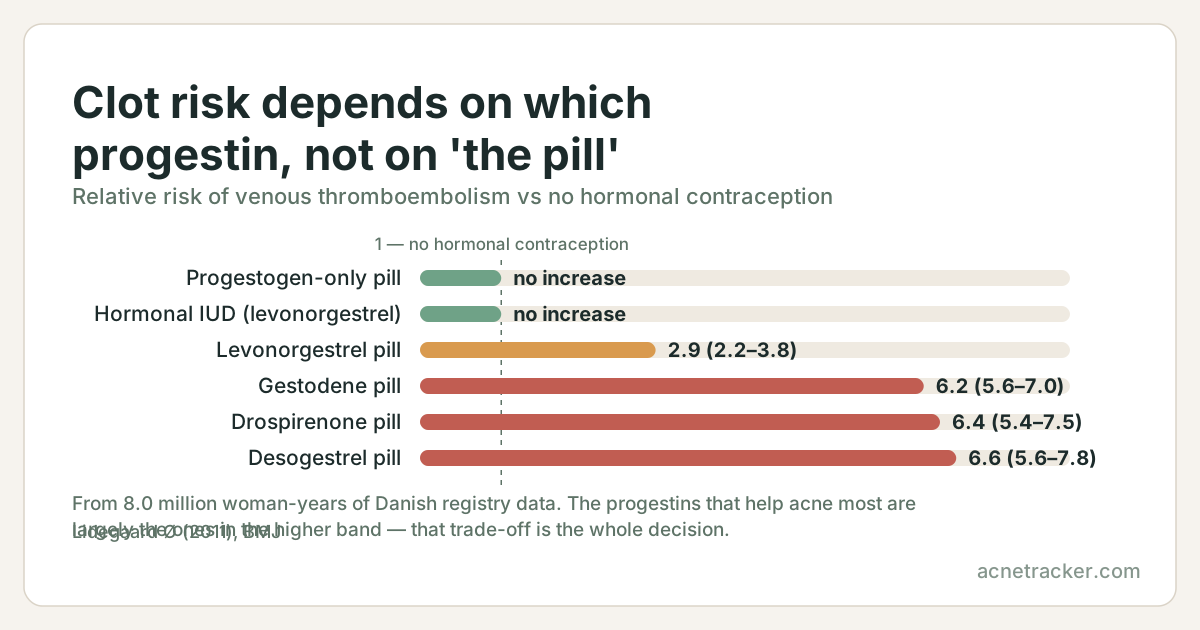
- Clot risk is where the pills genuinely differ. Against no hormonal contraception, levonorgestrel pills carry about 2.9 times the risk of venous thromboembolism; drospirenone, desogestrel and gestodene pills carry roughly twice that again.
- The absolute risk stays low — around 10 events per 10,000 woman-years on the higher-risk pills — but it is not zero, and it is highest in the first year of use.
- A Danish cohort of over a million women found combined pill users were 1.23 times more likely to start an antidepressant, rising to 1.8 times among 15–19 year-olds. Association, not proof, but the age gradient is real.
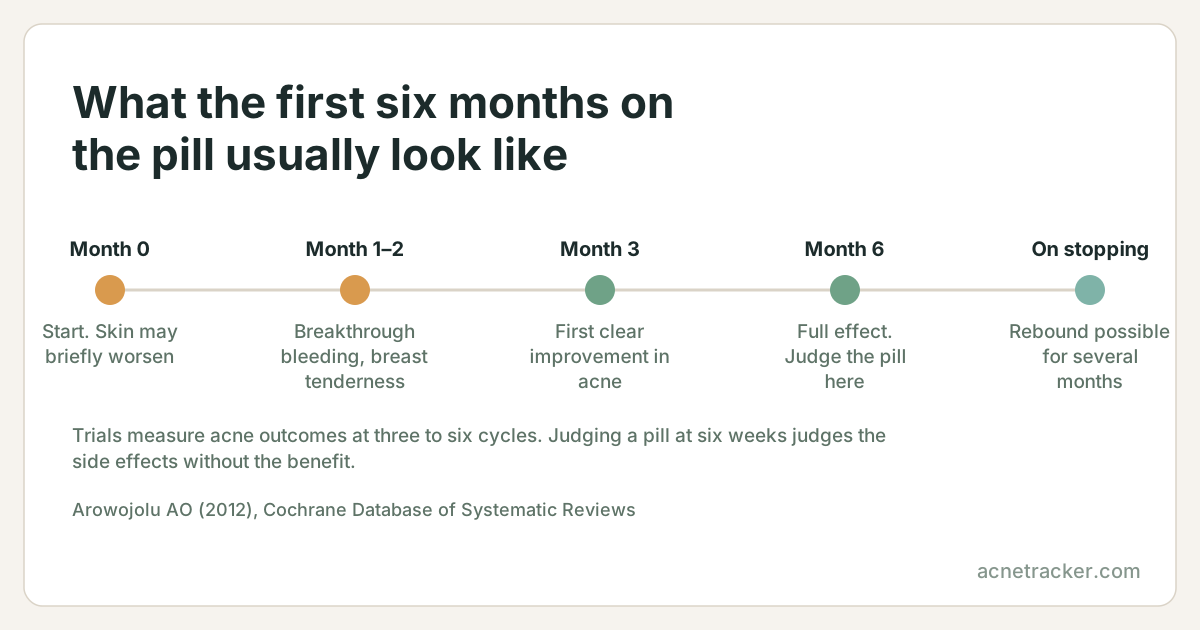
- It takes three to six months to judge whether a pill is helping your skin. Acne often gets briefly worse first, and stopping at six weeks means you took the side effects and skipped the benefit.
Why a contraceptive treats a skin condition at all
Acne is, mechanically, a sebum problem, and sebum production is driven by androgens acting on the sebaceous gland. Anything that lowers the amount of androgen reaching that gland will lower oil production, and combined oral contraceptives do it in two ways at once.
The oestrogen component suppresses the ovarian production of androgens through the same feedback loop that suppresses ovulation. Separately, oestrogen raises the liver's output of sex hormone-binding globulin, the protein that circulating testosterone binds to. More binding protein means less free testosterone available to act on anything — including the sebaceous gland. The two effects compound.
This also explains the pattern of who it helps most. Acne that flares in the week before a period, sits along the jaw and lower face, persists past the teenage years, or comes with irregular cycles and unwanted hair growth is acne with a visible hormonal signature, and that is the acne a combined pill is best placed to change. Acne that is purely comedonal, mostly on the forehead, and unrelated to the cycle is less likely to respond, because there is less androgen drive there to remove.
How well it actually works
The evidence here is better than for most things in dermatology. The Cochrane review pooled 31 randomised trials covering 12,579 women. Of the nine placebo-controlled trials with usable data, all of them showed the pill reducing acne lesion counts, severity grades and the women's own assessment of their skin.
The size of the effect is worth putting in real numbers rather than adjectives. A levonorgestrel pill cut total lesion counts by about ten more than placebo (mean difference −9.98, 95% CI −16.51 to −3.45). A norgestimate pill was similar at −9.32. A dienogest pill produced a 15-point greater percentage fall in total lesion count. For a drospirenone pill, an investigator rating of clear or almost clear skin was three times as likely as on placebo (OR 3.02, 95% CI 1.99–4.59).
One important limitation: of those 31 trials, exactly one compared a combined pill against an alternative acne treatment. So the evidence tells you clearly that the pill beats nothing. It does not tell you how it compares to a topical retinoid, to spironolactone, or to an oral antibiotic, because those trials have mostly not been run.
Sources1. Arowojolu AO 2012
Which pill — and why the progestin is the whole question
Every combined pill contains an oestrogen (almost always ethinylestradiol) and a progestin. The oestrogen is doing the helpful work for skin. The progestin is where pills differ from each other, because progestins are not androgen-neutral: some have androgenic activity of their own, which works against the oestrogen, and some are actively anti-androgenic, which works with it.
Broadly, cyproterone acetate, chlormadinone acetate, drospirenone and dienogest sit at the anti-androgenic end. Levonorgestrel and norethisterone sit at the androgenic end. That would predict a large difference in acne outcomes, and it is the basis of most of the marketing.
The trial data support a smaller version of that story than the marketing does. Cochrane's summary is that 'differences in the comparative effectiveness of COCs containing varying progestin types and dosages were less clear, and data were limited for any particular comparison.' The differences that did show up: chlormadinone acetate and cyproterone acetate improved acne better than levonorgestrel; drospirenone appeared better than norgestimate but less effective than cyproterone acetate; levonorgestrel versus desogestrel gave inconsistent results. Real, but modest — and every one of those comparisons has a clot-risk consequence attached, which is the next section.
Sources1. Arowojolu AO 2012
Blood clots: the risk that actually varies
This is the number that should drive the choice, and it is one of the best-measured numbers in medicine because Denmark has the registries to measure it. Lidegaard's cohort followed non-pregnant Danish women aged 15–49 across 8,010,290 woman-years and recorded 4,246 first-ever venous thromboembolic events.
Compared with women using no hormonal contraception, pills containing 30–40 µg ethinylestradiol with levonorgestrel carried 2.9 times the risk (95% CI 2.2–3.8). With desogestrel it was 6.6 (5.6–7.8), with gestodene 6.2 (5.6–7.0), and with drospirenone 6.4 (5.4–7.5). Comparing the newer progestins directly against levonorgestrel and adjusting for how long women had been taking them, the newer ones came out at roughly twice the risk. Progestogen-only pills and hormone-releasing intrauterine devices showed no increase at all.
Two things keep that in proportion. First, the absolute numbers are small: the authors put the risk in current users of the higher-risk pills at around 10 events per 10,000 woman-years, and calculated that 2,000 women would need to switch from a newer-progestin pill to levonorgestrel for one year to prevent a single event. Second, pregnancy itself carries a higher clot risk than any of these pills, so 'no contraception' is not automatically the safer column.
But notice the shape of the problem. The progestins with the best anti-androgenic effect on skin — drospirenone, and cyproterone acetate, which sits in the same higher-risk band — are largely the ones in the upper group. Choosing a pill for acne is therefore not a free choice; it is a trade of a modest skin advantage against a roughly doubled clot risk, and that is a trade a prescriber should make with you explicitly rather than by handing over whatever is on the formulary.
Sources2. Lidegaard Ø 20117. Direktoratet for medisinske produkter 2024
How long before you know if it is working
Three to six months. The acne trials measure their outcomes at three to six cycles, and that is not an arbitrary window — it takes that long for the reduction in circulating free androgen to translate into a measurable change in what comes out of the follicle.
Many women's skin gets briefly worse in the first weeks, particularly on a pill with a more androgenic progestin, and particularly if they have just come off something else. It is a poor guide to where the pill will land.
The practical failure this produces is the six-week verdict. Someone starts a pill, gets breakthrough bleeding, sore breasts and no visible skin improvement, concludes it does not suit them, and stops — having collected the entire side-effect profile and none of the benefit. If a pill is being taken for acne specifically, the decision point is the third to sixth month, and knowing that in advance is most of what makes it survivable.
Sources1. Arowojolu AO 2012
The rest of the side effects
Breakthrough bleeding and spotting are the commonest early complaint and usually settle within three cycles. Breast tenderness, nausea and headaches follow a similar pattern. None of these are trivial when you are living through them, but most do resolve.
Some effects do not follow that pattern. Reduced libido is reported consistently enough to be taken seriously and does not reliably improve with time. Migraine can worsen, and migraine with aura is a contraindication rather than a side effect, because the combination raises stroke risk. Blood pressure rises modestly in some women and is worth checking rather than assuming.
Weight gain is the one where the folklore and the evidence diverge most. Controlled comparisons have not found a consistent, clinically meaningful weight difference attributable to combined pills, which is not the same as saying no individual gains weight — it means the average effect that trials can detect is close to nothing.
- Common and usually settling: breakthrough bleeding, breast tenderness, nausea, headache
- Less likely to settle: reduced libido, mood change
- Needs assessment, not tolerance: new or worsening migraine, especially with aura
- Worth measuring: blood pressure, particularly in the first year
Sources6. World Health Organization 20157. Direktoratet for medisinske produkter 2024
Mood: the finding that deserves a straight answer
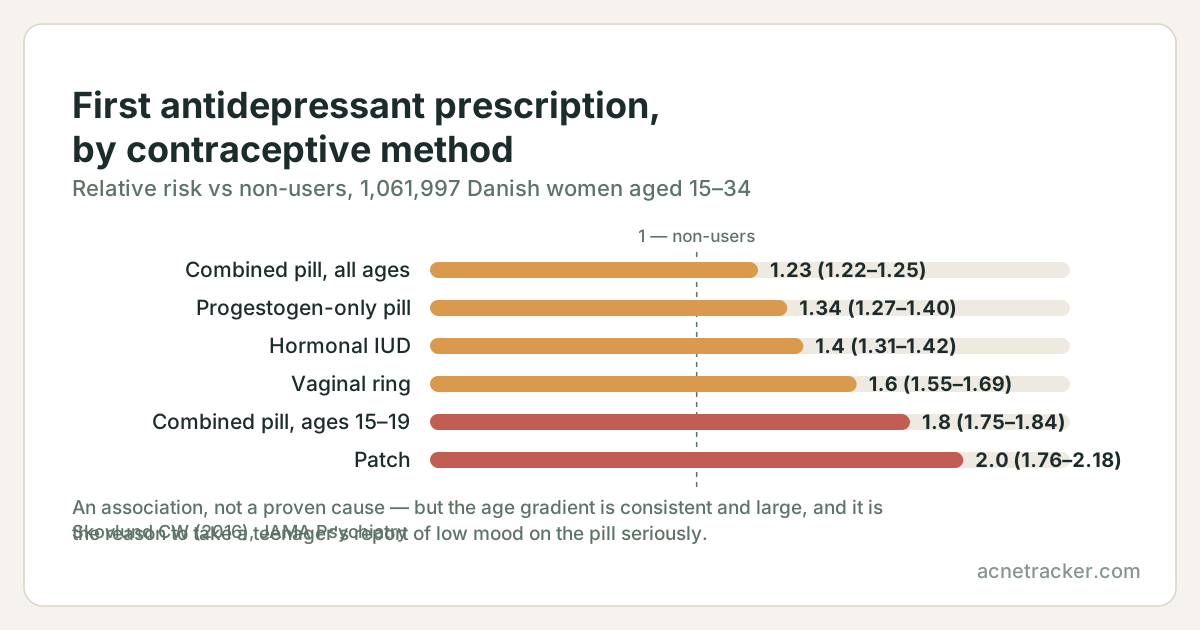
The largest study on this is a Danish nationwide cohort of 1,061,997 women and adolescents aged 15 to 34, none of whom had a prior depression diagnosis or antidepressant prescription. Compared with non-users, women on combined oral contraceptives had a relative risk of starting an antidepressant of 1.23 (95% CI 1.22–1.25). Progestogen-only pills came out at 1.34, the hormonal IUD at 1.4, the vaginal ring at 1.6 and the patch at 2.0.
The age pattern is the part that matters most. Among 15–19 year-olds on a combined pill the relative risk was 1.8 (95% CI 1.75–1.84), and on a progestin-only pill 2.2. Risk peaked around six months after starting and generally fell with increasing age.
This is an association in observational data, and it cannot by itself establish cause — women who start hormonal contraception differ from women who do not in ways that registries cannot fully adjust for. But the size, the consistency, the dose-like gradient by age and the timing peak at six months are all the shape you would expect if some of it were real. The reasonable conclusion is not to avoid hormonal contraception; it is that 'the pill made me feel flat' is a clinical observation worth acting on rather than a thing to be talked out of, especially in a teenager.
Sources3. Skovlund CW 2016
Who should not take a combined pill
Some of the contraindications are absolute, and they are worth knowing before an appointment rather than discovering during one. The WHO's medical eligibility criteria are the standard reference and are freely available.
The clearest exclusions are a personal history of venous thromboembolism or a known thrombophilia; migraine with aura at any age; smoking at 35 or over; uncontrolled hypertension; current breast cancer; and the postpartum period, where the timing depends on breastfeeding and on other clot risk factors. Being over 35 with a BMI above 30 does not exclude a woman, but it shifts the balance enough that a lower-risk progestin or a non-oestrogen method is usually the better route.
None of this makes hormonal contraception a bad choice. It makes the choice specific: if a combined pill is off the table for you, spironolactone is the other systemic option for hormonally driven acne, and it has its own article here — including the fact that unlike the pill it does nothing for contraception and cannot be taken in pregnancy.
Sources6. World Health Organization 20157. Direktoratet for medisinske produkter 20245. Santer M 2023
Coming off the pill
Stopping a combined pill removes both mechanisms at once: ovarian androgen production returns and sex hormone-binding globulin falls, so free testosterone rises. Skin that was being held clear by that suppression will often flare, sometimes several months after stopping rather than immediately, and sometimes worse than it was before starting.
This is not a withdrawal syndrome or a sign of damage. It is the underlying acne becoming visible again, plus a period of hormonal readjustment. It is also entirely predictable, which means it can be planned for: starting a topical retinoid before or at the point of stopping, rather than after the flare arrives, is the standard way to blunt it.
It does mean something for how a pill should be framed when it is prescribed for skin. A combined pill is not a course of treatment that fixes acne and is then finished. It is ongoing suppression, and the question of what happens when it stops is part of the decision to start it, not a surprise to deal with years later.
Sources4. Reynolds RV 2024
The pill, spironolactone, or isotretinoin?
For hormonally driven acne in an adult woman there are three systemic routes, and they are not interchangeable.
A combined pill lowers androgen production and provides contraception in the same tablet, which for many people is the deciding practical advantage. Spironolactone blocks the androgen receptor instead, works for women who cannot or will not take oestrogen, and now has a proper randomised trial behind it — but it offers no contraception and must not be taken in pregnancy, so it often ends up being taken alongside contraception rather than instead of it. Isotretinoin does not touch hormones at all; it shrinks the gland itself, and it is the route when the acne is severe or scarring rather than merely persistent.
The two hormonal options are also frequently combined, since they act at different points in the same pathway — production versus receptor. That combination is common clinical practice for acne that responds partially to either alone.
Sources5. Santer M 20234. Reynolds RV 20241. Arowojolu AO 2012
The bottom line
Combined pills work for acne, and the evidence for that is stronger than for most things sold for the same purpose. The decision is not really whether they work; it is which progestin, and that question has an answer with a number attached. If your acne has a hormonal pattern and you want contraception anyway, a combined pill is a reasonable and well-supported choice — but ask specifically which progestin you are being given, what its clot risk is relative to levonorgestrel, and whether the acne advantage of a higher-risk progestin is worth it in your case. That is a five-minute conversation that most prescriptions do not currently include, and it is the one that changes the answer.
Frequently asked questions
Which pill is best for acne?
Pills containing cyproterone acetate or chlormadinone acetate showed the clearest advantage over levonorgestrel in the Cochrane review, with drospirenone and dienogest also performing well. But those advantages are modest, and several of those progestins carry roughly twice the clot risk of levonorgestrel — so 'best for acne' and 'best overall' are not the same answer.
How long until the pill clears my skin?
Three to six months. Trials measure acne outcomes at three to six cycles. Skin often gets briefly worse first, so a verdict at six weeks captures the side effects without the benefit.
How much do birth control pills raise the risk of blood clots?
Against no hormonal contraception, levonorgestrel pills carry about 2.9 times the risk and drospirenone, desogestrel or gestodene pills about 6.2 to 6.6 times. In absolute terms that is roughly 10 events per 10,000 woman-years on the higher-risk pills — small, but highest in the first year and not zero. Progestogen-only pills and hormonal IUDs showed no increase.
Do birth control pills cause depression?
A Danish cohort of over a million women found combined pill users were 1.23 times more likely to start an antidepressant than non-users, rising to 1.8 times among 15–19 year-olds, with risk peaking about six months after starting. That is an association rather than proven causation, but it is large and consistent enough that a reported mood change should be taken seriously rather than dismissed.
Will my acne come back if I stop?
Often, yes — sometimes several months later and sometimes worse than before, because the pill was suppressing androgen rather than curing anything. It is predictable enough to plan for, usually by starting a topical retinoid at the point of stopping rather than after the flare arrives.
Can I take spironolactone and the pill together?
This is common practice. They act at different points of the same pathway — the pill lowers androgen production, spironolactone blocks the receptor — and spironolactone must not be taken in pregnancy, so effective contraception alongside it is usually wanted anyway. It is a prescriber's decision, not a self-directed combination.
References
Every claim on this page traces to one of the works below. Links open the original paper, guideline or regulator page — not a summary of it.
- (2012). Combined oral contraceptive pills for treatment of acneCochrane Database of Systematic Reviews.
- (2011). Risk of venous thromboembolism from use of oral contraceptives containing different progestogens and oestrogen doses: Danish cohort study, 2001-9BMJ.
- (2016). Association of Hormonal Contraception With DepressionJAMA Psychiatry.
- (2024). Guidelines of care for the management of acne vulgarisJournal of the American Academy of Dermatology.
- (2023). Effectiveness of spironolactone for women with acne vulgaris (SAFA) in England and Wales: pragmatic, multicentre, phase 3, double blind, randomised controlled trialBMJ.
- (2015). Medical eligibility criteria for contraceptive use, fifth editionWHO.
- (2024). Hormonelle prevensjonsmidler — råd til helsepersonellNorwegian Medical Products Agency (DMP).
Medical disclaimer
Find your personal acne triggers
Our free Acne Tracker lets you log breakouts, sleep, stress and diet, and shows you which factors correlate with your flare-ups.