Can You Mix Niacinamide and Vitamin C?
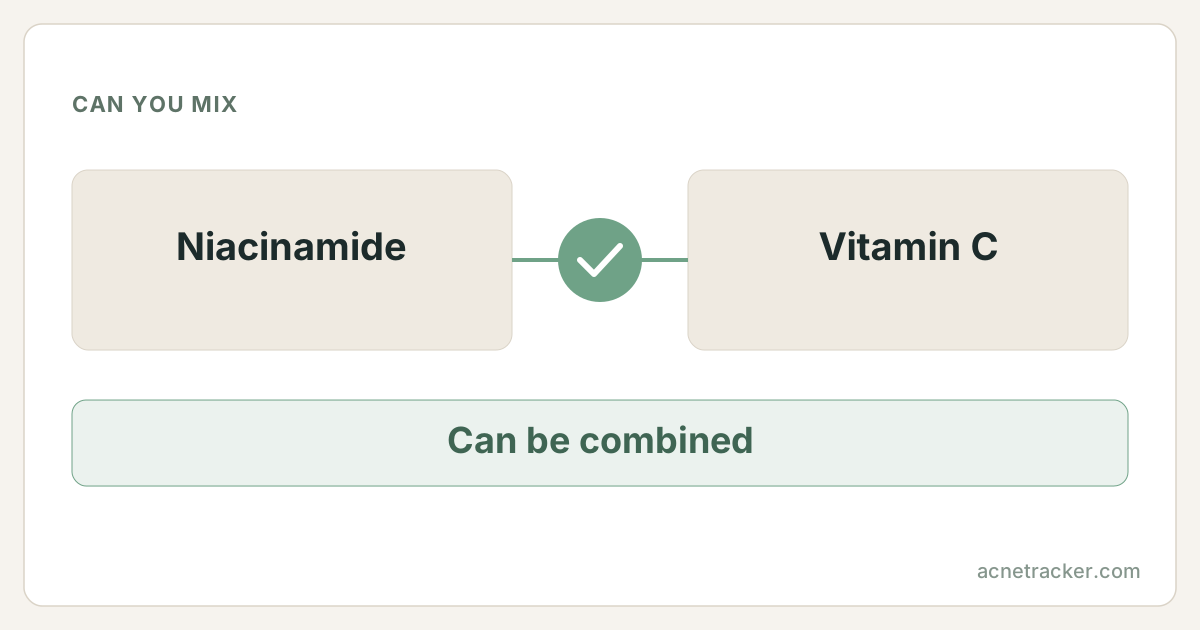
Yes. The idea that niacinamide and vitamin C cancel each other out is a myth built on decades-old lab data, not modern skincare. In today's stable formulas they layer safely and even complement each other, tackling dullness, dark marks and uneven tone from two angles. Apply vitamin C first, then niacinamide, or use a well-made product that contains both.
How this pairing resolves
The two ingredients, their published numbers, and where they land together.
The numbers beside each ingredient are its published comedogenic rating and effective pH window, taken from its own profile page.
Show the numbers
| Ingredients | Metric | 0–5 |
|---|---|---|
| Niacinamide | Comedogenic rating | 0/5 |
| Niacinamide | Effective pH | 5.0–7.0 |
| Vitamin C | Comedogenic rating | 0/5 |
| Vitamin C | Effective pH | 2.5–3.5 |
Why
The cancellation myth traces back to 1960s studies where pure ascorbic acid and niacinamide were heated together in unbuffered water solutions. Under that prolonged heat and moisture they reacted to form nicotinic acid (niacin), which can cause a temporary flush. Those beaker conditions do not exist on your face: modern serums are pH-balanced, often contain stabilisers, and are not simmered for hours. On skin, at room temperature, the two coexist without any meaningful conversion. Chemically they also do genuinely different jobs. Vitamin C, as L-ascorbic acid, is an antioxidant that donates electrons to neutralise free radicals and is a cofactor for collagen synthesis, working best at low pH around 3. Niacinamide supports the skin's NAD-dependent repair enzymes, curbs the transfer of pigment to surface cells, and strengthens the barrier, comfortable across pH 5 to 7. Both fade hyperpigmentation but by separate routes, so combining them broadens the effect rather than blunting it.
How to combine them
The simplest morning approach is vitamin C on clean, dry skin first, because it prefers a low pH and direct contact. Wait about a minute, then apply niacinamide, moisturizer and broad-spectrum sunscreen. If you would rather split them, vitamin C in the morning and niacinamide at night both works and lets each ingredient headline its own routine. Many modern brightening serums combine the two deliberately at compatible concentrations, and those are perfectly reasonable to use. If your skin is sensitive, start with the gentler derivative forms of vitamin C, which are less acidic and stack even more easily with niacinamide. There is no mandatory long wait time and no need to buffer with moisturizer between them unless your skin is reactive.
Example routine
| When | Steps |
|---|---|
| Every morning | Cleanser → Vitamin C → Niacinamide → Moisturizer → SPF 30+ |
| Alternative split (AM) | Cleanser → Vitamin C → Moisturizer → SPF 30+ |
| Alternative split (PM) | Cleanser → Niacinamide → Moisturizer |
Warning signs
Frequently asked questions
Do niacinamide and vitamin C really cancel each other out?
No. That belief comes from mid-20th-century experiments that heated raw ingredients in water for a long time. Modern stable, pH-balanced serums applied at skin temperature do not recreate those conditions.
Which should I apply first, vitamin C or niacinamide?
Apply vitamin C first because it works best at a low pH and likes direct contact with skin. Wait about a minute, then layer niacinamide, moisturizer and sunscreen on top.
Can a single serum contain both ingredients?
Yes. Many brightening serums pair them on purpose because they target uneven tone through different pathways. Well-formulated combination products are stable and convenient.
Will using both make my skin brighter faster?
They can complement each other since they fade pigment by separate mechanisms, but results still take weeks. Consistency and daily sunscreen matter far more than stacking for speed.
Is niacinamide with vitamin C safe for sensitive skin?
Usually yes. If a high-strength L-ascorbic acid stings, switch to a gentler vitamin C derivative, which is less acidic and layers even more easily with niacinamide.
Sources & further reading
There is no single study of this exact question. The guidance here is reasoned from the ingredient profiles below, each of which carries its own references:
- Niacinamide2 refs
- Vitamin C3 refs
Show every reference behind this page (4)
- Niacinamide: mechanisms of action and its topical use in dermatology (PubMed)cited by Niacinamide
- European Commission CosIng database — Niacinamidecited by Niacinamide, Vitamin C
- PubChem — Ascorbic Acid compound summarycited by Vitamin C
- DermNet — Topical vitamin Ccited by Vitamin C
Medical disclaimer
Ingredients mentioned on this page
Find your personal acne triggers
Our free Acne Tracker lets you log breakouts, sleep, stress and diet, and shows you which factors correlate with your flare-ups.