Retinal: Comedogenic Rating & Ingredient Analysis
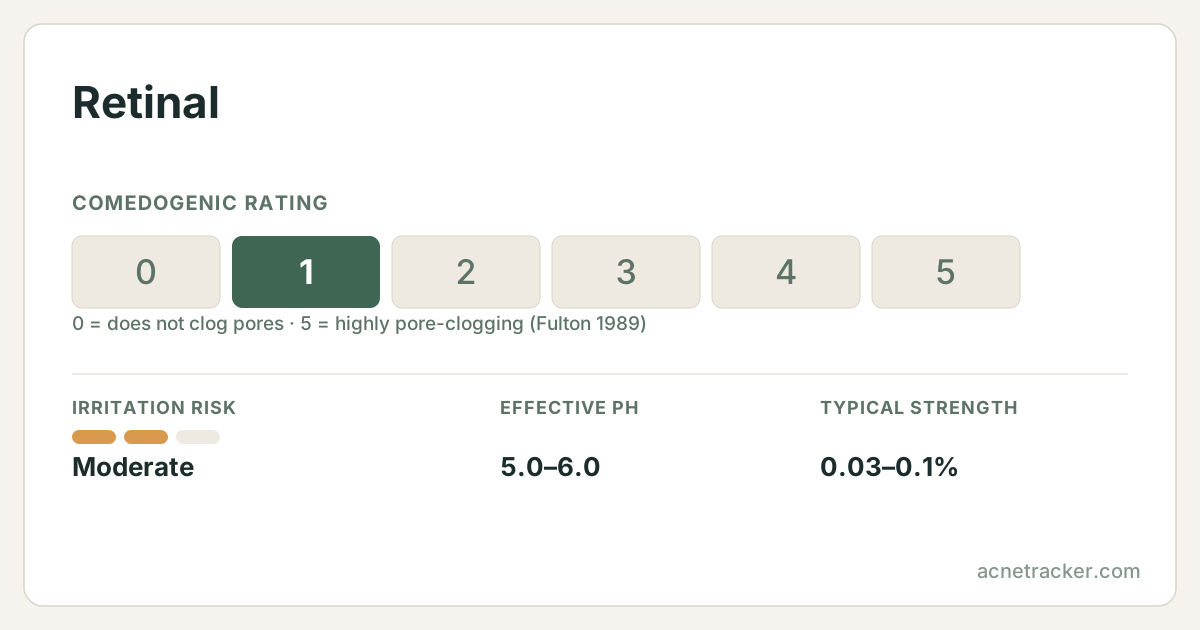
Retinal, short for retinaldehyde, sits one chemical step closer to active retinoic acid than ordinary retinol does. That single difference means the skin has less work to do converting it, so users often see results on breakouts and texture sooner than they would with a comparable retinol. It occupies a middle ground: stronger and faster than the retinol most beginners start with, yet still available without a prescription and gentler than tretinoin. Formulators use it at low percentages because a little goes a long way, and it carries an unusual bonus for acne-prone skin — a mild antibacterial effect that other cosmetic retinoids do not share.
Quick facts
- Comedogenic rating
- our estimate — not measured
- Irritation risk
- Moderate
- Effective pH
- 5.0–6.0
- Typical strength
- 0.03–0.1%
- Pregnancy
- Avoid
- Suits skin types
- oilycombinationnormalmatureacne-prone
Where this number comes from
No one has published a comedogenic rating for this ingredient. Fulton's 1989 table tested about 250 raw materials and this was not among them, and we found no later study measuring it. The figure shown is our own reasoning from the ingredient's chemistry and how it is used — treat it as an estimate, not a measurement.
Fulton read his own scale as 0-1 not significant, 2-3 borderline, 4-5 positive. The assay is the rabbit ear at 10% dilution, which the paper itself calls extremely sensitive and not fully predictive of human skin. Ratings describe the raw ingredient; concentration and formulation change real-world behaviour.
Caution profile
The four published fields on this page, on one 0–5 scale. Further from the centre means more care is needed — never that the ingredient is worse.
Derived, not measured: pore-clogging is the published comedogenic rating; irritation maps low/moderate/high to 1/3/5; pregnancy maps safe/caution/avoid to 0/3/5; skin-type limits is how many of the seven skin types this entry does NOT list. Every input is printed in words in the quick-facts card above.
Show the numbers
| Metric | 0–5 | Published field |
|---|---|---|
| Pore-clogging | 1 | 1/5 |
| Irritation | 3 | Moderate |
| Skin-type limits | 1.4 | 5/7 |
| Pregnancy | 5 | Avoid |
Working pH and typical strength
Where this ingredient is formulated to sit, and at what concentration.
Both bars come from the fields above: the pH window and the typical strength range published for this ingredient. The tinted column is healthy skin's surface pH (about 4.7–5.75).
Show the numbers
| Metric | 0–5 |
|---|---|
| Working pH | 5.0–6.0 |
| Typical strength | 0.03–0.1% |
What is it?
In the body's vitamin A pathway, retinol is oxidised first to retinaldehyde and then to retinoic acid, the molecule that actually signals skin cells. Because retinal is already the aldehyde, only one enzymatic conversion stands between it and full activity, which explains its efficiency at concentrations as low as 0.03%. Beyond the usual retinoid actions of accelerating renewal and prompting collagen, laboratory work has shown retinaldehyde can suppress the growth of Cutibacterium acnes, the bacterium involved in inflammatory acne. It is light-sensitive and prone to oxidising, so reputable products package it in opaque, air-tight tubes. Visible improvement in tone and clogged pores generally appears within six to ten weeks of steady use.
Benefits
Converts to active form quickly
Needing only one conversion step, retinal reaches its working form faster than retinol, so many people notice smoother skin and fewer clogged pores in a shorter timeframe.
Has a mild antibacterial effect
Unlike other over-the-counter retinoids, retinaldehyde has been shown in studies to curb Cutibacterium acnes, giving it a small extra edge against inflammatory spots.
Unclogs and refines pores
By keeping the lining of the follicle shedding evenly, it stops the microscopic plugs that later become blackheads and pimples from forming.
Supports firmness over time
Like the wider retinoid family it nudges the deeper skin to lay down more collagen, gradually improving resilience and the look of fine lines.
How to use
Use retinal at night, since light degrades it. Begin with the lowest available strength, around 0.03–0.05%, two evenings a week on clean, dry skin, and build up to nightly only as your skin proves it can cope. Following with a plain moisturiser buffers the sting for reactive skin. Keep the tube sealed and away from sunlight so the active does not oxidise before you finish it. A daily broad-spectrum SPF is essential, because renewed skin sunburns more readily. Do not combine it in the same session with exfoliating acids or benzoyl peroxide — the last of these can chemically deactivate the retinoid.
Side effects
The familiar retinoid adjustment applies: dryness, flaking, tightness and pink patches during the first few weeks. Retinal can feel slightly stronger than an equivalent retinol because of its faster conversion, so restraint at the start pays off. A short-lived purge of small spots is possible where you normally break out. Persistent burning, weeping or a spreading rash is not normal retinisation and means you should stop and let the barrier recover.
Who should avoid it
Retinal is a vitamin A derivative and is avoided during pregnancy and breastfeeding as a precaution, in line with all cosmetic retinoids. Skip it if your barrier is currently inflamed, if you have an active rosacea or eczema flare, or if you are already using a prescription retinoid without medical guidance to add more.
Pairs well with
Avoid combining with
Frequently asked questions
Is retinal stronger than retinol?
Effectively yes. Retinal is one conversion step closer to active retinoic acid, so gram for gram it tends to act faster and show results sooner, which also means it can feel a little more irritating at first.
Can I use retinal with benzoyl peroxide?
Not at the same time. Benzoyl peroxide can oxidise and inactivate the retinoid, wasting both. If you use both, apply them at different times of day or on alternate days.
Does retinal help with acne bacteria?
Studies suggest retinaldehyde has a mild suppressing effect on Cutibacterium acnes, which is unusual among cosmetic retinoids and adds a small benefit for inflammatory breakouts alongside its pore-clearing action.
How do I store retinal products?
Keep them sealed, cool and out of direct light. Retinal oxidises easily, so opaque, air-restricting packaging matters, and a product that has turned brown or smells off has likely degraded.
Is retinal safe in pregnancy?
No. As with all retinoids it is avoided during pregnancy and breastfeeding. Niacinamide and azelaic acid are the usual pregnancy-friendly alternatives for acne and tone.
Where this ingredient shows up here
Counted across this database, not the web — these are the pages on this site that reason about this ingredient.
Combination guides 9
- Azelaic Acid
- Bakuchiol
- Hyaluronic Acid
- Niacinamide
- Benzoyl Peroxide
- Glycolic Acid
- Lactic Acid
- Mandelic Acid
+1 more on the site
Condition pages 4
Buying guides 11
- How to Choose a Night Cream for Dull Skin
- How to Choose a Night Cream for Fine Lines and Wrinkles
- How to Choose a Night Cream for Hyperpigmentation
- How to Choose a Night Cream for Mature Skin
- How to Choose an Eye Cream for Crow's Feet
- How to Choose an Eye Cream for Dark Circles
+5 more on the site
Sources & further reading
Medical disclaimer
Find your personal acne triggers
Our free Acne Tracker lets you log breakouts, sleep, stress and diet, and shows you which factors correlate with your flare-ups.