How to Choose an Eye Cream for Crow's Feet
Crow's feet have a mechanical origin that most product copy quietly ignores. The orbicularis oculi is a ring of muscle around the eye, and every smile, squint and blink folds the skin above it in the same radiating pattern. For years those folds appear only during the expression and vanish afterwards. Eventually the repeated creasing plus sun damage etches them so they remain at rest. That two-stage story matters commercially: during stage one, a cream is working against a muscle and will lose. During stage two, there is skin damage to treat and topicals become relevant. Knowing which stage you are in tells you whether to buy anything at all.
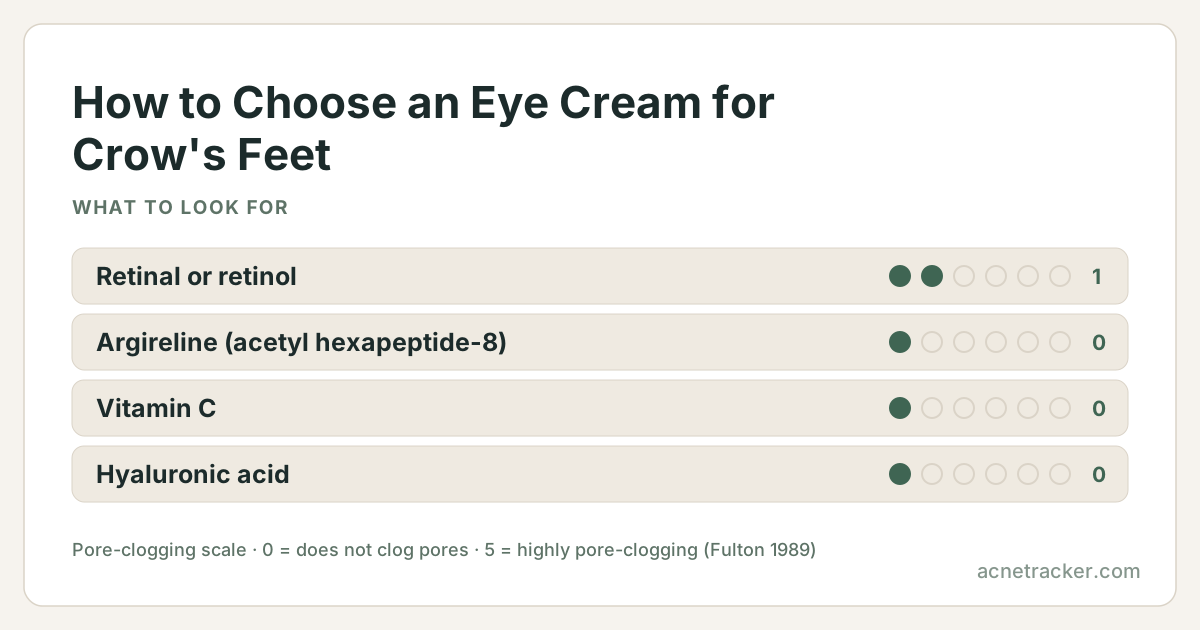
Ingredients to look for
| Ingredient | Why it matters |
|---|---|
| Retinal or retinol | Once lines are etched at rest, retinoids are the ingredient class with real trial support for reducing their depth by rebuilding dermal collagen. They do nothing to the muscle that folds the skin. |
| Argireline (acetyl hexapeptide-8) | Marketed as topical botulinum toxin because it interferes with the SNARE complex in vitro. The honest problem is delivery: it is a large water-loving peptide that penetrates skin poorly, and the supporting studies are small and mostly industry-run. |
| Vitamin C | Crow's feet are the most sun-driven lines on the face, sitting where sunglasses do not always cover. A morning antioxidant reduces the oxidative half of the damage that etches them. |
| Hyaluronic acid | Swells the skin surface so the finest radiating lines blur. Temporary and superficial, but the outer corner is exactly where a little plumping reads well in photographs. |
| Squalane | Fulton rates it 1. The outer eye area gets dry and moves constantly, and a light, non-irritating emollient keeps skin pliable so creases sit less sharply. |
Ingredients to avoid
| Ingredient | Why it matters |
|---|---|
| Products promising a needle-free freeze | No cosmetic ingredient reliably reduces muscle contraction through intact skin. The comparison to injectables is a marketing borrow, not a demonstrated equivalence. |
| Rich creams pushed into the outer corner | The lateral eye area creases heavily under makeup, and heavy emollients there migrate and settle into the very lines you are photographing. |
| Strong actives in the crease itself | Skin that folds thousands of times a day is mechanically stressed already; adding an irritant produces dermatitis faster here than almost anywhere on the face. |
| Ignoring your eyesight | A surprising share of squinting is uncorrected vision or missing sunglasses. Fixing that reduces the movement causing the lines, which is more than any cream in this category achieves. |
How to choose
Smile in a mirror, then let your face fall completely slack and look again. If the fan of lines disappears entirely at rest, they are purely dynamic. In that state the driver is muscle contraction, and honestly, no topical addresses it — the interventions that do are injectable and belong in a conversation with a qualified doctor rather than in a shopping decision. What a cream can do at this stage is keep the skin hydrated and protected so the transition to stage two takes longer, and that is genuinely worth doing at 25 even though it is unexciting. If lines remain visible at rest, you have etched creases, and now a retinoid has something to work on. Look for eye-appropriate strength, opaque packaging and no fragrance. Add a morning antioxidant. Then be honest about the fact that this area moves constantly and sits at the edge of sunglasses coverage, so results are more modest here than on, say, the forehead. If the label leans on the phrase 'expression lines' while implying erasure, it is describing biology it cannot alter.
How to apply
Work outward from the outer corner toward the temple, following the fan of lines rather than a circle around the eye. Use very little; this is the area most prone to product creeping into makeup. Retinoid at night on the bone and the outer corner, never on the lid. If you wear glasses, clean the nose pads and check where the frame sits — pressure marks and product build-up in that zone are commonly mistaken for wrinkles. And wear sunglasses in bright light, which both blocks UV and stops the squint.
Frequently asked questions
Can you get rid of crow's feet with eye cream?
Not while they are purely dynamic, because muscle causes them and creams do not reach muscle. Once they persist at rest, a retinoid can reduce their depth moderately over months. The gap between those two answers explains most of the disappointment in this category.
Does Argireline work like botox?
Not comparably. It interferes with the same signalling machinery in laboratory conditions, but it is a large hydrophilic peptide with poor penetration through intact skin, and the human data are small, short and largely from manufacturers. Expect a modest cosmetic effect at best.
At what age do crow's feet start?
Dynamic ones can appear in the twenties, especially in people who smile broadly or squint in bright light without sunglasses. When they become permanent depends far more on cumulative sun exposure and smoking than on age, which is why they vary so widely between people of the same year.
Do sunglasses prevent crow's feet?
They help twice over, which makes them one of the better-value interventions here. They block the UV that degrades collagen at the outer eye, and they remove the reflexive squinting that folds the skin in the first place. Neither effect is dramatic; both are free and cumulative.
Is eye cream or face cream better for crow's feet?
For this specific area, often neither matters much — what matters is whether it contains a retinoid you tolerate. The genuine advantages of eye-specific products are lower active concentrations, no fragrance and ophthalmological testing, not a special ingredient the face version lacks.
Sources & further reading
There is no single study of this exact question. The guidance here is reasoned from the ingredient profiles below, each of which carries its own references:
- Retinal3 refs
- Argireline2 refs
- Vitamin C3 refs
- Hyaluronic Acid3 refs
- Squalane3 refs
Show every reference behind this page (9)
- European Commission CosIng database — Retinalcited by Retinal, Argireline, Vitamin C, Hyaluronic Acid, Squalane
- PubChem — Retinaldehydecited by Retinal
- Kwon HS et al. Efficacy and safety of retinaldehyde 0.1% and 0.05% creams used to treat photoaged skin: A randomized double-blind controlled trial. J Cosmet Dermatol 2018 Jun (PubMed)cited by Retinal
- PubMed — The efficacy study of the combination of tripeptide-10-citrulline and acetyl hexapeptide-3 (J Cosmet Dermatol, 2017, randomized controlled trial)cited by Argireline
- PubChem — Ascorbic Acid compound summarycited by Vitamin C
- DermNet — Topical vitamin Ccited by Vitamin C
- PubChem — Hyaluronic acid compound summarycited by Hyaluronic Acid
- DermNet — Moisturisers and humectantscited by Hyaluronic Acid, Squalane
- PubChem — Squalane compound summarycited by Squalane
Medical disclaimer
Ingredients mentioned on this page
Find your personal acne triggers
Our free Acne Tracker lets you log breakouts, sleep, stress and diet, and shows you which factors correlate with your flare-ups.