How to Choose a Night Cream for Mature Skin
Mature skin makes less oil, holds less water and repairs more slowly, and night is when its slower renewal has the best chance to catch up. A night cream here can be genuinely richer than a day cream, because higher overnight water loss meets skin that already struggles to retain moisture. The realistic goal is comfort, barrier support and a supporting role for evidence-backed actives like retinoids and peptides — not a promise to reverse ageing. This guide describes that richer, repair-focused profile so you can tell a well-formulated mature-skin night cream from an expensive jar selling hope.
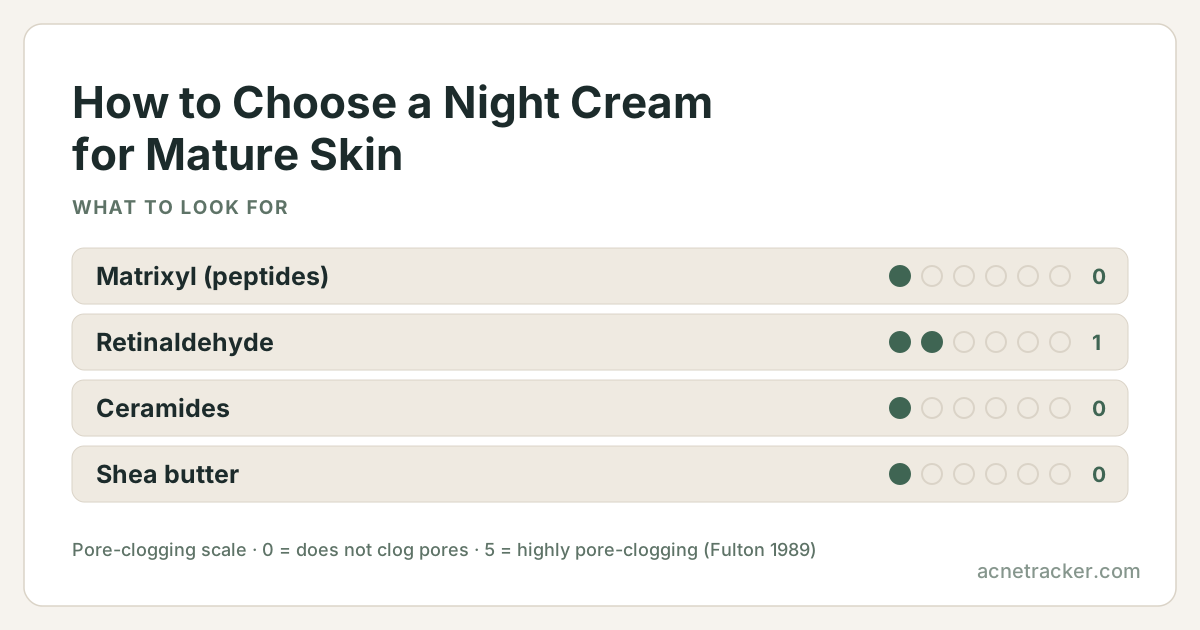
Ingredients to look for
| Ingredient | Why it matters |
|---|---|
| Matrixyl (peptides) | Signal peptides with reasonable evidence for supporting the skin's own collagen, best used consistently over months. |
| Retinaldehyde | A well-tolerated retinoid that supports overnight cell turnover and firmness; night is the correct place for it. |
| Ceramides | Rebuild a barrier that thins and dries with age, which is what makes mature skin feel tight and look crepey. |
| Shea butter | A rich emollient that gives the comfort and cushion mature, drier skin wants from a night cream. |
| Coenzyme Q10 | An antioxidant that supports the skin against the oxidative stress accumulated through the day. |
Ingredients to avoid
| Ingredient | Why it matters |
|---|---|
| Thin, oil-free gels marketed as 'anti-ageing' | Mature skin usually needs more emollience than a light gel provides, so it feels tight and under-nourished by morning. |
| Fragrance-heavy luxury formulas | A high price and a strong scent do not equal efficacy, and fragrance still risks irritating thinner, drier skin. |
| Products promising to 'erase wrinkles overnight' | No leave-on cream does this; the claim signals film-forming optical tricks rather than genuine skin change. |
| Stacking a retinoid cream over a separate strong retinol | Doubling retinoids irritates thinning skin; keep one retinoid in the routine and let the cream support it. |
How to choose
Match richness to need: mature skin generally justifies a fuller night cream than a light daytime lotion, so look for emollients like shea butter and squalane alongside barrier lipids. For active benefit, choose a formula featuring peptides or a gentle retinoid, and give it months, not days — collagen support is slow and cumulative. Read claims through an evidence lens: retinoids, peptides and antioxidants have real backing, while 'instant lift' and 'wrinkle erasing' describe temporary optical effects. Price is a poor guide to a formula; the ingredient list is not. This is a strong case for a dedicated night cream, since a richer texture and a night-appropriate retinoid both belong in the evening. If your skin is also sensitive, prioritise barrier ingredients first and introduce the retinoid slowly.
How to apply
After cleansing, apply any retinoid to dry skin, then press a generous layer of night cream over the face and neck, extending onto the chest if you treat it too. Mature skin tolerates and appreciates a fuller amount. If the retinoid is new or irritating, apply the cream first as a buffer. Do not neglect the neck and back of the hands, which show age readily. Be patient: firmness and texture changes take two to three months of consistent nights. And because retinoids increase sun sensitivity, daily morning sunscreen is the non-negotiable other half of an anti-ageing routine.
Frequently asked questions
Do peptides in a night cream actually help mature skin?
Some do, with reasonable evidence for supporting the skin's own collagen, but they are subtle and slow. Expect gradual improvement over months of consistent use, not a dramatic overnight change, and pair them with sunscreen by day.
Should mature skin use retinol at night or in the day?
At night. Retinoids are broken down by light and increase sun sensitivity, so evening is the correct time. Apply it before your night cream, and always follow with sunscreen the next morning to protect the new skin.
Is an expensive night cream worth it for mature skin?
Not because of the price. Efficacy comes from the ingredients — peptides, retinoids, ceramides, antioxidants — not the cost or packaging. A well-formulated affordable cream can outperform a luxury one built mostly on fragrance and claims.
Can a night cream get rid of deep wrinkles on mature skin?
No. A night cream can soften fine lines, improve texture and support firmness over time, but it cannot erase deep, established wrinkles. Products promising that are describing temporary optical effects, not real structural change.
Sources & further reading
There is no single study of this exact question. The guidance here is reasoned from the ingredient profiles below, each of which carries its own references:
- Matrixyl2 refs
- Retinal3 refs
- Ceramides3 refs
- Shea Butter3 refs
- Coenzyme Q103 refslimited evidence
The ingredients below are described here on the basis of laboratory, systemic or traditional-use sources rather than trials of topical use. Advice on this page that depends on them is correspondingly less certain.
- Coenzyme Q10 — CoQ10's antioxidant chemistry and its role in cellular energy production are established biochemistry. The cited assessment evaluates CoQ10 as a supplement, however, and does not measure what a cosmetic concentration does when applied to skin. Read the anti-aging description as a proposed mechanism rather than a demonstrated outcome.
Show every reference behind this page (10)
- European Commission CosIng database — Palmitoyl Pentapeptide-4cited by Matrixyl, Retinal, Ceramides, Shea Butter, Coenzyme Q10
- PubMed — Peptides: Emerging Candidates for the Prevention and Treatment of Skin Senescence: A Review (Biomolecules, 2025)cited by Matrixyl
- PubChem — Retinaldehydecited by Retinal
- Kwon HS et al. Efficacy and safety of retinaldehyde 0.1% and 0.05% creams used to treat photoaged skin: A randomized double-blind controlled trial. J Cosmet Dermatol 2018 Jun (PubMed)cited by Retinal
- DermNet — Skin barrier functioncited by Ceramides
- PubChem — Ceramide compound summarycited by Ceramides
- PubChem — Stearic acid (major shea fatty acid)cited by Shea Butter
- Safety Assessment of Butyrospermum parkii (Shea)-Derived Ingredients as Used in Cosmetics (PubMed)cited by Shea Butter
- PubChem — Coenzyme Q10 / Ubiquinone (CID 5281915)cited by Coenzyme Q10
- Safety assessment of coenzyme Q10 (CoQ10) (PubMed)cited by Coenzyme Q10
Medical disclaimer
Ingredients mentioned on this page
Find your personal acne triggers
Our free Acne Tracker lets you log breakouts, sleep, stress and diet, and shows you which factors correlate with your flare-ups.