How to Choose an Eye Cream for Dark Circles
Almost every page about dark circles makes the same mistake: it treats them as one problem with one shopping list. Dermatology has recognised for years that the shadow under an eye can be at least three different things — blood showing through translucent skin, melanin sitting in the skin, or a hollow casting a shadow — and they respond to completely different interventions. One of them barely responds to skincare at all. So before any ingredient discussion, this page gives you the two-minute self-assessment that tells you which of the three you are looking at, because buying the wrong active is the reason so many people conclude that eye creams are a scam.
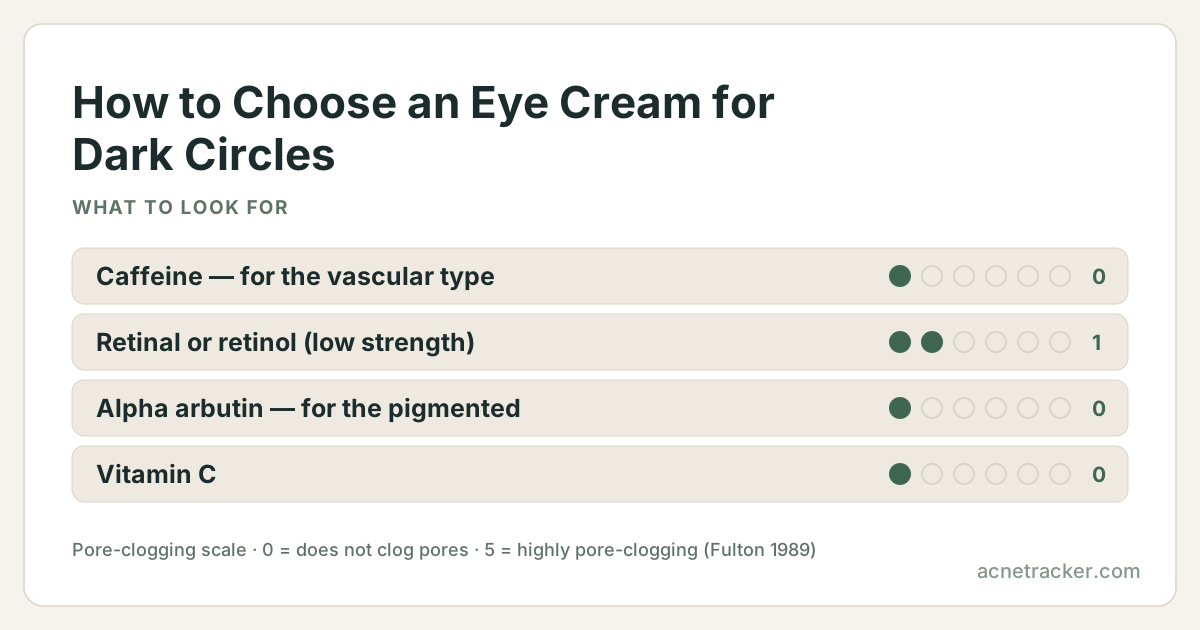
Ingredients to look for
| Ingredient | Why it matters |
|---|---|
| Caffeine — for the vascular type only | A vasoconstrictor and phosphodiesterase inhibitor. The pharmacology is solid; the cosmetic evidence in the eye area is small and short-term, so expect a mild, temporary lightening rather than a fix. |
| Retinal or retinol (low strength) | The one mechanism that plausibly addresses the vascular type at the root: retinoids thicken the epidermis and build dermal collagen over months, making thin skin less translucent. |
| Alpha arbutin — for the pigmented type only | A tyrosinase inhibitor with a gentler profile than hydroquinone, which matters on eyelid skin. Useless against a shadow or a blue vein. |
| Vitamin C | Works on both axes in theory: it interferes with melanin synthesis and supports collagen. Well tolerated derivatives are worth seeking out here — L-ascorbic acid at face strength stings near the eye. |
| Vitamin K | The clotting rationale is that it clears leaked blood pigment. It is a popular eye-cream inclusion, but the human evidence is thin and absorption through intact skin is poor. Treat it as unproven, not as the reason to buy. |
Ingredients to avoid
| Ingredient | Why it matters |
|---|---|
| Any product promising to erase dark circles | No topical removes a structural hollow or a genetic dermal pigment pattern. A claim that ignores the three-type distinction is a claim written by marketing. |
| Face-strength acids and retinoids applied to the lid | The eyelid is the thinnest skin on the body. Concentrations your cheeks tolerate produce dermatitis here, and eyelid dermatitis darkens the very area you are treating. |
| Vigorous rubbing and 'massage' routines | Chronic friction is a documented cause of post-inflammatory pigment around the eye. If you have allergies or eczema, the rubbing is often the whole story. |
| Skipping sunscreen while using pigment actives | Melanin responds to UV faster than any inhibitor suppresses it. Pigmented circles without daily sun protection do not measurably improve. |
How to choose
Do the assessment first. Stretch the skin under your eye gently sideways: if the darkness fades or disappears, it is vascular — you were seeing blood through translucent skin, and stretching thickened the optical path. If it stays put, it is pigment. Now tilt your head back and look up at the ceiling in a mirror: if the darkness lightens dramatically at that angle, it is structural — a hollow that was catching a shadow, not a stain at all. Most people find they are a mix, usually with one dominant type. Match the purchase to the answer. Vascular: caffeine for a temporary effect, a low-strength retinoid for the slow structural one. Pigmented: arbutin, tranexamic acid, niacinamide, vitamin C, plus sunscreen, and a six-month horizon. Structural: put your money elsewhere, because this is anatomy, and the honest options are volume procedures discussed with a doctor, or good lighting and concealer. A cream that hydrates the area will soften the appearance of all three slightly, and that modest effect is what most eye creams actually deliver.
How to apply
Use a rice-grain amount per eye and place it on the orbital bone, not on the lid itself — body heat and blinking migrate product upward and inward on their own. Pat with the ring finger; it applies the least pressure. Keep any retinoid at least a centimetre from the lash line, because the product will travel that centimetre by morning, and retinoid in the eye is a stinging, red-lid problem rather than a dangerous one. Photograph yourself in fixed lighting at week zero. Circles change with sleep, salt and allergies day to day, and without a baseline photo you will never know whether anything worked.
Frequently asked questions
Why do my dark circles look worse when I am tired?
Fatigue makes vascular circles more visible: skin pales slightly, sluggish circulation leaves more deoxygenated blood in the fine vessels under thin lid skin, and both increase the contrast. Pigmented circles barely change with sleep, which is itself a useful clue about which type you have.
Can eye cream get rid of dark circles permanently?
Not permanently, and for one of the three types not at all. Pigmented circles can genuinely fade with months of tyrosinase inhibitors and sunscreen but return without maintenance. Structural shadows do not respond to any cream, and any product claiming otherwise is describing a hydration effect.
Does caffeine eye cream actually work for dark circles?
Modestly and briefly, and only for the vascular type. Caffeine constricts small blood vessels, so less blue shows through — an effect measured in hours, not weeks. It does nothing to melanin and nothing to a hollow, which is why it disappoints roughly two-thirds of the people who buy it.
Are dark circles genetic?
Frequently, yes. Both dermal pigment patterns and the facial bone structure that creates tear-trough shadowing run strongly in families, and periorbital hyperpigmentation is notably common in people of South Asian, Middle Eastern and Mediterranean descent. Genetic does not mean untreatable, but it does mean managed rather than cured.
When should I see a doctor about dark circles?
If circles appear suddenly rather than gradually, affect one eye only, come with swelling, pain or any change in vision, or if there is a visible lump on the lid. Persistently itchy, scaly, darkening lids also deserve a look, since chronic eyelid eczema and allergy drive pigment through rubbing and are treatable causes.
Sources & further reading
There is no single study of this exact question. The guidance here is reasoned from the ingredient profiles below, each of which carries its own references:
- Caffeine2 refs
- Retinal3 refs
- Alpha-Arbutin3 refs
- Vitamin C3 refs
Show every reference behind this page (9)
- PubChem — Caffeinecited by Caffeine
- DermNet — Cosmeceuticalscited by Caffeine
- European Commission CosIng database — Retinalcited by Retinal, Alpha-Arbutin, Vitamin C
- PubChem — Retinaldehydecited by Retinal
- Kwon HS et al. Efficacy and safety of retinaldehyde 0.1% and 0.05% creams used to treat photoaged skin: A randomized double-blind controlled trial. J Cosmet Dermatol 2018 Jun (PubMed)cited by Retinal
- PubChem — Arbutincited by Alpha-Arbutin
- A comprehensive review of the therapeutic potential of α-arbutin (PubMed)cited by Alpha-Arbutin
- PubChem — Ascorbic Acid compound summarycited by Vitamin C
- DermNet — Topical vitamin Ccited by Vitamin C
Medical disclaimer
Ingredients mentioned on this page
Find your personal acne triggers
Our free Acne Tracker lets you log breakouts, sleep, stress and diet, and shows you which factors correlate with your flare-ups.