Can You Mix Benzoyl Peroxide and Retinal?
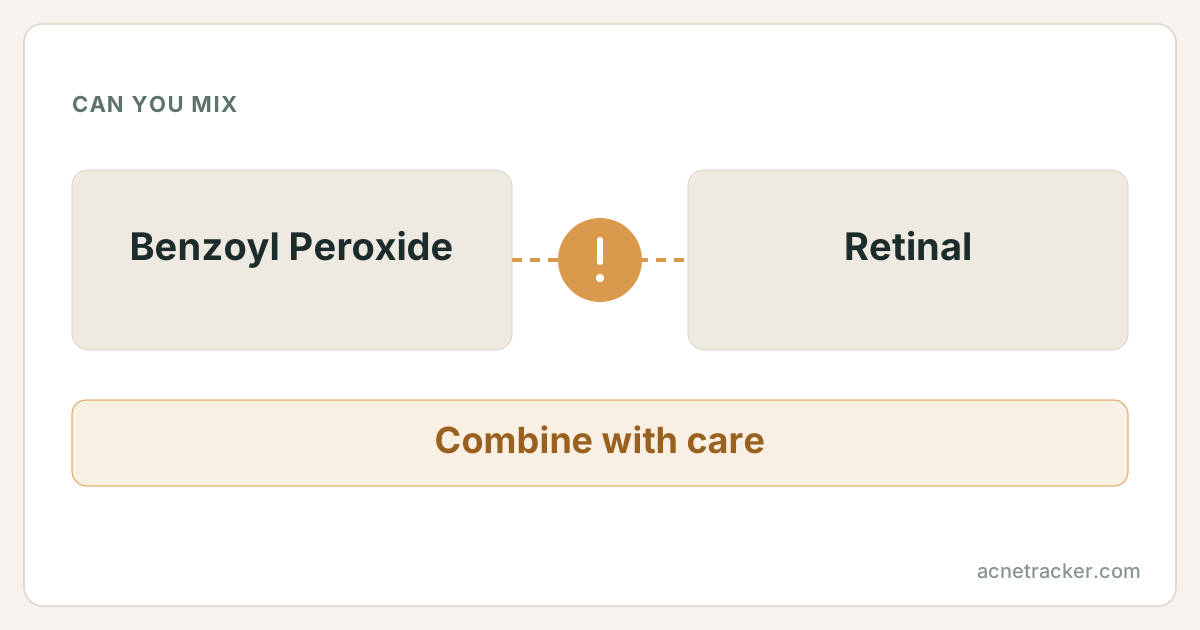
Not in the same layer. Retinal (retinaldehyde) is a true vitamin A derivative with the same oxidation-prone chain that makes tretinoin vulnerable to benzoyl peroxide, so layering them wet-on-wet risks wasting the retinal. The fix is trivial: benzoyl peroxide in the morning, retinal at night. Both are also irritating, so the split protects your barrier as well as the molecule.
How this pairing resolves
The two ingredients, their published numbers, and where they land together.
The numbers beside each ingredient are its published comedogenic rating and effective pH window, taken from its own profile page.
Show the numbers
| Ingredients | Metric | 0–5 |
|---|---|---|
| Benzoyl Peroxide | Comedogenic rating | 0/5 |
| Benzoyl Peroxide | Effective pH | no published pH |
| Retinal | Comedogenic rating | 1/5 |
| Retinal | Effective pH | 5.0–6.0 |
Why
Retinal sits one metabolic step from retinoic acid — skin converts retinol to retinal, then retinal to the active retinoic acid — which is why it works faster than retinol at equivalent strengths and why it carries more of retinol's irritation. That position on the ladder is also its chemical weakness. Retinal keeps the conjugated polyene chain common to the vitamin A family, and an aldehyde group on top, and both are exactly what free-radical oxygen attacks. The stability data everyone cites comes from tretinoin work in the late 1990s, which measured substantial degradation when tretinoin sat next to benzoyl peroxide, while adapalene — structurally different — held steady. Retinal has not been through the same head-to-head testing, but it belongs to the vulnerable structural family, not the resistant one, so treating it like tretinoin is the defensible assumption rather than hoping it behaves like adapalene. Alongside that sits the tolerance question: retinal drives flaking and retinisation while benzoyl peroxide dries and can sensitise. Even if the chemistry were fine, stacking them nightly would be a barrier problem.
How to combine them
Split by time of day and stop thinking about it. Benzoyl peroxide in the morning on inflamed spots, moisturiser, sunscreen. Retinal at night on the whole face, moisturiser on top, starting at two or three nights a week and building over six weeks — retinal at 0.05–0.1% is roughly as strong as considerably higher retinol percentages, so do not treat the small number as gentleness. If your acne demands both at night, apply benzoyl peroxide only after the retinal has fully absorbed and only on the specific lesions, but understand you are choosing convenience over certainty. Do not introduce both in the same month; you will not be able to attribute a reaction. Sunscreen is genuinely required — retinal increases photosensitivity, and retinal itself degrades in daylight, which is another argument for keeping it nocturnal.
Example routine
| When | Steps |
|---|---|
| Morning | Cleanser → Benzoyl peroxide 2.5% on spots → Moisturiser → SPF 30+ |
| Evening (Mon/Wed/Fri) | Cleanser → Retinal 0.05% → Moisturiser |
| Evening (other days) | Cleanser → Moisturiser (recovery night) |
| Introduction | One ingredient at a time, 4 weeks apart — never both in the same month |
Warning signs
Frequently asked questions
Does benzoyl peroxide destroy retinal?
It has not been tested directly, but retinal shares the oxidation-prone polyene chain that made tretinoin degrade next to benzoyl peroxide in stability testing. Assuming it is vulnerable is the safer bet — and separating them costs nothing.
Isn't adapalene fine with benzoyl peroxide? Why not retinal?
Adapalene is a naphthoic acid derivative, not a vitamin A molecule, and has no oxidisable chain — which is why fixed-combination gels exist. Retinal is a true vitamin A derivative and belongs to the vulnerable family.
Can I use them in the same evening if I wait long enough?
If the retinal has fully absorbed and the benzoyl peroxide goes only on individual spots, the risk drops. It is still more irritation for less certainty than simply putting benzoyl peroxide in the morning.
Is retinal stronger than retinol at the same percentage?
It is one conversion step closer to retinoic acid, so it acts faster at comparable concentrations and typically irritates more. That is why retinal percentages look small — 0.05% retinal is not a beginner dose.
Sources & further reading
There is no single study of this exact question. The guidance here is reasoned from the ingredient profiles below, each of which carries its own references:
- Benzoyl Peroxide3 refs
- Retinal3 refs
Show every reference behind this page (6)
- PubChem — Benzoyl peroxide compound summarycited by Benzoyl Peroxide
- DermNet — Benzoyl peroxidecited by Benzoyl Peroxide
- FDA — Drugs (OTC acne products)cited by Benzoyl Peroxide
- European Commission CosIng database — Retinalcited by Retinal
- PubChem — Retinaldehydecited by Retinal
- Kwon HS et al. Efficacy and safety of retinaldehyde 0.1% and 0.05% creams used to treat photoaged skin: A randomized double-blind controlled trial. J Cosmet Dermatol 2018 Jun (PubMed)cited by Retinal
Medical disclaimer
Ingredients mentioned on this page
Find your personal acne triggers
Our free Acne Tracker lets you log breakouts, sleep, stress and diet, and shows you which factors correlate with your flare-ups.