Lactic Acid: Comedogenic Rating & Ingredient Analysis
Lactic acid is the gentle alpha hydroxy acid (AHA) — the one most often recommended to people who want the brightening and smoothing benefits of chemical exfoliation but find glycolic acid too harsh. Originally associated with sour milk and now produced by fermentation, it has a larger molecule than glycolic acid, so it penetrates more slowly and works nearer the surface. That makes it milder and, unusually for an exfoliating acid, mildly hydrating, because lactic acid is also a natural component of the skin's own moisture system. It suits dry, sensitive and mature skin especially well, and appears in toners, serums, masks and peels at concentrations from about 5% up to 12% over the counter.
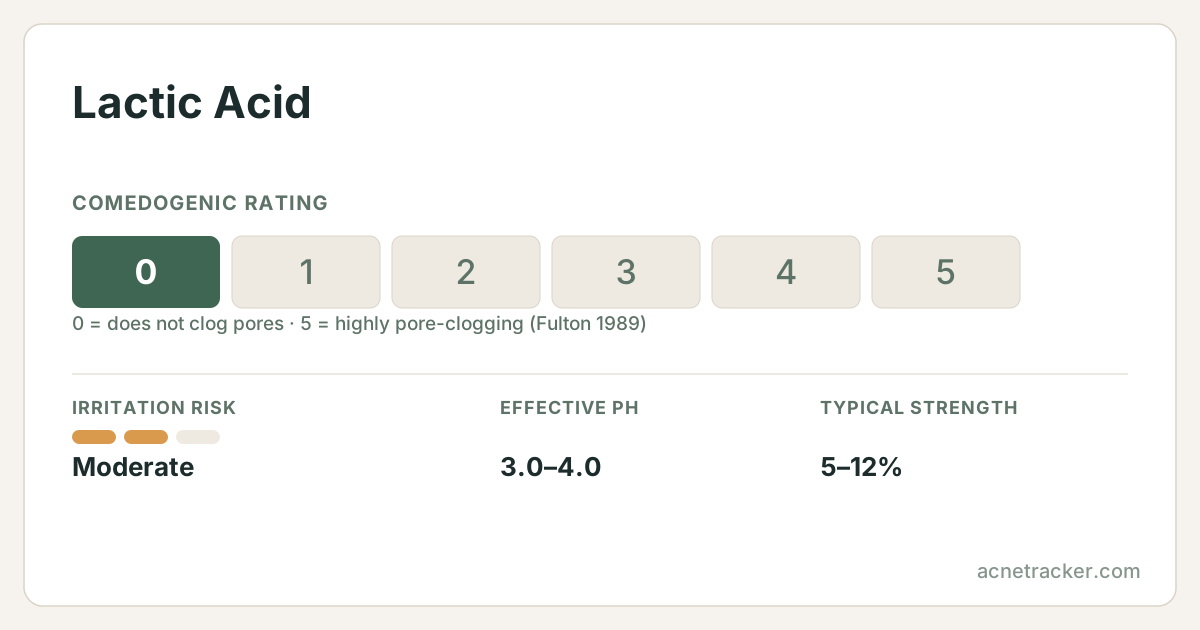
Quick facts
- Comedogenic rating
- our estimate — not measured
- Irritation risk
- Moderate
- Effective pH
- 3.0–4.0
- Typical strength
- 5–12%
- Pregnancy
- Ask your doctor
- Suits skin types
- drycombinationnormalsensitivemature
Where this number comes from
No one has published a comedogenic rating for this ingredient. Fulton's 1989 table tested about 250 raw materials and this was not among them, and we found no later study measuring it. The figure shown is our own reasoning from the ingredient's chemistry and how it is used — treat it as an estimate, not a measurement.
Fulton read his own scale as 0-1 not significant, 2-3 borderline, 4-5 positive. The assay is the rabbit ear at 10% dilution, which the paper itself calls extremely sensitive and not fully predictive of human skin. Ratings describe the raw ingredient; concentration and formulation change real-world behaviour.
Caution profile
The four published fields on this page, on one 0–5 scale. Further from the centre means more care is needed — never that the ingredient is worse.
Derived, not measured: pore-clogging is the published comedogenic rating; irritation maps low/moderate/high to 1/3/5; pregnancy maps safe/caution/avoid to 0/3/5; skin-type limits is how many of the seven skin types this entry does NOT list. Every input is printed in words in the quick-facts card above.
Show the numbers
| Metric | 0–5 | Published field |
|---|---|---|
| Pore-clogging | 0 | 0/5 |
| Irritation | 3 | Moderate |
| Skin-type limits | 1.4 | 5/7 |
| Pregnancy | 3 | Ask your doctor |
Working pH and typical strength
Where this ingredient is formulated to sit, and at what concentration.
Both bars come from the fields above: the pH window and the typical strength range published for this ingredient. The tinted column is healthy skin's surface pH (about 4.7–5.75).
Show the numbers
| Metric | 0–5 |
|---|---|
| Working pH | 3.0–4.0 |
| Typical strength | 5–12% |
What is it?
Lactic acid is a water-soluble AHA and one of the humectant molecules the skin naturally produces as part of its natural moisturizing factor. As an exfoliant it works like other AHAs — loosening the bonds between dead surface cells so they shed evenly and reveal smoother, brighter skin — but its larger molecular size slows penetration, which softens its intensity compared with glycolic acid. It has a documented second role as a humectant: at cosmetic strengths it helps bind water in the outer skin, so where glycolic acid can leave skin feeling stripped, lactic acid tends to leave it feeling smoother and more supple. As with all AHAs, the free-acid concentration and a low pH around 3–4 determine how strongly a given product actually exfoliates.
Benefits
Exfoliates gently
Its larger molecule penetrates more slowly than glycolic acid, giving a milder exfoliation that brightens and smooths with less stinging — a good entry point into acids for reactive skin.
Hydrates while it exfoliates
Lactic acid is part of the skin's natural moisturizing factor and acts as a humectant, so it improves surface hydration rather than leaving skin feeling tight and stripped.
Brightens and evens tone
By speeding the shedding of dull, pigment-laden surface cells, lactic acid gradually softens post-acne marks and uneven tone and restores a healthier glow.
Smooths dry, flaky texture
It is particularly effective on dry, rough or flaky skin, refining texture while its humectant action keeps the newly exposed surface comfortable.
How to use
Begin with a lower-strength leave-on product (around 5–8%) one to three evenings a week, applied to clean, dry skin and followed by moisturizer. Because lactic acid is milder, sensitive-skin users often tolerate it where glycolic acid caused stinging, but the same rules apply: build up frequency slowly and do not stack it with retinol, benzoyl peroxide or other exfoliating acids in the same routine — alternate nights instead. Sunscreen every morning is essential, as AHAs increase sun sensitivity. If your skin is very dry, lactic acid pairs beautifully with hyaluronic acid and ceramides layered afterward to reinforce the barrier.
Side effects
Lactic acid is milder than glycolic acid but is still an exfoliating acid, so a light tingle on application is normal and over-use can cause dryness, redness, peeling and sensitivity. As with any AHA, increased sun sensitivity means unprotected exposure can cause irritation and pigmentation. Pushing the strength or frequency too fast can compromise the barrier, at which point everything you apply starts to sting — the signal to cut back. Higher-strength lactic acid peels should be approached cautiously and, at professional concentrations, left to a trained provider.
Who should avoid it
People with an actively damaged barrier, open or inflamed skin, or acute eczema or rosacea flares should let the skin settle before using any acid. During pregnancy, low-strength cosmetic lactic acid is generally considered low risk, but strong peels are usually avoided as a precaution — check with your doctor. If you already use a prescription retinoid or a committed retinol routine, do not add lactic acid on top without guidance, and choose it over glycolic acid if your main issue is sensitivity or dryness.
Pairs well with
Avoid combining with
Frequently asked questions
Is lactic acid or glycolic acid better for sensitive skin?
Lactic acid, generally. Its larger molecule penetrates more slowly, so at equivalent strengths it tends to be milder and better suited to dry or sensitive skin, while glycolic acid is faster and stronger.
Does lactic acid hydrate the skin?
Yes, uniquely among common exfoliating acids. Lactic acid is part of the skin's natural moisturizing factor and acts as a humectant, so it can improve surface hydration while it exfoliates.
How often should I use lactic acid?
Start with one to three evenings a week and build up only as tolerated. Even a gentle AHA can over-exfoliate if used too often, so watch for tightness or flaking as a sign to reduce frequency.
Can I use lactic acid with niacinamide?
Yes. Applying lactic acid first, then niacinamide, is a well-tolerated pairing — niacinamide's barrier support helps offset any dryness from the acid.
Is lactic acid safe during pregnancy?
Low-strength cosmetic products are generally regarded as low risk, but strong AHA peels are usually avoided during pregnancy as a precaution. Lactic acid's slower, larger molecule does not change that advice — take the strength you are considering to your midwife or obstetrician first.
Where this ingredient shows up here
Counted across this database, not the web — these are the pages on this site that reason about this ingredient.
Combination guides 22
+14 more on the site
Condition pages 11
- Acanthosis Nigricans on the Neck (Not Acne)
- Butt Acne Scars
- Butt Acne: What Those Bumps Actually Are
- Dark Spots on the Buttocks
- Does Keratosis Pilaris Ever Go Away?
- Keratosis Pilaris on the Buttocks
+5 more on the site
Buying guides 18
- How to Choose a Body Wash for Dark Spots on the Body
- How to Choose a Body Wash for Keratosis Pilaris
- How to Choose a Chemical Exfoliant for Combination Skin
- How to Choose a Chemical Exfoliant for Dark Skin Tones
- How to Choose a Chemical Exfoliant for Dry Skin
- How to Choose a Chemical Exfoliant for Dull Skin
+12 more on the site
Sources & further reading
Medical disclaimer
Find your personal acne triggers
Our free Acne Tracker lets you log breakouts, sleep, stress and diet, and shows you which factors correlate with your flare-ups.