Does Keratosis Pilaris Ever Go Away?
The honest answer is: not on demand, but often on its own, eventually. Keratosis pilaris is an inherited difference in how skin sheds around hair follicles, not something you acquired and can therefore return. Nothing available over the counter or on prescription changes the underlying tendency, so no product cures it, and any that claims to is lying to you. What does happen is that it commonly becomes less prominent through adulthood — many people find their arms are noticeably better in their thirties than their teens without ever having treated it. And in the meantime, consistent keratin-softening care makes a real, if partial, difference. That combination — genetic, harmless, manageable, often self-improving — is the whole picture.
How to recognize it
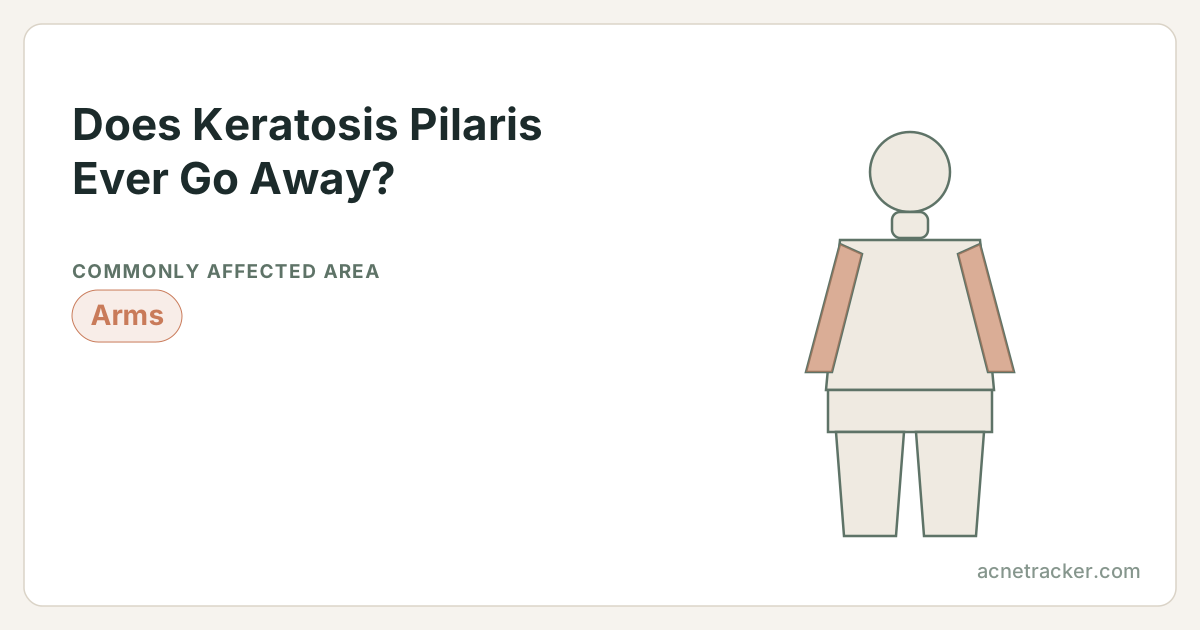
The trajectory is as characteristic as the texture. It usually appears in childhood, becomes most prominent in adolescence when it can affect a majority of teenagers to some degree, and then tends to recede gradually through the twenties and thirties. Pregnancy and the drier decades of later life can make it fluctuate. Through all of that it keeps the same signature: firm bumps at follicles, worse in winter, symmetrical, on the outer upper arms and the front of the thighs. It does not scar, does not spread to new areas in adulthood and does not lead to anything else. If your bumps behave otherwise, they are not doing this.
What causes it
Why there is no cure
The tendency is written into how your skin cells behave at the follicular opening. Keratolytics soften what has already formed; they do not reprogramme the shedding process. Stop applying them and plugs re-accumulate within weeks, which is not a failure of the product but the correct expected behaviour.
Why it often improves with age
The pattern of gradual improvement into middle adulthood is well recognised, and hormonal changes after adolescence are the usual explanation offered. It is not universal — some people carry it lifelong — but it is common enough that waiting is a legitimate strategy.
Why it gets worse in some phases
Puberty, pregnancy and any period of drier skin can each make it more prominent. Winter does the same every year. So a run of worsening does not mean it is progressing as a condition; it usually means the skin around the plugs is drier or more irritated than it was.
Why consistency beats intensity
Because plugs reform continuously, an occasional strong treatment fights a battle that resets between applications. A milder product used every day holds the texture down, which is why routines that people actually sustain outperform ones that look more impressive on paper.
Ingredients with evidence
| Ingredient | Role |
|---|---|
| Urea | The most sustainable long-term option for something you will be managing for years: it softens keratin and hydrates, and it is tolerable enough for daily indefinite use, which is precisely the requirement. |
| Lactic acid (AHA) | The alternative daily route, with the same logic. Evidence for smoothing keratosis pilaris is real and modest; expect improvement, not resolution. |
| Salicylic acid (BHA) | Reaches into the follicular opening. Sometimes rotated with an AHA when one alone is not enough, though there is no need to use everything at once. |
| Glycerin | The unglamorous constant. Hydrated skin sheds better, so a plain humectant genuinely contributes to the outcome over years rather than weeks. |
| Prescription topical retinoids | A dermatologist may discuss these for stubborn cases. They can help the plugging but frequently irritate a large body surface, so they are a conversation to have with a doctor rather than an obvious next step. |
Building the routine
Set the goal correctly and the routine follows. You are aiming for smoother and calmer, not gone. Use one keratolytic body cream daily on damp skin, keep showers short and warm, and drop every form of physical exfoliation permanently. Review at eight weeks, then simply keep going — this is a maintenance habit like flossing, not a course of antibiotics. Two things will tempt you off it: a winter where it looks worse regardless, and a summer where it looks so good you stop. Both are normal parts of the cycle. If you want a rest, take one and accept the texture returns within about a month. Nothing is lost by stopping and nothing is gained by escalating, which is a genuinely freeing thing to know about a condition that harms nothing but your patience.
When to see a doctor
Frequently asked questions
Will keratosis pilaris go away on its own?
Often it fades substantially with age, commonly becoming much less noticeable through the twenties and thirties. It is not guaranteed and some people have it lifelong. It will not disappear on a timetable, and no product accelerates the underlying change.
Can keratosis pilaris be cured permanently?
No. It is an inherited shedding trait, so there is nothing to cure in the usual sense. Treatment reduces how noticeable it is for as long as you keep treating. Any product marketed as a permanent fix is overpromising on something genetics decides.
How long until I see a difference from urea or lactic acid?
Redness often eases within two to four weeks; texture takes longer, and eight weeks of daily use is a fair point to judge. If nothing has changed at all by then, the strength or the diagnosis is worth revisiting rather than the effort.
If it comes back when I stop, was the treatment pointless?
No — it means the treatment was working on the plugs rather than on your genes, which is the only thing it was ever going to do. Compare it to shaving: nobody concludes a razor failed because hair returns. This is maintenance by design.
Sources & further reading
What this page cites about the condition itself:
There is no single study of this exact question. The guidance here is reasoned from the ingredient profiles below, each of which carries its own references:
- Urea2 refs
- Lactic Acid3 refs
- Salicylic Acid2 refs
- Glycerin3 refs
Show every reference behind this page (9)
- PubChem — Ureacited by Urea
- DermNet — Emollients and moisturiserscited by Urea
- PubChem — Lactic acid compound summarycited by Lactic Acid
- DermNet — Alpha hydroxy acidscited by Lactic Acid
- European Commission CosIng database — Lactic Acidcited by Lactic Acid, Glycerin
- Salicylic acid as a peeling agent: a comprehensive review (PubMed)cited by Salicylic Acid
- FDA OTC monograph — acne drug products (salicylic acid 0.5–2%)cited by Salicylic Acid
- PubChem — Glycerol compound summarycited by Glycerin
- DermNet — Moisturiserscited by Glycerin
Medical disclaimer
Ingredients mentioned on this page
Find your personal acne triggers
Our free Acne Tracker lets you log breakouts, sleep, stress and diet, and shows you which factors correlate with your flare-ups.