Allantoin: Comedogenic Rating & Ingredient Analysis
Allantoin is a quiet workhorse ingredient that rarely gets top billing but appears in an enormous number of moisturisers, soothing creams and after-treatment products. Originally isolated from the comfrey plant and now made synthetically for purity and consistency, it is prized for a single, well-defined job: calming and conditioning the skin. It has no strong action of its own — it does not exfoliate aggressively, brighten or fight bacteria — but it makes almost every other ingredient more comfortable to use. For people managing acne, that supporting role is exactly the point, because the treatments that clear breakouts are frequently the ones that leave skin raw, and allantoin softens that blow.
Quick facts
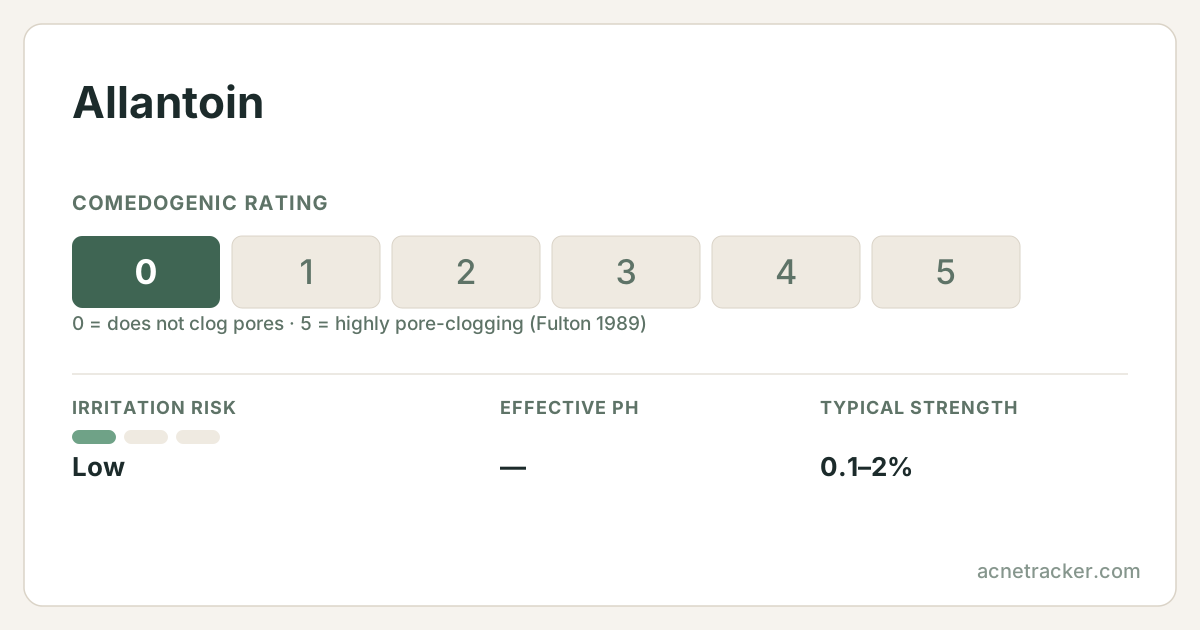
- Comedogenic rating
- measured (Fulton 1989)
- Irritation risk
- Low
- Effective pH
- —
- Typical strength
- 0.1–2%
- Pregnancy
- Considered safe
- Suits skin types
- drysensitivenormalcombinationacne-pronemature
Where this number comes from
Read directly from Table I of Fulton's 1989 paper — the primary source, not one of the copied tables that circulate online.
Fulton read his own scale as 0-1 not significant, 2-3 borderline, 4-5 positive. The assay is the rabbit ear at 10% dilution, which the paper itself calls extremely sensitive and not fully predictive of human skin. Ratings describe the raw ingredient; concentration and formulation change real-world behaviour.
Caution profile
The four published fields on this page, on one 0–5 scale. Further from the centre means more care is needed — never that the ingredient is worse.
Derived, not measured: pore-clogging is the published comedogenic rating; irritation maps low/moderate/high to 1/3/5; pregnancy maps safe/caution/avoid to 0/3/5; skin-type limits is how many of the seven skin types this entry does NOT list. Every input is printed in words in the quick-facts card above.
Show the numbers
| Metric | 0–5 | Published field |
|---|---|---|
| Pore-clogging | 0 | 0/5 |
| Irritation | 1 | Low |
| Skin-type limits | 0.7 | 6/7 |
| Pregnancy | 0 | Considered safe |
Working pH and typical strength
Where this ingredient is formulated to sit, and at what concentration.
Both bars come from the fields above: the pH window and the typical strength range published for this ingredient. The tinted column is healthy skin's surface pH (about 4.7–5.75).
Show the numbers
| Metric | 0–5 |
|---|---|
| Typical strength | 0.1–2% |
What is it?
Allantoin is a small nitrogen-rich molecule classed cosmetically as a skin-conditioning and soothing agent. It has a mild keratolytic effect, meaning it gently helps loosen and shed the outermost dead skin cells, which improves texture and softness without the sting of an acid. At the same time it is a recognised soothing agent that reduces the sensation of irritation and supports the skin's natural recovery, which is why it has a long history in products for chapped, sunburned or eczema-prone skin. It is water-soluble, non-acidic, odourless and stable, so formulators use it at low concentrations — often well under 1% — to round the sharp edges off actives, sunscreens and cleansers. Because it is used at such low levels and is chemically inert toward other ingredients, it is one of the most compatible additions in any formula.
Benefits
Calms irritated, reactive skin
Allantoin is a classic soothing agent that eases the feeling of irritation, making it a dependable addition to routines built around stronger, potentially stinging acne actives.
Gently smooths rough texture
Its mild keratolytic action helps shed the flaky, built-up surface cells that make skin feel bumpy, improving smoothness without the irritation of an exfoliating acid.
Supports skin recovery
Long used in products for chapped and damaged skin, allantoin conditions the surface and supports the skin's natural repair process, which helps a barrier stressed by acne treatment bounce back.
Boosts overall comfort and hydration
By conditioning and softening, allantoin leaves skin feeling more supple and less tight, which makes irritating routines noticeably easier to keep up with day to day.
How to use
Allantoin usually comes built into a moisturiser, soothing serum or gentle cleanser rather than sold on its own, and it needs no special handling. Use the product wherever it fits your routine — often as a hydrating or calming step after your active treatments. Because it is gentle and non-reactive, you can apply it morning and night with no adjustment period and no risk of over-use. It pairs naturally with strong actives: apply your exfoliating acid or retinoid, then follow with an allantoin-containing moisturiser to settle the skin. It sits well under sunscreen and makeup and requires no separation from any other ingredient.
Side effects
Allantoin has an excellent safety record and a comedogenic rating of 0, so it does not clog pores. Adverse reactions are very rare; at the low concentrations used in cosmetics it is considered non-irritating and non-sensitising for the vast majority of people. As always, an isolated allergy is theoretically possible, so patch test if your skin is highly reactive. It does not increase photosensitivity and can be used year-round.
Who should avoid it
There is virtually no group that must avoid allantoin. The only sensible precaution is for people who have previously reacted to a product where allantoin was the likely culprit, though this is uncommon. If your skin reacts easily, introduce any new product one at a time and patch test, so that if a problem does arise you can identify the actual cause.
Pairs well with
Frequently asked questions
What does allantoin do for your skin?
Allantoin soothes irritation, conditions the skin and gently smooths rough texture through a mild keratolytic effect. It is mainly a supportive ingredient that makes skin more comfortable, especially alongside stronger acne treatments.
Is allantoin safe for acne-prone skin?
Yes. Allantoin has a comedogenic rating of 0, does not clog pores, and helps calm the irritation caused by acne actives like salicylic acid and retinoids, so it is well suited to breakout-prone skin.
Is allantoin the same as comfrey?
Allantoin was originally found in the comfrey plant, but the version used in skincare today is almost always made synthetically. Synthetic allantoin is chemically identical, purer and free of the other plant compounds found in raw comfrey.
Can I use allantoin with other active ingredients?
Yes. Allantoin is chemically inert and used at very low concentrations, so it combines safely with retinol, acids, niacinamide and vitamin C. It is often added precisely to make those stronger actives gentler on the skin.
Is allantoin safe during pregnancy?
Topical allantoin is generally regarded as safe during pregnancy and breastfeeding. As always, check with your doctor about your full routine, but allantoin itself is a low-risk, soothing ingredient.
Where this ingredient shows up here
Counted across this database, not the web — these are the pages on this site that reason about this ingredient.
Condition pages 4
Buying guides 27
- How to Choose a Body Wash for Sensitive Skin
- How to Choose a Chemical Exfoliant for Rosacea-Prone Skin
- How to Choose a Cleanser for a Damaged Skin Barrier
- How to Choose a Cleanser for Hyperpigmentation
- How to Choose a Cleanser for Men
- How to Choose a Cleanser for Rosacea-Prone Skin
+21 more on the site
Sources & further reading
Medical disclaimer
Find your personal acne triggers
Our free Acne Tracker lets you log breakouts, sleep, stress and diet, and shows you which factors correlate with your flare-ups.