Snail Mucin: Comedogenic Rating & Ingredient Analysis
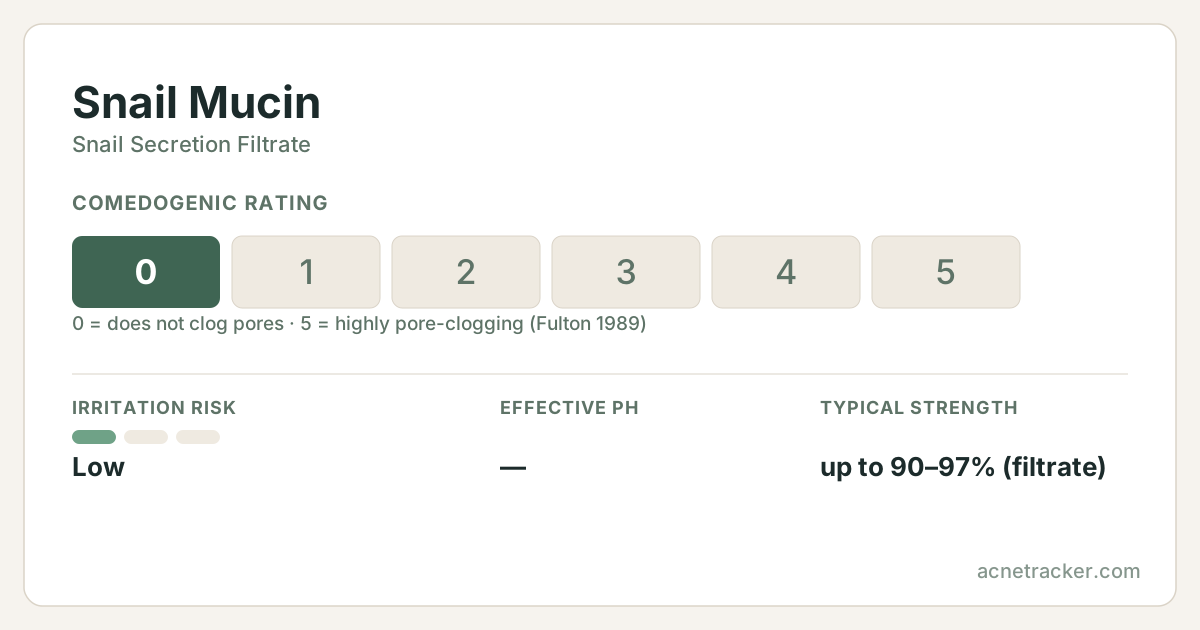
Snail mucin, listed on labels as snail secretion filtrate, is a hallmark ingredient of Korean skincare that has become a global favourite for hydration and barrier comfort. It is the filtered secretion produced by snails, a naturally complex fluid that carries a mix of water-binding and skin-conditioning components. What makes it distinctive is not a single dramatic effect but a broad, gentle one: it hydrates, it feels soothing, and it plays extraordinarily well with almost every other ingredient. In popular essences and serums it appears at very high concentrations, often listed as 90% or more of the formula, which is part of the appeal for people chasing a plump, dewy finish.
Quick facts
- Comedogenic rating
- our estimate — not measured
- Irritation risk
- Low
- Effective pH
- —
- Typical strength
- up to 90–97% (filtrate)
- Pregnancy
- Considered safe
- Suits skin types
- drysensitivenormalcombinationacne-pronemature
Where this number comes from
No one has published a comedogenic rating for this ingredient. Fulton's 1989 table tested about 250 raw materials and this was not among them, and we found no later study measuring it. The figure shown is our own reasoning from the ingredient's chemistry and how it is used — treat it as an estimate, not a measurement.
Fulton read his own scale as 0-1 not significant, 2-3 borderline, 4-5 positive. The assay is the rabbit ear at 10% dilution, which the paper itself calls extremely sensitive and not fully predictive of human skin. Ratings describe the raw ingredient; concentration and formulation change real-world behaviour.
Caution profile
The four published fields on this page, on one 0–5 scale. Further from the centre means more care is needed — never that the ingredient is worse.
Derived, not measured: pore-clogging is the published comedogenic rating; irritation maps low/moderate/high to 1/3/5; pregnancy maps safe/caution/avoid to 0/3/5; skin-type limits is how many of the seven skin types this entry does NOT list. Every input is printed in words in the quick-facts card above.
Show the numbers
| Metric | 0–5 | Published field |
|---|---|---|
| Pore-clogging | 0 | 0/5 |
| Irritation | 1 | Low |
| Skin-type limits | 0.7 | 6/7 |
| Pregnancy | 0 | Considered safe |
Working pH and typical strength
Where this ingredient is formulated to sit, and at what concentration.
Both bars come from the fields above: the pH window and the typical strength range published for this ingredient. The tinted column is healthy skin's surface pH (about 4.7–5.75).
Show the numbers
| Metric | 0–5 |
|---|---|
| Typical strength | up to 90–97% (filtrate) |
What is it?
Snail secretion filtrate is a heterogeneous natural material rather than a single molecule. It contains humectants such as naturally occurring glycosaminoglycans and hyaluronic-acid-like substances that draw and hold water, alongside glycoproteins and other conditioning agents that leave the skin feeling smooth and supple. Because it is a mild, water-based ingredient with no acid or retinoid activity, it has no meaningful active pH and does not exfoliate or force cell turnover. Instead it works cosmetically at the surface, adding lightweight hydration and a soft protective feel. Its gentleness and lack of irritating actives are exactly why it is so often used as a buffer alongside stronger ingredients.
Benefits
Lightweight, layered hydration
Rich in water-binding humectants, snail mucin delivers a plump, dewy hydration that sinks in without heaviness, making it suitable even for oily and combination skin that dislikes rich creams.
Soothes and comforts the skin
Its conditioning components leave irritated, tight or wind-chapped skin feeling calmer and softer, which is why it is a favourite for post-cleanse comfort and after stronger actives.
Supports a healthy skin barrier
By adding hydration and a smoothing film, snail mucin helps skin feel more resilient and less reactive, complementing barrier ingredients like ceramides in a layered routine.
Pairs with almost anything
With no irritating acids or retinoids of its own, snail mucin buffers harsher actives beautifully — it can be layered under retinol or over niacinamide to soften their impact without cancelling their benefits.
How to use
Snail mucin is one of the easiest ingredients to slot into a routine. Apply an essence or serum to clean skin after toning, morning and night, then follow with moisturizer to seal it in. Because it is a humectant-rich water-phase product, it works best applied to slightly damp skin and sealed with a cream, especially in dry climates. It layers safely under sunscreen and makeup, and it makes an excellent buffer for people building tolerance to retinol — apply snail mucin first, let it absorb, then the retinoid. There is no adjustment period and no need to limit how often you use it.
Side effects
Snail mucin is very well tolerated and rarely causes problems. The main consideration is that, like any protein-containing natural ingredient, it can trigger an allergy in a small number of sensitive individuals, so a patch test is sensible if your skin reacts easily. Occasionally the slippery, film-forming texture can pill under other products or feel tacky if over-applied; using a thinner layer solves this. Those following vegan or shellfish-allergy-conscious routines may prefer to avoid it on principle.
Who should avoid it
Most people can use snail mucin freely, including during pregnancy, where it is regarded as a safe, non-active hydrating ingredient. People with a known sensitivity to it should avoid it, and anyone with very reactive skin should patch test first. Those who avoid animal-derived ingredients for ethical reasons will want to choose a plant-based humectant such as hyaluronic acid or glycerin instead.
Pairs well with
Frequently asked questions
What does snail mucin do for your skin?
It mainly hydrates and soothes. Snail secretion filtrate is rich in water-binding humectants and conditioning agents that leave skin plump, soft and comfortable, and it supports the barrier without exfoliating or irritating.
Can I use snail mucin every day?
Yes. It is gentle enough for morning and night use with no adjustment period. Apply it after toner and before moisturizer as often as you like; consistency is what produces the dewy, hydrated look.
Can I use snail mucin with retinol or niacinamide?
Yes — it pairs with almost everything. It is especially useful as a buffer, applied before retinol to soften irritation, and layers well with niacinamide and hyaluronic acid for extra hydration.
Is snail mucin good for acne-prone skin?
It can be. With a comedogenic rating of 0, it adds hydration without clogging pores, which helps acne-prone skin stay comfortable, though it treats dryness and soothes rather than clearing breakouts directly.
Is snail mucin safe during pregnancy?
Yes. It is a gentle, non-active hydrating ingredient generally considered safe during pregnancy and breastfeeding. As always, confirm with your doctor if you have any concerns.
Where this ingredient shows up here
Counted across this database, not the web — these are the pages on this site that reason about this ingredient.
Combination guides 7
Buying guides 1
Sources & further reading
Medical disclaimer
Find your personal acne triggers
Our free Acne Tracker lets you log breakouts, sleep, stress and diet, and shows you which factors correlate with your flare-ups.