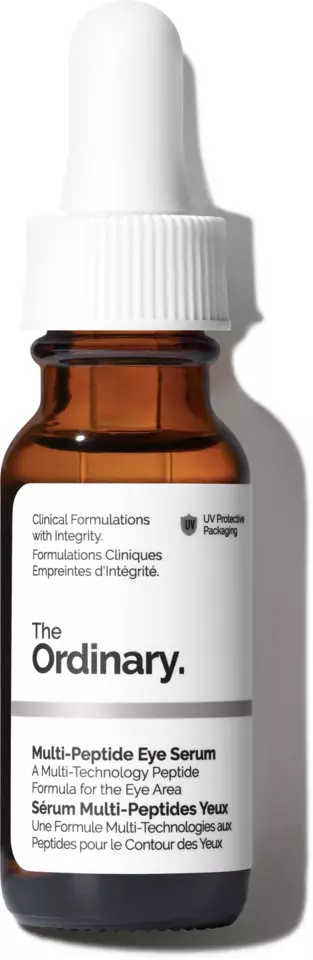
The Ordinary Multi-Peptide Eye Serum: Ingredient Analysis
A water-and-glycol base carrying four separate peptides, caffeine, niacinamide, acetyl glucosamine and a pair of green-tea-derived antioxidants. It is one of the more crowded formulas The Ordinary sells, and the peptides sit between positions eight and eleven — after three glycols, which tells you they are present at low percentages, as peptides almost always are.
No ingredient on this list carries a high published comedogenic rating (3+).
Full ingredient list, explained
| Ingredient | Function | Role | Pore-clog |
|---|---|---|---|
| Aqua (Water) | Solvent | The base most water-soluble ingredients are dissolved in. | – |
| Glycerin | Humectant | The most reliable humectant in skincare; binds water to the skin. | 0 |
| Butylene Glycol | Humectant / solvent | Lightweight moisturizer and carrier that improves texture. | 1 |
| Propanediol | Humectant / solvent | Draws water into skin and helps dissolve actives; a plant-derived glycol. | – |
| Dipropylene Glycol | Humectant / solvent | Holds water and dissolves ingredients that water alone cannot. | – |
| Acetyl Glucosamine | Brightening / Hydration | Acetyl glucosamine, often shortened to NAG, is an amino sugar with a quiet but useful set of skin benefits. | – |
| Niacinamide | Barrier repair / Sebum regulation | Niacinamide is one of the most studied and best tolerated active ingredients in modern skincare. | 0 |
| Palmitoyl Tripeptide-38 | Signal peptide | A lab-made peptide marketed for support of the skin's matrix proteins. | – |
| Acetyl Tetrapeptide-5 | Signal peptide | A peptide used in eye formulas, associated with puffiness claims. | – |
| Myristoyl Nonapeptide-3 | Signal peptide | A nine-amino-acid peptide used in tone-targeting formulas. | – |
| Dipeptide Diaminobutyroyl Benzylamide Diacetate | Signal peptide | A peptide marketed for a relaxing effect on expression lines. | – |
| Caffeine | Active — soothing / antioxidant | In hair products, marketed to support the follicle; also an antioxidant and de-puffing agent. | – |
| Epigallocatechin Gallatyl Glucoside | Antioxidant | A stabilised green-tea catechin derivative. | – |
| Gallyl Glucoside | Antioxidant | A glucose-bound form of gallic acid, used for stability. | – |
| Fraxinus Excelsior Bark Extract | Skin conditioning | Ash bark extract, used in eye formulas as a conditioning agent. | – |
| Silanetriol | Skin conditioning | A silicon-based conditioning agent. | – |
| Arginine | Amino acid | A conditioning amino acid and mild pH adjuster. | – |
| Pentylene Glycol | Humectant / preservative booster | Adds moisture and helps the preservative system work. | – |
| Hydroxymethoxyphenyl Decanone | Soothing agent | Included for a calming effect on visible redness. | – |
| Propyl Gallate | Antioxidant (formula) | Protects the formula's own oils from going rancid. | – |
| Maltodextrin | Carrier / film former | A plant sugar used to carry and encapsulate actives. | – |
| Hydroxypropyl Cyclodextrin | Stabiliser | A ring-shaped sugar that holds unstable ingredients inside it. | – |
| Hydroxyethylcellulose | Thickener | A cellulose-derived gum that gives the serum its texture. | – |
| Xanthan Gum | Thickener / stabilizer | A fermentation-derived gum that thickens and stabilizes. | – |
| Citric Acid | pH adjustment / Chemical exfoliation | Citric acid is one of the most common ingredients on skincare labels, but its role is often misunderstood. | – |
| Glycolic Acid | Chemical exfoliation / Brightening | Glycolic acid is the most widely studied alpha hydroxy acid (AHA) and the benchmark surface exfoliant in skincare. | – |
| Sodium Citrate | Buffering agent | Adjusts and holds pH alongside citric acid. | – |
| Polysorbate 20 | Emulsifier / solubilizer | Keeps oil-soluble and water-soluble parts mixed. | 0 |
| Trisodium Ethylenediamine Disuccinate | Chelating agent | Binds trace metals so the formula stays stable. | – |
| Dehydroacetic Acid | Preservative | A preservative often paired with benzyl alcohol. | – |
| Ethylhexylglycerin | Humectant | The most reliable humectant in skincare; binds water to the skin. | – |
| Benzyl Alcohol | Preservative / Solvent | Benzyl alcohol is a multitasking cosmetic ingredient that mainly acts as a preservative, protecting products from bacteria, mould and yeast. | – |
| Phenoxyethanol | Preservative | A widely used broad-spectrum preservative. | – |
| Chlorphenesin | Preservative | Works alongside phenoxyethanol to keep the product safe. | – |
Open this full list in the comedogenic checker
Ingredient list copied from the brand's own page on 2026-08-27. Formulations change without notice and vary by region — the brands say so themselves. Check the list on your own package before relying on this. The Ordinary — Multi-Peptide Eye Serum (official product page)
Who it's for
Anyone wanting to try a peptide eye product without a luxury price. It is worth being clear about expectations: peptide research is mostly manufacturer-run and short, and the honest position is that these are plausible, well-tolerated ingredients with thin independent evidence for visible change around the eye.
How to use it
A small amount patted around the orbital bone morning and evening — not on the lid itself, and not closer than the bone, since product migrates. Caffeine's effect on puffiness is temporary and mostly about fluid, so judge that within the hour rather than over weeks.
Frequently asked questions
Do the peptides actually work?
The honest answer is that the evidence is thin. Peptides are plausible on mechanism and well tolerated, but the published studies are typically small, short and run by ingredient suppliers. We would not tell you they do nothing; we would not tell you to expect a visible change either.
What does the caffeine do?
Caffeine constricts small blood vessels, which can briefly reduce the look of puffiness and, for some people, darkness caused by visible vessels. It is a short-term cosmetic effect that wears off — it does not treat the cause of dark circles.
Will it help dark circles?
It depends entirely on why yours are dark. Pigment-driven circles may respond a little to the niacinamide and acetyl glucosamine over months. Shadow from bone structure will not respond to any serum, and vessel-driven darkness responds only temporarily. This is worth diagnosing before buying anything.
Is there glycolic acid in an eye product?
Yes, but near the end of the list alongside citric acid and sodium citrate, which is the signature of pH adjustment rather than exfoliation. It is not there to exfoliate the eye area.
Can I use it with retinol around the eyes?
Generally yes, on alternate evenings while you adjust. The eye area is thin and irritates easily, so introduce one thing at a time and stop stacking if you see flaking.
Sources & further reading
- Ingredient list sourced from: The Ordinary — Multi-Peptide Eye Serum (official product page)
Medical disclaimer
Find your personal acne triggers
Our free Acne Tracker lets you log breakouts, sleep, stress and diet, and shows you which factors correlate with your flare-ups.