Arginine: Comedogenic Rating & Ingredient Analysis
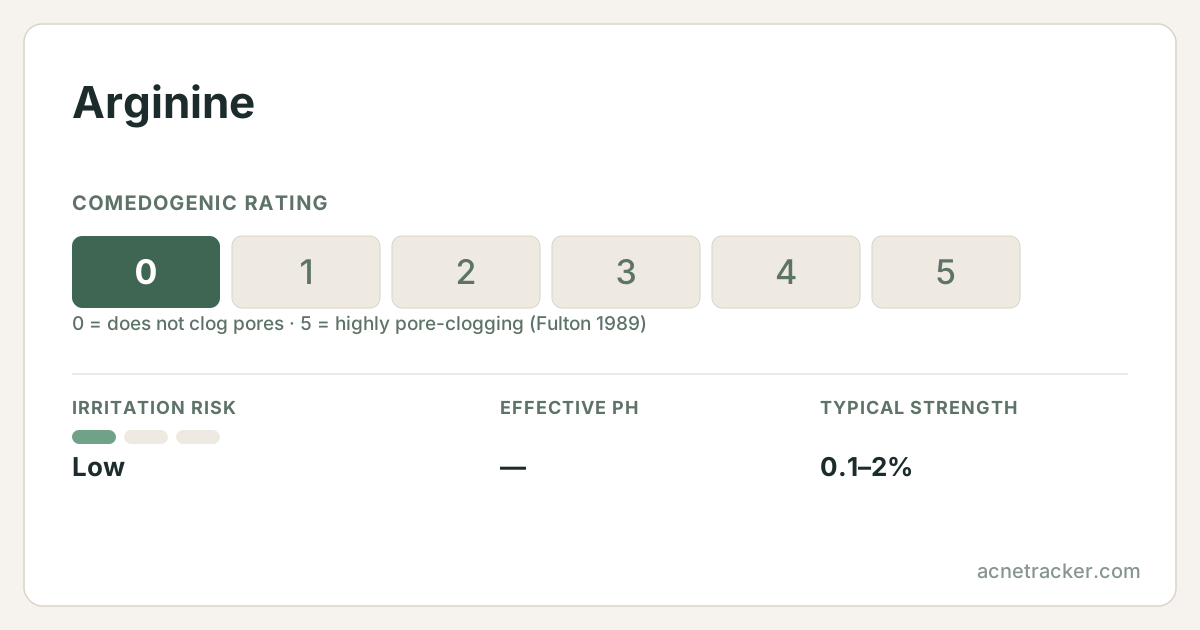
Arginine is an amino acid that plays several supporting roles in skincare, from hydration to acting as a gentle, natural pH adjuster in a formula. Amino acids are the building blocks of the proteins that structure skin, and several of them, arginine included, are part of the skin's own natural moisturising factor. On the skin, arginine helps bind water, offers some antioxidant defence against the free radicals generated by stress and sunlight, and has been studied for a role in the skin's repair processes. It is gentle, non-comedogenic and useful across skin types, appearing in everything from soothing serums to anti-aging creams.
Quick facts
- Comedogenic rating
- our estimate — not measured
- Irritation risk
- Low
- Effective pH
- —
- Typical strength
- 0.1–2%
- Pregnancy
- Considered safe
- Suits skin types
- drysensitivenormalcombinationmatureacne-prone
Where this number comes from
No one has published a comedogenic rating for this ingredient. Fulton's 1989 table tested about 250 raw materials and this was not among them, and we found no later study measuring it. The figure shown is our own reasoning from the ingredient's chemistry and how it is used — treat it as an estimate, not a measurement.
Fulton read his own scale as 0-1 not significant, 2-3 borderline, 4-5 positive. The assay is the rabbit ear at 10% dilution, which the paper itself calls extremely sensitive and not fully predictive of human skin. Ratings describe the raw ingredient; concentration and formulation change real-world behaviour.
Caution profile
The four published fields on this page, on one 0–5 scale. Further from the centre means more care is needed — never that the ingredient is worse.
Derived, not measured: pore-clogging is the published comedogenic rating; irritation maps low/moderate/high to 1/3/5; pregnancy maps safe/caution/avoid to 0/3/5; skin-type limits is how many of the seven skin types this entry does NOT list. Every input is printed in words in the quick-facts card above.
Show the numbers
| Metric | 0–5 | Published field |
|---|---|---|
| Pore-clogging | 0 | 0/5 |
| Irritation | 1 | Low |
| Skin-type limits | 0.7 | 6/7 |
| Pregnancy | 0 | Considered safe |
Working pH and typical strength
Where this ingredient is formulated to sit, and at what concentration.
Both bars come from the fields above: the pH window and the typical strength range published for this ingredient. The tinted column is healthy skin's surface pH (about 4.7–5.75).
Show the numbers
| Metric | 0–5 |
|---|---|
| Typical strength | 0.1–2% |
What is it?
Arginine (L-arginine) is a semi-essential amino acid found throughout the body and in the skin, where it contributes to protein building and to the natural moisturising factor that keeps the surface hydrated. In cosmetic formulas it does double duty: as a mildly alkaline molecule it is often used to neutralise acidic ingredients and bring a product to a skin-friendly pH, and as a skin-conditioning agent it binds water and delivers antioxidant support. In the body arginine is a precursor to nitric oxide, a molecule involved in circulation and healing, and topical research has explored its part in wound repair and defending skin against oxidative stress. It is non-comedogenic, has a low irritation profile and is well tolerated.
Benefits
Hydrates as an NMF amino acid
As part of the skin's natural moisturising factor, arginine helps bind water in the surface layers for a softer, more comfortable feel.
Antioxidant support
It offers some defence against the free radicals produced by UV exposure and daily stress, complementing dedicated antioxidants.
Balances formula pH
Its mildly alkaline nature lets formulators neutralise acids and bring a product to a comfortable, skin-friendly pH.
Supports skin repair
Research links arginine to the skin's repair and defence processes, making it a useful conditioning amino acid in recovery-focused products.
How to use
You use arginine simply by choosing products that contain it, morning or night. As a hydrating and conditioning amino acid, it fits well in soothing and barrier-focused routines, layered with humectants like glycerin and hyaluronic acid and calming actives like niacinamide. Where it appears as a pH adjuster it is present at low levels and needs no thought on your part. There is no adjustment period, it does not increase sun sensitivity, and it is compatible with the common actives you are likely to use alongside it.
Side effects
Arginine is well tolerated on the skin, with irritation and allergy being uncommon at cosmetic levels. Because it is mildly alkaline, very high amounts could in theory disturb the skin's slightly acidic surface, but formulators balance this, so finished products are comfortable. It has a comedogenic rating of 0 and does not raise photosensitivity. For the vast majority of users it causes no issues.
Who should avoid it
No skin type specifically needs to avoid topical arginine. People with very reactive skin can patch test a new product first. If you have a known amino-acid sensitivity, check with a dermatologist, though such cases are rare.
Pairs well with
Frequently asked questions
What does arginine do for skin?
It hydrates as part of the skin's natural moisturising factor, offers antioxidant support, helps balance a formula's pH and has been studied for a role in skin repair.
Is arginine good for acne-prone skin?
It can be. Arginine is non-comedogenic and gentle, so it adds hydration and antioxidant support without clogging pores, making it suitable for acne-prone skin.
Is topical arginine the same as the supplement?
It is the same amino acid, but skincare uses it on the surface as a humectant, antioxidant and pH adjuster. Its topical effects are unrelated to those of oral supplements.
Does arginine clog pores?
No. Arginine has a comedogenic rating of 0 and is a water-soluble amino acid, so it does not clog pores.
Sources & further reading
Arginine's water-binding role and its use as a pH adjuster are straightforward chemistry and are not in doubt. The antioxidant and conditioning descriptions draw on general amino-acid biochemistry and nutrition research; we found no trial of topically applied arginine on human skin.
Medical disclaimer
Find your personal acne triggers
Our free Acne Tracker lets you log breakouts, sleep, stress and diet, and shows you which factors correlate with your flare-ups.