Citric Acid: Comedogenic Rating & Ingredient Analysis
Citric acid is one of the most common ingredients on skincare labels, but its role is often misunderstood. Derived from citrus fruits, it is an alpha hydroxy acid, so at the right concentration and pH it exfoliates. In most products, however, it appears near the end of the ingredient list in tiny amounts, where its real job is to fine-tune the pH so the formula sits in its stable, effective range. It also chelates metal ions and offers antioxidant activity, making it a quietly multitasking ingredient rather than a headline exfoliant.
Quick facts
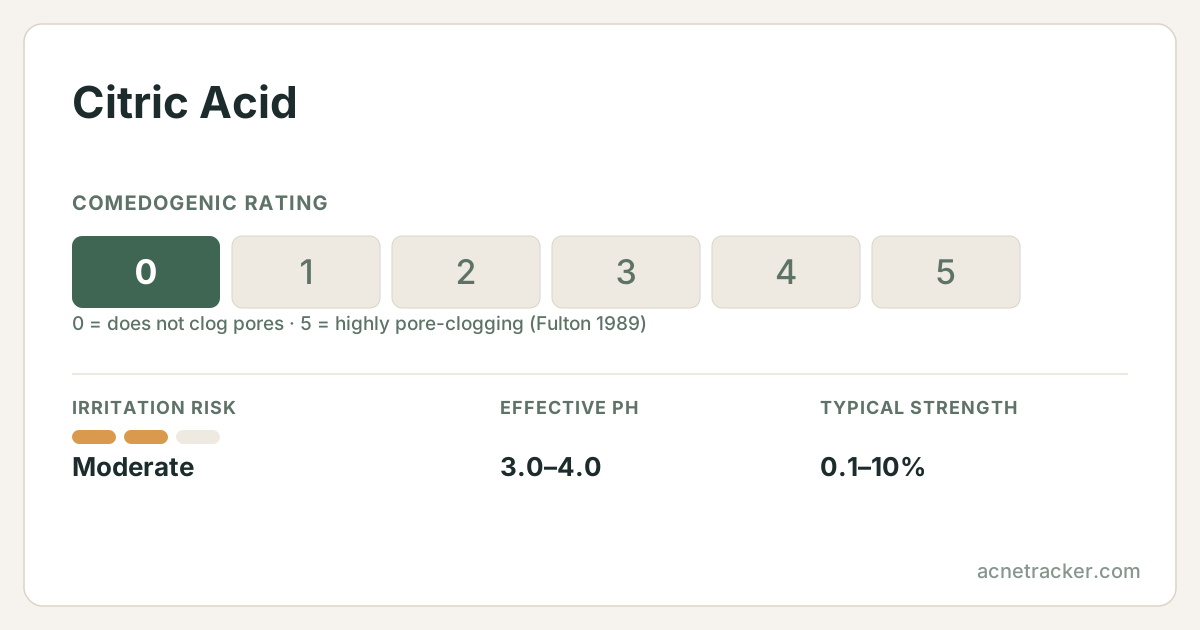
- Comedogenic rating
- our estimate — not measured
- Irritation risk
- Moderate
- Effective pH
- 3.0–4.0
- Typical strength
- 0.1–10%
- Pregnancy
- Ask your doctor
- Suits skin types
- normalcombinationoilymature
Where this number comes from
No one has published a comedogenic rating for this ingredient. Fulton's 1989 table tested about 250 raw materials and this was not among them, and we found no later study measuring it. The figure shown is our own reasoning from the ingredient's chemistry and how it is used — treat it as an estimate, not a measurement.
Fulton read his own scale as 0-1 not significant, 2-3 borderline, 4-5 positive. The assay is the rabbit ear at 10% dilution, which the paper itself calls extremely sensitive and not fully predictive of human skin. Ratings describe the raw ingredient; concentration and formulation change real-world behaviour.
Caution profile
The four published fields on this page, on one 0–5 scale. Further from the centre means more care is needed — never that the ingredient is worse.
Derived, not measured: pore-clogging is the published comedogenic rating; irritation maps low/moderate/high to 1/3/5; pregnancy maps safe/caution/avoid to 0/3/5; skin-type limits is how many of the seven skin types this entry does NOT list. Every input is printed in words in the quick-facts card above.
Show the numbers
| Metric | 0–5 | Published field |
|---|---|---|
| Pore-clogging | 0 | 0/5 |
| Irritation | 3 | Moderate |
| Skin-type limits | 2.1 | 4/7 |
| Pregnancy | 3 | Ask your doctor |
Working pH and typical strength
Where this ingredient is formulated to sit, and at what concentration.
Both bars come from the fields above: the pH window and the typical strength range published for this ingredient. The tinted column is healthy skin's surface pH (about 4.7–5.75).
Show the numbers
| Metric | 0–5 |
|---|---|
| Working pH | 3.0–4.0 |
| Typical strength | 0.1–10% |
What is it?
Citric acid is a tricarboxylic acid found abundantly in lemons, limes and other citrus fruit. Those three acid groups make it an excellent pH adjuster and buffer, which is why it turns up in so many formulations at low levels. At higher concentrations and low pH it behaves as a genuine AHA, loosening the bonds between dead surface cells to reveal smoother skin, and it is sometimes used in exfoliating blends for that purpose. It is also a chelator, binding metal ions that can destabilise formulas or drive oxidation, and it carries antioxidant capacity. So citric acid can be an exfoliant, but far more often it is there to keep a product balanced.
Benefits
Balances product pH
Its main practical role is adjusting and buffering pH, keeping a formula in the window where its active ingredients — including other acids — stay stable and effective.
Can exfoliate at strength
At higher concentrations and acidic pH, citric acid works as an AHA, loosening dead surface cells to smooth and brighten dull skin.
Chelates and stabilises
By binding stray metal ions, citric acid helps prevent the oxidation and instability that can degrade a formula over time, improving its shelf life and performance.
Antioxidant support
Citric acid contributes antioxidant activity, adding a mild protective element against the free radicals that dull and age the skin surface.
How to use
In the majority of products, citric acid is present at low levels for pH and you do not use it deliberately — you simply use the product. When it appears in an exfoliating blend at meaningful strength, treat it like any AHA: apply a few evenings a week to cleansed skin, follow with moisturiser, avoid stacking with other acids or retinol in the same routine, and wear daily sunscreen. Patch test exfoliating formulas if your skin is sensitive.
Side effects
At the tiny levels used for pH, citric acid is unlikely to cause problems. In stronger exfoliating products it behaves like other AHAs, so mild tingling is normal and overuse can cause dryness, redness and peeling. Very acidic formulas may sting sensitive skin. Stop if you develop persistent burning or a rash.
Who should avoid it
Sensitive skin should be cautious with high-strength citric acid exfoliants and may prefer gentler PHAs. During pregnancy, leave-on AHA exfoliation is generally used with caution — ask your doctor, though the trace amounts used for pH are not a concern. Avoid strong acids on a damaged barrier.
Pairs well with
Avoid combining with
Frequently asked questions
Is citric acid an exfoliant?
It can be, at higher concentrations and low pH, where it acts as an AHA. But in most products it appears in small amounts to adjust pH rather than to exfoliate.
Why is citric acid in so many products?
Mainly as a pH adjuster and buffer. Its three acid groups make it excellent at keeping a formula in the stable, effective pH range, and it also chelates metals.
Is a small amount of citric acid bad for skin?
No. At the low levels used for pH balancing, citric acid is not an exfoliating dose and is generally well tolerated. Its purpose there is to stabilise the product.
Does citric acid brighten skin?
At exfoliating strength it can help smooth and brighten dull skin by removing dead surface cells, and its antioxidant action adds a mild protective benefit.
Is citric acid safe during pregnancy?
Trace amounts used for pH are not a concern. Deliberate leave-on AHA exfoliation with citric acid is generally treated with caution, so confirm with your doctor.
Sources & further reading
Medical disclaimer
Find your personal acne triggers
Our free Acne Tracker lets you log breakouts, sleep, stress and diet, and shows you which factors correlate with your flare-ups.