Benzyl Alcohol: Comedogenic Rating & Ingredient Analysis
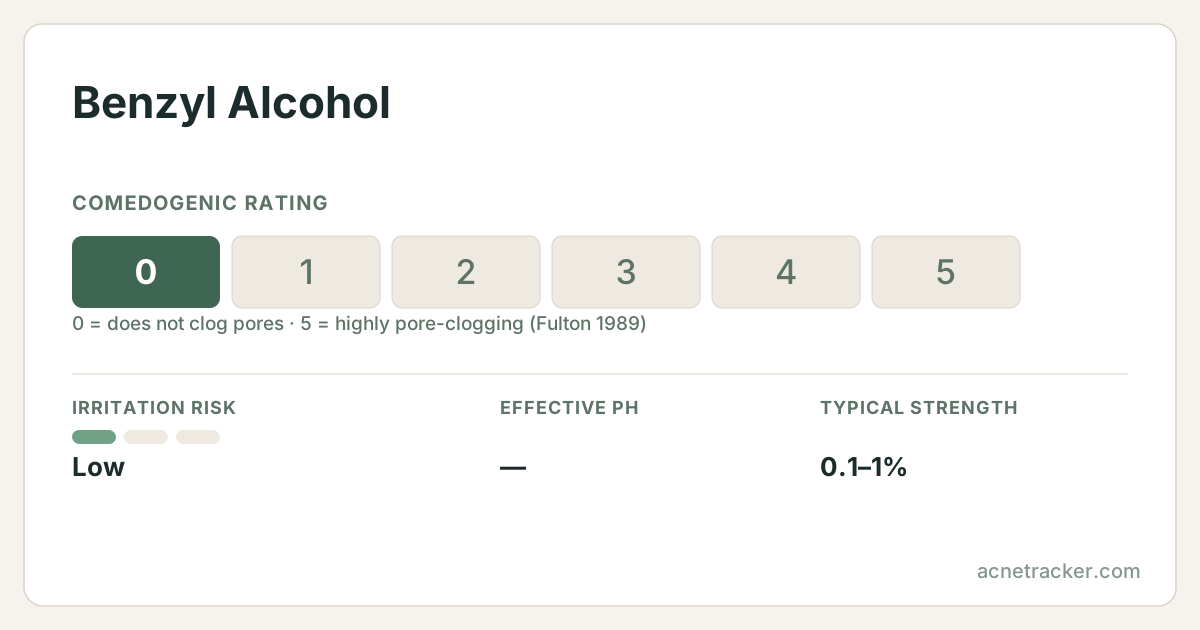
Benzyl alcohol is a multitasking cosmetic ingredient that mainly acts as a preservative, protecting products from bacteria, mould and yeast. It is a naturally occurring aromatic alcohol, found in small amounts in fruits and essential oils, and it is one of the preservatives favoured in "natural" and eco-certified skincare because it is accepted by many organic standards. It also has a faint scent, which is why the same molecule appears on the EU list of 26 declarable fragrance allergens — a detail that occasionally confuses shoppers who see it flagged as an allergen even though its primary job in most formulas is to keep the product safe to use.
Quick facts
- Comedogenic rating
- our estimate — not measured
- Irritation risk
- Low
- Effective pH
- —
- Typical strength
- 0.1–1%
- Pregnancy
- Considered safe
- Suits skin types
- oilydrycombinationsensitivenormalacne-prone
Where this number comes from
No one has published a comedogenic rating for this ingredient. Fulton's 1989 table tested about 250 raw materials and this was not among them, and we found no later study measuring it. The figure shown is our own reasoning from the ingredient's chemistry and how it is used — treat it as an estimate, not a measurement.
Fulton read his own scale as 0-1 not significant, 2-3 borderline, 4-5 positive. The assay is the rabbit ear at 10% dilution, which the paper itself calls extremely sensitive and not fully predictive of human skin. Ratings describe the raw ingredient; concentration and formulation change real-world behaviour.
Caution profile
The four published fields on this page, on one 0–5 scale. Further from the centre means more care is needed — never that the ingredient is worse.
Derived, not measured: pore-clogging is the published comedogenic rating; irritation maps low/moderate/high to 1/3/5; pregnancy maps safe/caution/avoid to 0/3/5; skin-type limits is how many of the seven skin types this entry does NOT list. Every input is printed in words in the quick-facts card above.
Show the numbers
| Metric | 0–5 | Published field |
|---|---|---|
| Pore-clogging | 0 | 0/5 |
| Irritation | 1 | Low |
| Skin-type limits | 0.7 | 6/7 |
| Pregnancy | 0 | Considered safe |
Working pH and typical strength
Where this ingredient is formulated to sit, and at what concentration.
Both bars come from the fields above: the pH window and the typical strength range published for this ingredient. The tinted column is healthy skin's surface pH (about 4.7–5.75).
Show the numbers
| Metric | 0–5 |
|---|---|
| Typical strength | 0.1–1% |
What is it?
Benzyl alcohol is an aromatic alcohol used at low concentrations, typically under 1%, to preserve water-containing products and, secondarily, as a solvent that helps dissolve other ingredients. It has broad-spectrum antimicrobial activity, though it is often paired with other preservatives to cover the full range of microbes. Despite the word "alcohol" in its name, it is not the drying, gel-type alcohol (like alcohol denat.) that some people try to avoid; it does not strip or dehydrate skin at cosmetic levels. It carries a low irritation risk and is generally well tolerated, with only a minority reacting to it as a fragrance allergen.
Benefits
Preserves the product
Its main role is antimicrobial: it prevents the growth of bacteria, mould and yeast, keeping a water-based formula safe and stable through months of use.
Accepted by natural standards
Because it occurs in nature and is permitted by many organic and eco certifications, it is a go-to preservative for brands avoiding synthetic-only systems.
Acts as a solvent
It helps dissolve and evenly distribute other ingredients, contributing to a stable, uniform texture.
Non-comedogenic and non-stripping
It does not clog pores and, unlike drying denatured alcohol, does not dehydrate the skin at the low levels used for preservation.
How to use
Benzyl alcohol is a formulation ingredient, so there is nothing to apply separately — it simply keeps your serum, cream or cleanser from spoiling. It is compatible with virtually all actives, including niacinamide, hyaluronic-acid, vitamin-c and retinol, and appears across product types. If you have very reactive skin or a known fragrance-allergen sensitivity, note that benzyl alcohol is on the declarable allergen list and patch test new products. For nearly everyone else it is a background ingredient that needs no special handling.
Side effects
Benzyl alcohol is well tolerated by the large majority of users. Because it doubles as a fragrance allergen, a small number of people can develop allergic contact dermatitis to it, appearing as localised itching or redness. At the low levels used as a preservative, irritation is uncommon. It is considered one of the gentler preservative options and is frequently chosen for sensitive-skin formulations.
Who should avoid it
Only people with a specific, confirmed allergy to benzyl alcohol need to avoid it. There is no general reason for sensitive or acne-prone skin to steer clear, and it is often the preservative of choice in products designed for reactive skin. If you have reacted to it before, check labels and choose an alternative preservative system.
Pairs well with
Frequently asked questions
Is benzyl alcohol a drying alcohol?
No. Despite its name, benzyl alcohol is an aromatic alcohol used as a preservative, not the drying denatured alcohol (alcohol denat.). It does not strip or dehydrate skin at cosmetic levels.
Why is benzyl alcohol both a preservative and an allergen?
It has antimicrobial activity that preserves products and a faint scent that places it on the EU list of 26 declarable fragrance allergens, so one molecule fills two roles on the label.
Is benzyl alcohol safe for acne-prone skin?
Yes. It has a comedogenic rating of zero and a low irritation risk, so it does not clog pores or typically trigger breakouts, making it a suitable preservative for acne-prone routines.
Is benzyl alcohol safe during pregnancy?
At the low concentrations used to preserve cosmetics it is generally considered safe during pregnancy. As always, if you have specific concerns, confirm with your doctor.
Sources & further reading
Medical disclaimer
Find your personal acne triggers
Our free Acne Tracker lets you log breakouts, sleep, stress and diet, and shows you which factors correlate with your flare-ups.