Xanthan Gum: Comedogenic Rating & Ingredient Analysis
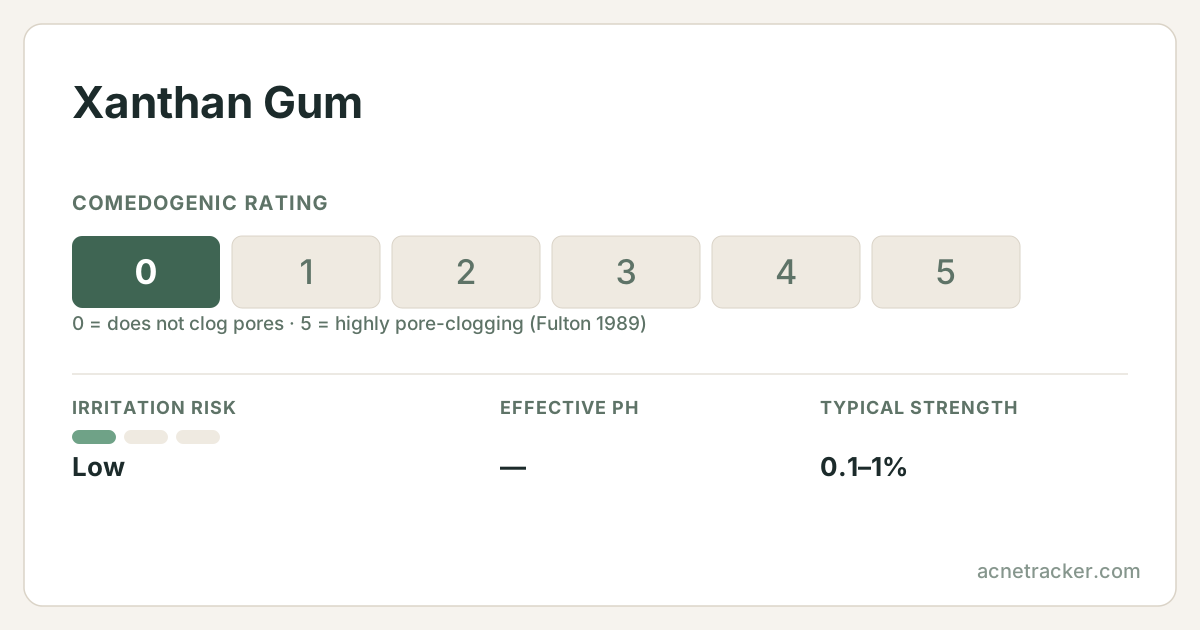
Xanthan gum is one of the most common thickeners you will find on a skincare label, yet almost no one buys a product for it. It is a natural polysaccharide produced by fermenting sugar with a bacterium called Xanthomonas campestris, and its job is textural rather than active. At fractions of a percent it turns a thin, watery mixture into a smooth gel, keeps oil and water from separating, and gives serums and gels the soft slip that makes them feel pleasant to spread. If you have ever wondered why a hyaluronic acid serum has a slightly stretchy, cushioned texture, xanthan gum is usually the reason.
Quick facts
- Comedogenic rating
- our estimate — not measured
- Irritation risk
- Low
- Effective pH
- —
- Typical strength
- 0.1–1%
- Pregnancy
- Considered safe
- Suits skin types
- oilydrycombinationsensitivenormalacne-pronemature
Where this number comes from
No one has published a comedogenic rating for this ingredient. Fulton's 1989 table tested about 250 raw materials and this was not among them, and we found no later study measuring it. The figure shown is our own reasoning from the ingredient's chemistry and how it is used — treat it as an estimate, not a measurement.
Fulton read his own scale as 0-1 not significant, 2-3 borderline, 4-5 positive. The assay is the rabbit ear at 10% dilution, which the paper itself calls extremely sensitive and not fully predictive of human skin. Ratings describe the raw ingredient; concentration and formulation change real-world behaviour.
Caution profile
The four published fields on this page, on one 0–5 scale. Further from the centre means more care is needed — never that the ingredient is worse.
Derived, not measured: pore-clogging is the published comedogenic rating; irritation maps low/moderate/high to 1/3/5; pregnancy maps safe/caution/avoid to 0/3/5; skin-type limits is how many of the seven skin types this entry does NOT list. Every input is printed in words in the quick-facts card above.
Show the numbers
| Metric | 0–5 | Published field |
|---|---|---|
| Pore-clogging | 0 | 0/5 |
| Irritation | 1 | Low |
| Skin-type limits | 0 | 7/7 |
| Pregnancy | 0 | Considered safe |
Working pH and typical strength
Where this ingredient is formulated to sit, and at what concentration.
Both bars come from the fields above: the pH window and the typical strength range published for this ingredient. The tinted column is healthy skin's surface pH (about 4.7–5.75).
Show the numbers
| Metric | 0–5 |
|---|---|
| Typical strength | 0.1–1% |
What is it?
Chemically, xanthan gum is a high-molecular-weight sugar chain that swells and tangles when dispersed in water, building a weak three-dimensional network. That network is what thickens the liquid and suspends tiny particles or oil droplets so they do not sink or float. It is the same food-grade ingredient used to thicken sauces and gluten-free baking, and it carries the food additive number E415. In cosmetics it is prized because it works at very low concentrations, tolerates a wide pH range, and is compatible with the humectants and actives it is usually paired with. It has no exfoliating, brightening or anti-acne action of its own; it is a formulation workhorse that makes the active ingredients easier to apply.
Benefits
Creates a pleasant gel texture
Even at 0.2–0.5% xanthan gum transforms a runny liquid into a cushioned gel, which is why so many hydrating serums feel smooth and cushiony rather than watery.
Keeps formulas stable
By thickening the water phase it slows the separation of oil and water and stops actives or pigments from settling to the bottom of the bottle over time.
Suspends particles evenly
It holds exfoliating grains, mineral pigments or encapsulated actives in even suspension so each pump delivers a consistent dose.
Gentle on every skin type
As an inert, non-sensitising polymer it adds no irritation of its own, making it suitable for sensitive, reactive and acne-prone skin alike.
How to use
There is nothing to do differently: xanthan gum is a background ingredient already blended into the product. It appears in serums, gels, cleansers, masks and lightweight moisturizers, usually near the middle or bottom of the ingredient list. If a gel ever feels tacky or leaves faint white pills as it dries, that is simply a formula using slightly too much gum rather than a sign of a problem — layering it with a humectant like glycerin and applying to slightly damp skin reduces the effect.
Side effects
Xanthan gum is considered non-irritating and non-comedogenic, with a comedogenic rating of 0. Allergic reactions are very rare. The only cosmetic downside is textural: overuse can make a product feel sticky or produce small crumbs (pilling) when layered under other products, but this is a formulation quirk, not a skin risk.
Who should avoid it
Effectively no one needs to avoid xanthan gum on the skin. People with an extremely rare sensitivity to fermented corn-derived ingredients could patch test, but topical reactions are almost unheard of. It is safe during pregnancy and breastfeeding.
Pairs well with
Frequently asked questions
Is xanthan gum bad for your skin?
No. It is an inert thickener with a comedogenic rating of 0 and a very low irritation profile. It does not penetrate or affect skin biology; it only changes how a product feels and stays stable.
Why is xanthan gum in my serum?
It thickens the water phase so the serum spreads smoothly, feels cushioned, and keeps its active ingredients evenly suspended instead of separating or settling at the bottom.
Does xanthan gum clog pores?
No. It sits on the surface, rinses or wears away easily, and has a comedogenic rating of 0, so it is safe for acne-prone skin.
Is xanthan gum natural?
It is naturally derived through bacterial fermentation of sugar, then purified. It is the same food-grade ingredient (E415) used to thicken sauces and gluten-free foods.
Can xanthan gum cause pilling?
Occasionally. If a formula uses a bit too much, it can roll into tiny crumbs under makeup or other layers. Applying to damp skin and waiting for it to absorb usually prevents this.
Sources & further reading
Medical disclaimer
Find your personal acne triggers
Our free Acne Tracker lets you log breakouts, sleep, stress and diet, and shows you which factors correlate with your flare-ups.