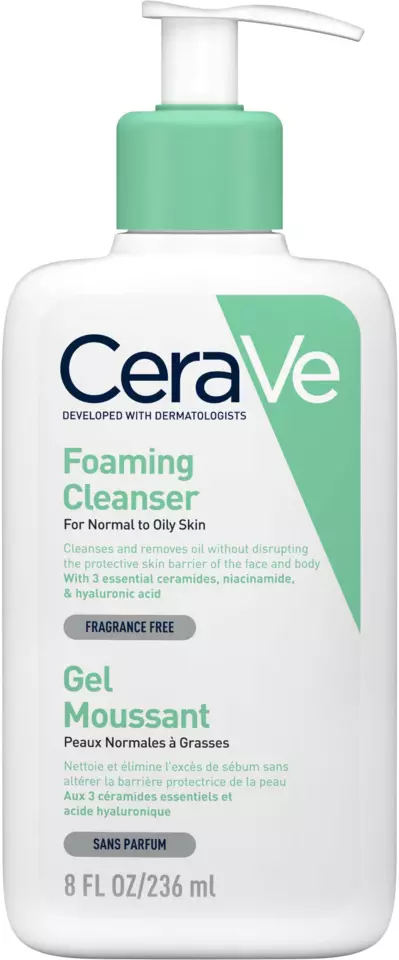
CeraVe Foaming Facial Cleanser: Ingredient Analysis
A gel-to-foam wash built on a mild surfactant blend rather than soap, with the three ceramides CeraVe puts in most of its range plus niacinamide and hyaluronic acid. The formula's whole argument is that you can clean oily skin thoroughly without stripping it, and the ingredient list supports that: the surfactants are amphoteric and amino-acid-derived rather than sulfates, and the barrier lipids are there to put back what washing takes out.
1 ingredient(s) on this list carry a higher published comedogenic rating (3+) — see the "Pore-clog" column. Remember that position on the list and formulation affect real-world behavior.
Full ingredient list, explained
| Ingredient | Function | Role | Pore-clog |
|---|---|---|---|
| Aqua / Water / Eau | Solvent | The base most water-soluble ingredients are dissolved in. | – |
| Cocamidopropyl Hydroxysultaine | Mild surfactant | A gentle amphoteric cleanser used to soften harsher surfactants in a wash. | – |
| Glycerin | Humectant | The most reliable humectant in skincare; binds water to the skin. | 0 |
| Sodium Lauroyl Sarcosinate | Surfactant | An amino-acid-derived cleanser that foams well at skin-friendly pH. | – |
| PEG-150 Pentaerythrityl Tetrastearate | Thickener | Gives a liquid cleanser body so it does not run straight off the hand. | – |
| Niacinamide | Barrier repair / Sebum regulation | Niacinamide is one of the most studied and best tolerated active ingredients in modern skincare. | 0 |
| PEG-6 Caprylic/Capric Glycerides | Emulsifier / solubiliser | Keeps oily ingredients dispersed in a water-based formula. | – |
| Sodium Methyl Cocoyl Taurate | Mild surfactant | A taurine-derived cleanser known for a soft after-feel. | – |
| Propylene Glycol | Humectant / solvent | Holds water and dissolves ingredients that water alone cannot. | 0 |
| Ceramide NP | Barrier repair / Moisture retention | Ceramides are the mortar that holds your skin barrier together. | – |
| Ceramide AP | Barrier lipid | One of the ceramide classes found in the skin's own barrier. | – |
| Ceramide EOP | Barrier lipid | A long-chain ceramide that helps hold the barrier's lipid layers together. | – |
| Carbomer | Gelling agent / Thickener | Carbomer is the invisible scaffolding behind most clear gels in your bathroom, from aloe gels and cleansing gels to lightweight moisturizers and ha… | – |
| Methylparaben | Preservative | Methylparaben is a preservative from the paraben family and one of the most mischaracterised ingredients in skincare. | 0 |
| Sodium Chloride | Viscosity control | Common salt, used to thicken surfactant systems. | 5 |
| Sodium Lauroyl Lactylate | Emulsifier | A lactic-acid-derived emulsifier that also conditions the surface. | – |
| Cholesterol | Barrier repair / Emollient | Cholesterol has an unfairly bad reputation from heart-health headlines, but on the skin it is essential. | 0 |
| Disodium EDTA | Chelating agent / Stabiliser | Disodium EDTA is a chelating agent, a type of ingredient whose job is to grab hold of metal ions in a formula and hold them inactive. | – |
| Propylparaben | Preservative | A paraben preservative, permitted in the EU at restricted levels. | 0 |
| Citric Acid | pH adjustment / Chemical exfoliation | Citric acid is one of the most common ingredients on skincare labels, but its role is often misunderstood. | – |
| Tetrasodium EDTA | Chelating agent | Binds trace metal ions so the formula stays stable. | – |
| Hydrolyzed Hyaluronic Acid | Humectant | A smaller-molecule hyaluronic acid that binds water at the surface. | – |
| Phytosphingosine | Barrier repair / Antimicrobial | Phytosphingosine is a lipid that punches above its weight in skincare. | – |
| Xanthan Gum | Thickener / stabilizer | A fermentation-derived gum that thickens and stabilizes. | – |
Open this full list in the comedogenic checker
Ingredient list copied from the brand's own page on 2026-08-27. Formulations change without notice and vary by region — the brands say so themselves. Check the list on your own package before relying on this. CeraVe — Foaming Facial Cleanser (official product page)
Who it's for
Oily and combination skin that wants a proper wash rather than a milky cleanser. It is the higher-foam sibling of the Hydrating Facial Cleanser, and the choice between them is mostly about how much your skin tolerates surfactant. If your face feels tight ten minutes after washing, that is the signal to move to the hydrating version, whatever the label says about your skin type.
How to use it
Use morning and evening on damp skin, massaging for 30 to 60 seconds so the surfactants have working time, then rinse. If you wear sunscreen or makeup, an oil or balm first step does the dissolving and lets this finish gently. It is a wash, not a treatment: the niacinamide and ceramides have seconds of contact time, so treat them as a sign of a considered formula rather than the reason to buy it.
Frequently asked questions
Does the paraben content matter?
This formula uses methylparaben and propylparaben. Both are permitted in the EU at restricted concentrations and are among the best-studied cosmetic preservatives. If you prefer to avoid them the Hydrating Facial Cleanser is the same brand's paraben-free option — but the choice is a preference, not a safety correction.
Will it clog pores?
Nothing in the list carries a comedogenic rating of 3 or above in our database, and it is a rinse-off product, so contact time is seconds. Pore-clogging is largely the wrong question for a cleanser; irritation from over-washing is the more realistic risk.
Is the niacinamide in it doing anything?
Very little. Niacinamide needs to sit on skin to work, and this is rinsed off within a minute. It signals a formula designed around the barrier, but if you want niacinamide's effects you need it in a leave-on product.
How does it differ from the Hydrating Facial Cleanser?
This one foams and uses a surfactant system built for oil removal. The hydrating version has no foaming surfactants at the top of its list and leans on cetearyl and cetyl alcohol instead, so it cleans more gently and leaves more behind.
Is it suitable for acne-prone skin?
As a base cleanser, yes — it is fragrance-free and does not strip. It contains no acne actives, so it is the thing you wash with before your treatment, not the treatment itself.
Sources & further reading
- Ingredient list sourced from: CeraVe — Foaming Facial Cleanser (official product page)
Medical disclaimer
Find your personal acne triggers
Our free Acne Tracker lets you log breakouts, sleep, stress and diet, and shows you which factors correlate with your flare-ups.