How to Choose a Face Oil for Fungal Acne
This page has an unusual conclusion, so it belongs at the top: for Malassezia folliculitis — the itchy, uniform, monomorphic bumps commonly called fungal acne — almost no face oil is a good idea. The yeast lives on skin normally, but it cannot make its own fatty acids and must harvest them from its surroundings using lipases. Nearly every plant oil is a triglyceride built from exactly the chain lengths it can use, which means most face oils are food. There is one clean exception, and a couple of qualified ones. If you came here for a list of nourishing botanical oils, the honest answer is that this is the one category where the answer is mostly no.
Ingredients to look for
| Ingredient | Why it matters |
|---|---|
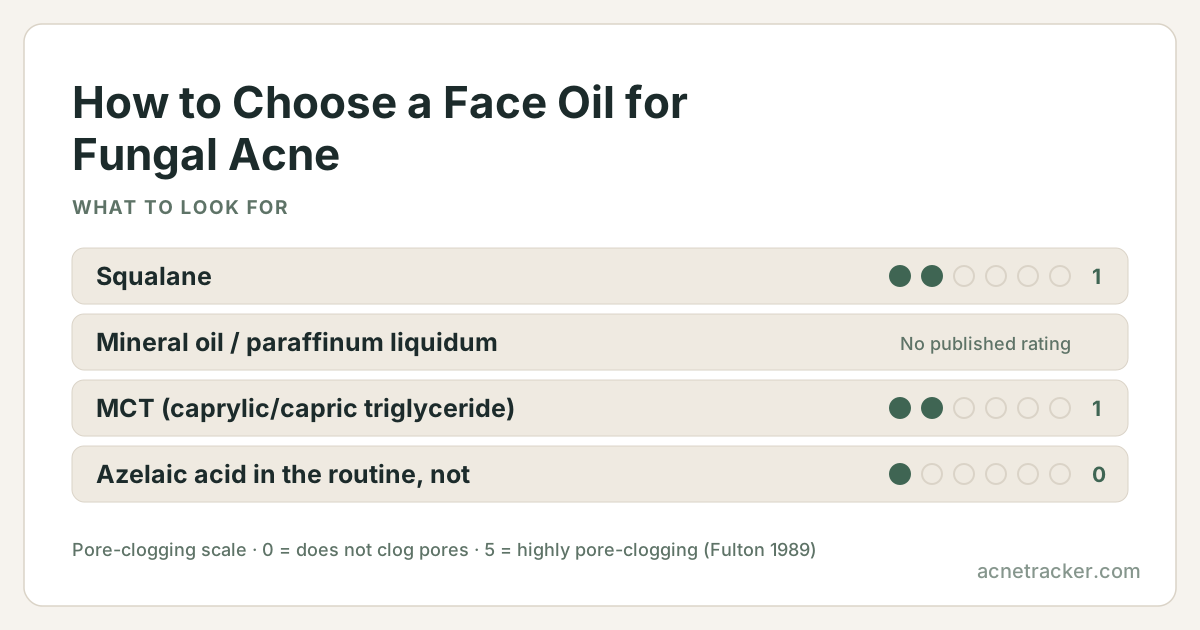
| Squalane | The exception. It is a saturated hydrocarbon, not a triglyceride — no fatty acid chains, nothing for Malassezia lipases to cleave. Fulton rates it 1. |
| Mineral oil / paraffinum liquidum | Also a hydrocarbon rather than a fat, so it is not a substrate either. Cosmetically unfashionable, chemically the most inert occlusive available. |
| MCT (caprylic/capric triglyceride) — with caution | Its C8 and C10 chains fall below the range Malassezia typically uses, but it is still a triglyceride and reports are mixed. Squalane is the safer default. |
| Azelaic acid in the routine, not in the oil | It has documented activity against Malassezia and is used in seborrhoeic conditions — an actual active, where an oil is only a barrier support. |
| A short ingredient list generally | Fewer esters and fewer botanical extracts means fewer chances that something in the blend falls in the C11–C24 window. |
Ingredients to avoid
| Ingredient | Why it matters |
|---|---|
| Essentially all plant triglyceride oils | Olive, coconut, jojoba, argan, rosehip, marula, avocado, hemp, sunflower — all are built from fatty acids in the range Malassezia metabolises. Non-comedogenic is not the same as fungal-safe. |
| Fatty esters (isopropyl myristate, isopropyl palmitate, ethylhexyl palmitate) | Esters of the same mid-chain fatty acids; several are also comedogenic in Fulton's data, with isopropyl myristate at 5. |
| Fatty alcohols and polysorbates | Cetyl, stearyl and cetearyl alcohol are commonly reported as triggers, as is polysorbate 60, which is partly an ester of the relevant chain lengths. |
| Fermented and yeast-derived ingredients | Galactomyces and similar ferments are frequently reported to aggravate this condition, though the evidence here is anecdotal rather than trial data. |
How to choose
The mechanism gives you a rule you can apply to any label. Malassezia species depend on external lipids and use fatty acids in roughly the C11 to C24 range; they cannot use very short chains, and they cannot use pure hydrocarbons. So the question is never 'is this oil natural or gentle', it is 'does this molecule contain a fatty acid chain in that window'. Squalane and mineral oil pass because they contain no fatty acid at all. Almost everything else in the oil aisle fails, regardless of how it is marketed. Two caveats matter. First, this is a fungal condition, which means the actual treatment is antifungal — ketoconazole or selenium sulfide, discussed with a pharmacist or doctor — and not an oil choice. Second, the diagnosis itself is frequently wrong: uniform itchy bumps that ignore acne treatment are suggestive, but a doctor confirming it saves you months of guessing. If your bumps are varied in size, come with blackheads and do not itch, this is probably ordinary acne and this page's restrictions do not apply to you.
How to apply
If you use squalane, keep it simple: two to three drops on damp skin at night, with nothing else oily layered around it. The point is to give the barrier some support during antifungal treatment, which is often drying. Introduce it while the antifungal is already working, not before, so you can tell what is doing what. Watch the whole routine, not just the oil — a fungal-safe oil over a moisturiser full of fatty esters achieves nothing. And accept that oils are optional here; skipping them entirely is a perfectly reasonable strategy.
Frequently asked questions
Is any plant oil safe for fungal acne?
Effectively no. Every common plant oil is a triglyceride made of fatty acids in the range Malassezia can metabolise. Squalane, which can be plant-derived from sugarcane or olives, is safe because it is a hydrocarbon rather than a fat.
Why is squalane fungal-safe when olive oil is not?
Squalane has no fatty acid chains for the yeast's lipases to cleave — it is pure saturated hydrocarbon. Olive oil is a triglyceride of oleic acid, a C18 fatty acid that sits squarely inside the range Malassezia uses.
Is MCT oil fungal acne safe?
Contested. Its C8 and C10 chains are shorter than the range usually cited, which is the argument for it, but it is still a triglyceride and user reports disagree. If you want certainty rather than an argument, use squalane.
Does a non-comedogenic rating mean an oil is fungal-safe?
No, and conflating the two causes a lot of frustration. Comedogenicity is about physically plugging a follicle; fungal-safety is about whether a yeast can eat the molecule. Jojoba is rated 0 and still feeds Malassezia.
Should I be treating this with skincare at all?
Skincare choices reduce the fuel, but they are not the treatment. Malassezia folliculitis responds to antifungals, and it is worth having a doctor confirm the diagnosis before you rebuild your entire routine around it.
Sources & further reading
There is no single study of this exact question. The guidance here is reasoned from the ingredient profiles below, each of which carries its own references:
- Squalane3 refs
- Caprylic/Capric Triglyceride2 refs
- Azelaic Acid3 refs
Show every reference behind this page (6)
- PubChem — Squalane compound summarycited by Squalane
- DermNet — Emollients and moisturiserscited by Squalane
- European Commission CosIng database — Squalanecited by Squalane, Caprylic/Capric Triglyceride, Azelaic Acid
- Cosmetic Ingredient Review — Caprylic/Capric Triglyceridecited by Caprylic/Capric Triglyceride
- PubChem — Azelaic acid compound summarycited by Azelaic Acid
- DermNet — Azelaic acidcited by Azelaic Acid
Medical disclaimer
Ingredients mentioned on this page
Find your personal acne triggers
Our free Acne Tracker lets you log breakouts, sleep, stress and diet, and shows you which factors correlate with your flare-ups.