How to Choose a Face Mask for Fungal Acne
Fungal acne is not acne. Malassezia folliculitis is an overgrowth of a yeast that lives on everyone's skin, producing uniform itchy bumps of a similar size — typically on the forehead, chest, back and shoulders — with no blackheads or whiteheads among them. That distinction determines everything on this page, because Malassezia eats. It metabolises fatty acids roughly eleven to twenty-four carbons long and the esters built from them, which are the backbone of the majority of cosmetic formulas. So the honest headline is uncomfortable for a buying guide: most masks are not merely unhelpful here, they are food. The safe list is short, and the two entries on it are the two the marketing likes least.
Ingredients to look for
| Ingredient | Why it matters |
|---|---|
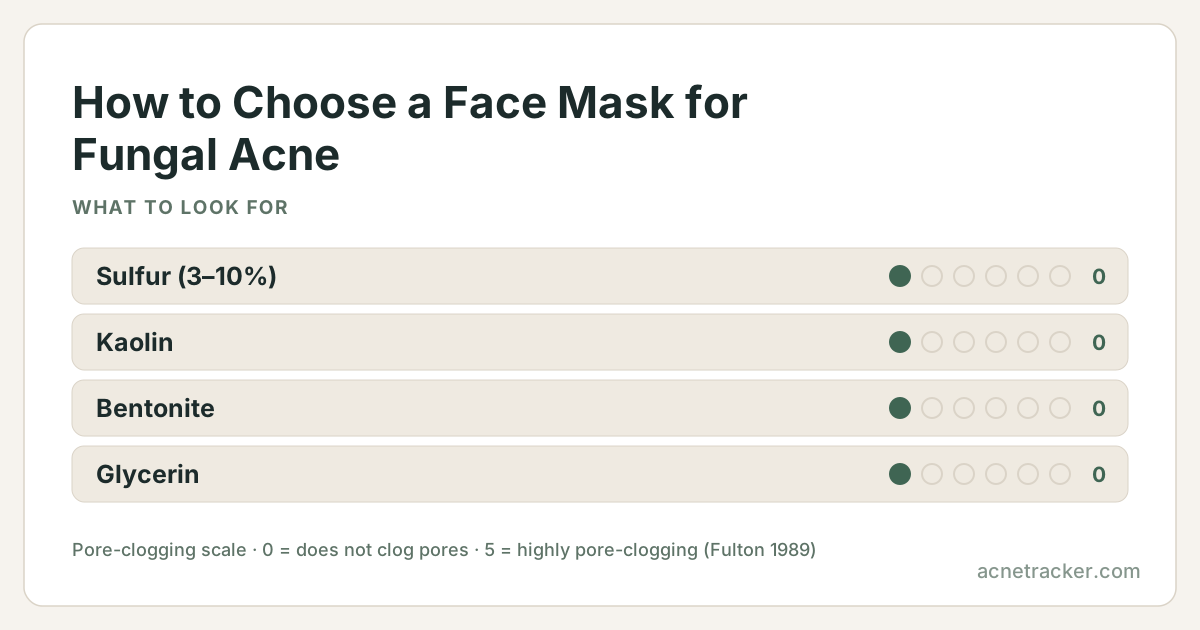
| Sulfur (3–10%) | The most defensible option in the category — antifungal, keratolytic, and free of the lipids the yeast feeds on. Fulton rates precipitated sulfur 0 and the water-soluble form 3. |
| Kaolin | A mineral, so there is nothing in it for Malassezia to metabolise. It also absorbs the surface sebum the yeast lives in. Fulton rates it 0. |
| Bentonite | Same logic and more absorbency. Both clays are inert as far as the yeast is concerned, which in this category is a rare and valuable property. Fulton rates it 0. |
| Glycerin | A safe humectant — it is not a fatty acid or an ester, so it is not on the menu. Useful for keeping a clay mask from over-drying you. |
| Squalane | The one emollient generally considered safe here: a saturated hydrocarbon with no ester bond and no usable fatty acid chain. Fulton rates it 1. |
| Urea | Humectant and keratolytic, and not a lipid. It has no published rating in Fulton's table, so we do not claim one. |
Ingredients to avoid
| Ingredient | Why it matters |
|---|---|
| Any plant oil or butter | Coconut, olive, jojoba, argan, shea, rosehip and the rest are triglycerides of exactly the fatty acids Malassezia metabolises. This is not about comedogenicity — a rating of 0 tells you nothing about whether it feeds a yeast. |
| Esters (isopropyl myristate, cetyl palmitate, caprylic/capric triglyceride…) | The largest hidden category, since these are texture ingredients rather than hero ones and they sit unread in the middle of the list. If a name ends in -ate and reads as a fatty acid, assume it is food. |
| Polysorbates and PEG fatty-acid esters | Emulsifiers built on fatty acids, present in a great many gel and cream masks. Polysorbate 20 and 80 in particular slip past most people's checks. |
| Sheet mask essences without checking every line | Sheet essences are dense with esters and plant extracts, and the format holds them against your skin under occlusion for twenty minutes. Of all formats, this is the worst risk-to-benefit trade here. |
| Fermented and yeast-derived ingredients, if you react | Galactomyces and similar ferments are debated rather than settled — the evidence is not strong either way. Given the format, caution is cheap and the mask is not worth a flare. |
How to choose
Read every line of the ingredient list, not the front of the box, because there is no shortcut and no reliable claim to lean on. 'Non-comedogenic' is not the same as Malassezia-safe: comedogenicity is about follicular plugging and this is about feeding a yeast, and plenty of ingredients rated 0 by Fulton are freely metabolised by Malassezia. 'Oil-free' is no better, since esters and polysorbates are not oils by the label's definition but are still food. Work down the list and reject on the first fatty acid, ester or plant oil you find. What survives is close to two things: a clay mask, and a sulfur mask. Both are honest options. Then set expectations, because a mask cannot resolve this. Malassezia folliculitis is usually treated with antifungals — a topical azole or a ketoconazole shampoo used as a short-contact wash, and oral antifungals for stubborn cases — and those come from a pharmacist or a doctor, not from this aisle. A sulfur mask twice a week is a reasonable adjunct alongside real treatment. Also worth knowing: it recurs. The yeast is normal flora, and heat, sweat, occlusion and humidity bring it back. If your bumps are itchy, uniform and not responding within a few weeks, ask a doctor rather than escalating your mask — many people spend months treating this as acne, and acne treatments do not touch it.
How to apply
Use a sulfur or clay mask on the affected areas twice a week at most, and remember the trunk: forehead, chest, back and shoulders are the usual sites and are frequently ignored in favour of the face. Rinse with lukewarm water and follow with a Malassezia-safe moisturiser, or you will fix one problem and create dryness. Shower and change out of damp clothing promptly after exercise — sweat and occlusion are the conditions the yeast thrives in, and no mask outpaces a wet t-shirt worn all afternoon.
Frequently asked questions
Are clay masks safe for fungal acne?
Yes, and they are one of the few safe options. Clay is a mineral, so it contains nothing Malassezia can metabolise, and it absorbs the surface sebum the yeast lives in. Just check the rest of the formula — the base often contains esters the clay does not.
Is 'non-comedogenic' the same as fungal-acne safe?
No, and this is the most expensive misunderstanding in the topic. Comedogenicity ratings describe follicular plugging. Malassezia safety is about whether an ingredient is metabolisable. Many ingredients rated 0 are perfectly good food for the yeast.
Can I use a sheet mask with fungal acne?
Almost never, unless you have read every ingredient and none is a fatty acid, an ester or a plant extract you cannot verify. Sheet essences are ester-rich and the format seals them against the skin. The risk-to-benefit ratio is poor.
Why did my fungal acne get worse after a hydrating mask?
Most likely because it fed the yeast. Hydrating masks are usually built on esters and emulsifiers even when they read as light and oil-free, and twenty minutes of occlusion is ideal conditions for Malassezia.
Do masks treat Malassezia folliculitis?
No. Treatment is antifungal — typically a topical azole or an antifungal shampoo used as a short-contact wash, and oral options for persistent cases, decided with a pharmacist or doctor. A sulfur mask supports that; it does not replace it.
Sources & further reading
There is no single study of this exact question. The guidance here is reasoned from the ingredient profiles below, each of which carries its own references:
Show every reference behind this page (11)
- FDA OTC monograph — acne drug products (sulfur 3–10%)cited by Sulfur
- PubChem — Sulfur (CID 5362487)cited by Sulfur
- European Commission CosIng database — Kaolincited by Kaolin, Bentonite, Glycerin, Squalane
- PubChem — Kaolincited by Kaolin
- Fulton JE. Comedogenicity and irritancy of commonly used ingredients in skin care products. J Soc Cosmet Chem 40:321–333 (1989) — Table I, pp. 324–326 (source of the comedogenic rating)cited by Kaolin, Bentonite
- PubChem — Bentonitecited by Bentonite
- PubChem — Glycerol compound summarycited by Glycerin
- DermNet — Moisturiserscited by Glycerin, Squalane
- PubChem — Squalane compound summarycited by Squalane
- PubChem — Ureacited by Urea
- DermNet — Emollients and moisturiserscited by Urea
Medical disclaimer
Ingredients mentioned on this page
Find your personal acne triggers
Our free Acne Tracker lets you log breakouts, sleep, stress and diet, and shows you which factors correlate with your flare-ups.