How to Choose a Micellar Water for Fungal Acne
Fungal acne — more accurately Malassezia folliculitis — is driven by a yeast that lives on everyone's skin but overgrows in some, producing uniform itchy bumps rather than true acne. Because the yeast feeds on certain fatty acids and their esters, people managing it often screen their products for ingredients that might feed it, and cleansers are no exception. Micellar water looks simple, but some formulas carry fatty-acid esters or polysorbates that Malassezia-reactive users prefer to flag. This page explains how to read a micellar water with fungal acne in mind, which components are worth scrutinising, and the honest limits of what a wiped-off cleanser can do. We describe ingredient profiles, not brands, and note where the evidence is individual rather than settled — self-diagnosis has limits, and persistent bumps deserve a professional look.
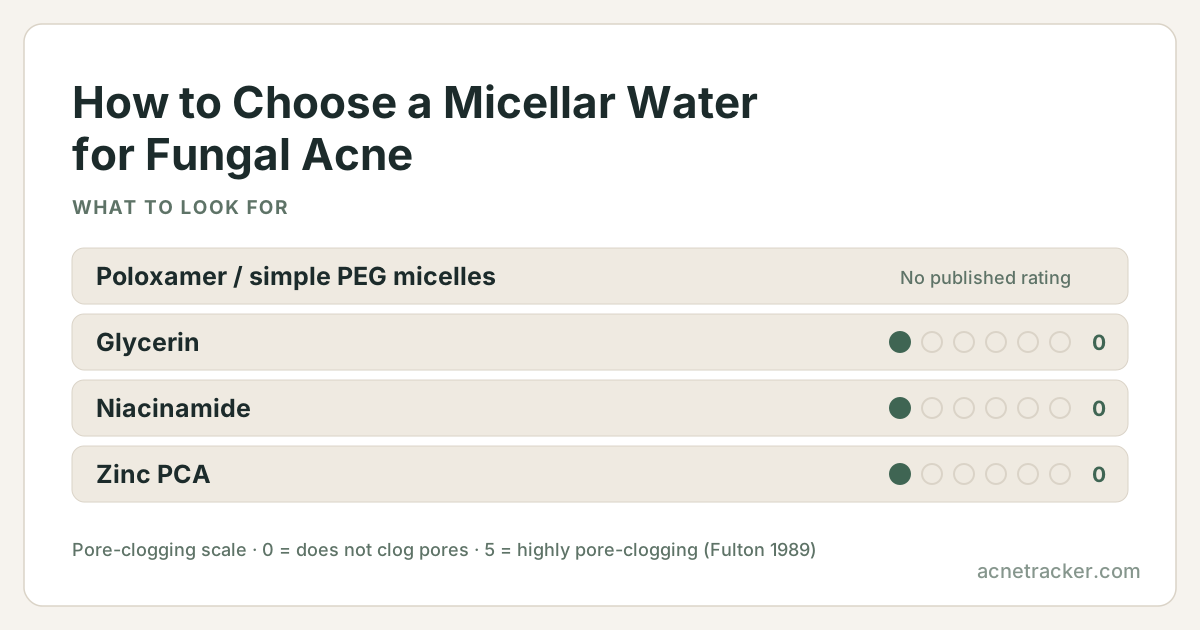
Ingredients to look for
| Ingredient | Why it matters |
|---|---|
| Poloxamer / simple PEG micelles | A short surfactant system based on poloxamers or simple PEG types cleans without adding the rich lipids that some Malassezia-reactive skin prefers to avoid. |
| Glycerin | A humectant with no fatty-acid content, so it keeps skin comfortable without feeding the yeast associated with fungal acne. |
| Niacinamide | A bonus in a wiped-off product; it is popular in fungal-acne routines for its barrier support, though the cleanser's contact time is brief. |
| Zinc PCA | A soothing, lightly sebum-balancing addition that suits the oily, congested skin fungal acne often appears on. |
| Pentylene glycol | A glycol humectant and mild preservative-booster with no fatty ester content, a neutral choice for fungal-acne-prone skin. |
Ingredients to avoid
| Ingredient | Why it matters |
|---|---|
| Fatty-acid esters (isopropyl myristate, glyceryl stearate, many '-ate' oils) | These are exactly the lipid types Malassezia can metabolise, so fungal-acne-prone users commonly avoid them even in a cleanser. |
| Polysorbates (polysorbate 20, 60, 80) | Some Malassezia-reactive people react to polysorbates; they are worth flagging on the label even though tolerance varies. |
| Added fragrance and essential oils | Fragrance adds irritation risk without cleansing benefit, and some plant oils contain fatty acids best avoided here. |
| Rich plant butters and oils in the formula | Oil-heavy micellar or bi-phase removers can leave a fatty residue that some fungal-acne-prone skin does not tolerate. |
How to choose
Read a fungal-acne micellar water ingredient by ingredient, because the concern here is specific chemistry rather than harshness. Favour a short list built on water, a poloxamer or simple PEG surfactant, a fatty-acid-free humectant like glycerin or pentylene glycol, and a preservative. Scan for fatty-acid esters — names ending in '-ate' such as isopropyl myristate or glyceryl stearate — and for polysorbates, since these are the components Malassezia-reactive users most often flag; whether you avoid them depends on your own tolerance, which is worth testing deliberately. Skip fragrance and oil-rich formulas. Be realistic about scope: fungal acne is a proliferation of yeast, and no cleanser treats it — that is the job of antifungal actives, which a doctor or pharmacist can advise on. A well-chosen micellar water simply avoids adding fuel while you clean, and pairs sensibly with the rest of a stripped-back, low-lipid routine. If bumps persist or spread, get them properly assessed rather than guessing.
How to apply
Saturate the pad and wipe once gently — friction offers no benefit here and can irritate inflamed follicles. Because fungal acne often sits on the forehead, chest and back as well as the face, use a fresh pad per area so you are not moving yeast and oil around. Follow with a light rinse if the formula contains anything you are unsure about, then apply only fungal-acne-safe leave-on products. Keep the routine minimal while you work out your triggers; a shorter product list makes it far easier to tell what your skin tolerates. Avoid re-using pads or cloths, which can harbour residue.
Frequently asked questions
Can micellar water treat fungal acne?
No. Fungal acne is an overgrowth of Malassezia yeast, and a wiped-off cleanser cannot resolve it. Micellar water only cleans; treatment means antifungal actives, so persistent or spreading bumps should be assessed by a doctor or pharmacist.
Which micellar water ingredients feed fungal acne?
Fatty-acid esters — many ingredients ending in '-ate' such as isopropyl myristate — and, for some people, polysorbates are the components Malassezia can use or react to. Fungal-acne-prone users commonly flag these, though individual tolerance varies.
Is plain micellar water fungal-acne safe?
Often, if it is a short, fragrance-free, oil-free formula without fatty esters or polysorbates. But 'safe' is individual with fungal acne, so read the full list and, ideally, patch-test one product at a time to learn your own triggers.
Should I rinse micellar water off if I have fungal acne?
A light rinse is sensible whenever a formula contains anything you are unsure about, so nothing questionable lingers on congested follicles. If the ingredient list is genuinely minimal and fatty-ester-free, leaving it on is usually fine.
Can micellar water make fungal acne worse?
It can if it contains fatty-acid esters, polysorbates or plant oils that your skin reacts to, since these may feed or irritate the yeast. A stripped-back formula avoids that, but no cleanser substitutes for antifungal treatment when the condition is active.
Sources & further reading
There is no single study of this exact question. The guidance here is reasoned from the ingredient profiles below, each of which carries its own references:
- Glycerin3 refs
- Niacinamide2 refs
- Zinc PCA3 refs
- Pentylene Glycol3 refs
Show every reference behind this page (8)
- PubChem — Glycerol compound summarycited by Glycerin
- DermNet — Moisturiserscited by Glycerin
- European Commission CosIng database — Glycerincited by Glycerin, Niacinamide, Zinc PCA, Pentylene Glycol
- Niacinamide: mechanisms of action and its topical use in dermatology (PubMed)cited by Niacinamide
- PubChem — Zinc PCA (zinc pyrrolidone carboxylate)cited by Zinc PCA
- Zinc l-pyrrolidone carboxylate inhibits the UVA-induced production of matrix metalloproteinase-1 by in vitro cultured skin fibroblasts, whereas it enhances their collagen synthesis (PubMed)cited by Zinc PCA
- PubChem — Pentylene Glycol (1,2-Pentanediol, CID 93000)cited by Pentylene Glycol
- Margin of safety of pentylene glycol derived using measurements of cutaneous absorption and volatility (PubMed)cited by Pentylene Glycol
Medical disclaimer
Ingredients mentioned on this page
Find your personal acne triggers
Our free Acne Tracker lets you log breakouts, sleep, stress and diet, and shows you which factors correlate with your flare-ups.