How to Choose a Face Oil for Dull Skin
Dullness is optics before it is biology. Smooth, well-hydrated skin reflects light in one direction and reads as luminous; rough, dehydrated, dead-cell-laden skin scatters it in every direction and reads as flat. That is why face oils produce such an immediate result here — they fill the microscopic gaps in the surface and restore a coherent reflection, sometimes within seconds. It is also why the effect is superficial in the literal sense. This page is honest about that division: what an oil genuinely does for radiance, and which parts of dullness need something else entirely.
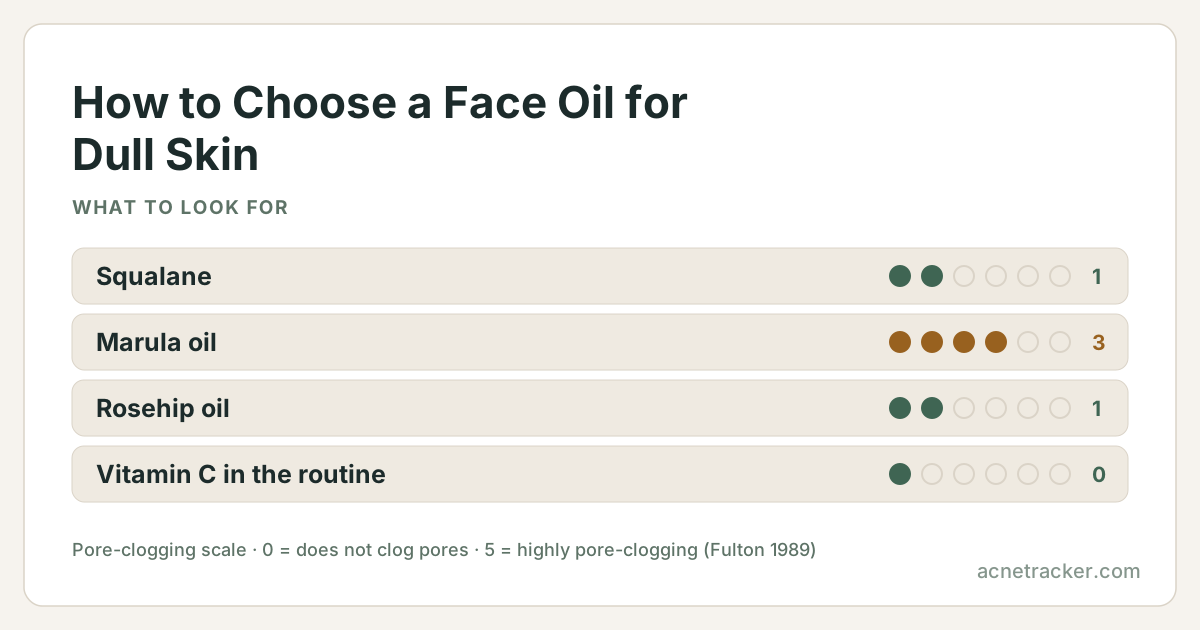
Ingredients to look for
| Ingredient | Why it matters |
|---|---|
| Squalane | Produces a satin finish rather than a greasy shine, absorbs cleanly, and does not oxidise. Fulton rates it 1, so almost any skin type can use it for this. |
| Marula oil | Oleic-rich and light-scattering in a flattering way; it stays on the surface long enough to keep the glow. Not rated by Fulton, so treat it as unrated. |
| Rosehip oil | Fast-absorbing and rich in polyunsaturated fatty acids; gives luminosity without the wet look that heavier oils leave under indoor lighting. |
| Vitamin C in the routine | The glow the oil creates is optical; vitamin C addresses the pigment and antioxidant side of dullness, which is the part an oil cannot reach. |
| Argan oil | The classic middle option — enough substance to smooth a rough surface, light enough not to look greasy on camera or in daylight. |
Ingredients to avoid
| Ingredient | Why it matters |
|---|---|
| Oil as a substitute for exfoliation | If dullness comes from a build-up of dead cells, the oil makes them shine rather than removing them. The glow lasts hours; the roughness stays. |
| Heavy oils in the morning | Under daylight and makeup, a thick oleic oil reads as grease rather than glow, and it will slide your foundation off by lunchtime. |
| 'Illuminating' oils with mica or shimmer | These are cosmetic light-reflecting particles. They are fine as makeup, but they are not doing anything for your skin — do not pay treatment prices for them. |
| Oil over an unexfoliated, flaking surface | Oil on flakes accentuates them by darkening and highlighting each one. Sort the texture first, then add the oil. |
How to choose
Diagnose the dullness before you buy anything. If your skin is rough to the touch, the problem is texture and an exfoliant is what you need — the oil will only glaze it. If your skin is smooth but flat and tired-looking, that is dehydration and surface lipid loss, and this is exactly the case an oil solves. If it is grey or sallow rather than flat, look at pigment, sun damage, sleep and smoking; an oil will not touch any of those. Once you know you have the right problem, choose for finish rather than richness: a light, fast-absorbing oil gives a satin glow, while a heavy one gives shine, and the two look very different in daylight. Look also for tocopherol, which keeps the oil fresh and adds antioxidant support, and skip anything with added shimmer — glow is a property of your skin's surface, not a particle you can buy. Finally, put the oil onto damp skin: a dry application gives you a slick, a damp one gives you the reflection you were after.
How to apply
Timing is what separates glow from grease. Apply two or three drops to slightly damp skin at night and it absorbs fully, leaving the surface smooth by morning. If you want visible radiance during the day, one drop pressed on after moisturiser and before makeup — or mixed into your foundation — gives the reflection without the slick. Never apply it over dry flakes: exfoliate gently first, twice a week, then let the oil do the optical work. On a face with visible texture, a good chemical exfoliant plus a light oil beats any amount of oil on its own.
Frequently asked questions
Does face oil actually make skin glow?
Yes, but optically. It smooths the microscopic irregularities that scatter light, so your skin reflects coherently instead of diffusely. That is a genuine visible effect — just not a change in the skin itself.
What is the difference between glow and shine?
Glow is even light reflecting off smooth skin; shine is light bouncing off a layer of oil sitting on top. Light, fast-absorbing oils tend toward glow, and heavy oleic oils tend toward shine.
Should I exfoliate or use oil for dull skin?
Both, in that order, if your skin is rough. Exfoliation removes the dead cells causing the scatter; the oil then smooths what remains. Oil over an unexfoliated surface just makes the roughness glossy.
Can I mix face oil into my foundation?
Yes, and it is one of the better uses for it. One drop thins the coverage and gives a lit-from-within finish. Use a light oil — a heavy one will break down the foundation and slide it around by midday.
Sources & further reading
There is no single study of this exact question. The guidance here is reasoned from the ingredient profiles below, each of which carries its own references:
- Squalane3 refs
- Marula Oil3 refslimited evidence
- Rosehip Oil3 refs
- Vitamin C3 refs
- Argan Oil3 refs
The ingredients below are described here on the basis of laboratory, systemic or traditional-use sources rather than trials of topical use. Advice on this page that depends on them is correspondingly less certain.
- Marula Oil — Marula oil's fatty-acid profile is well characterised, and its emollient behaviour follows directly from that composition. The antioxidant and barrier-support descriptions come from analyses of the oil's constituents and from research on marula as a food and traditional medicine — not from trials of the oil applied to human skin, of which we found none.
Show every reference behind this page (10)
- PubChem — Squalane compound summarycited by Squalane
- DermNet — Emollients and moisturiserscited by Squalane
- European Commission CosIng database — Squalanecited by Squalane, Marula Oil, Rosehip Oil, Vitamin C, Argan Oil
- PubChem — Oleic acid (major marula fatty acid)cited by Marula Oil, Argan Oil
- Marula [Sclerocarya birrea (A. Rich.) Hochst.] products as a food and medicine (PubMed)cited by Marula Oil
- PubChem — Linoleic acid (major rosehip fatty acid)cited by Rosehip Oil
- Safety Assessment of Rosa canina-derived Ingredients as Used in Cosmetics (PubMed)cited by Rosehip Oil
- PubChem — Ascorbic Acid compound summarycited by Vitamin C
- DermNet — Topical vitamin Ccited by Vitamin C
- Insights on Phytochemistry and Pharmacological Properties of Argania spinosa L. Skeels: A Comprehensive Review (PubMed)cited by Argan Oil
Medical disclaimer
Ingredients mentioned on this page
Find your personal acne triggers
Our free Acne Tracker lets you log breakouts, sleep, stress and diet, and shows you which factors correlate with your flare-ups.