How to Choose a Face Oil for Acne-Prone Skin
There is a real reason acne-prone skin gets recommended oils at all, and it is not marketing. Work by Downing and colleagues in the 1980s on sebum composition found that the sebum of acne-prone skin tends to be relatively poor in linoleic acid, and that this dilution correlates with the abnormal keratinisation seen inside a forming comedone. That does not make any oil a treatment, and nothing on this page will clear acne on its own. But it does explain why oil choice for this skin type is not arbitrary: the linoleic-rich oils are the plausible ones, and the oleic-rich oils are the ones dermatology forums keep filling with breakout stories.
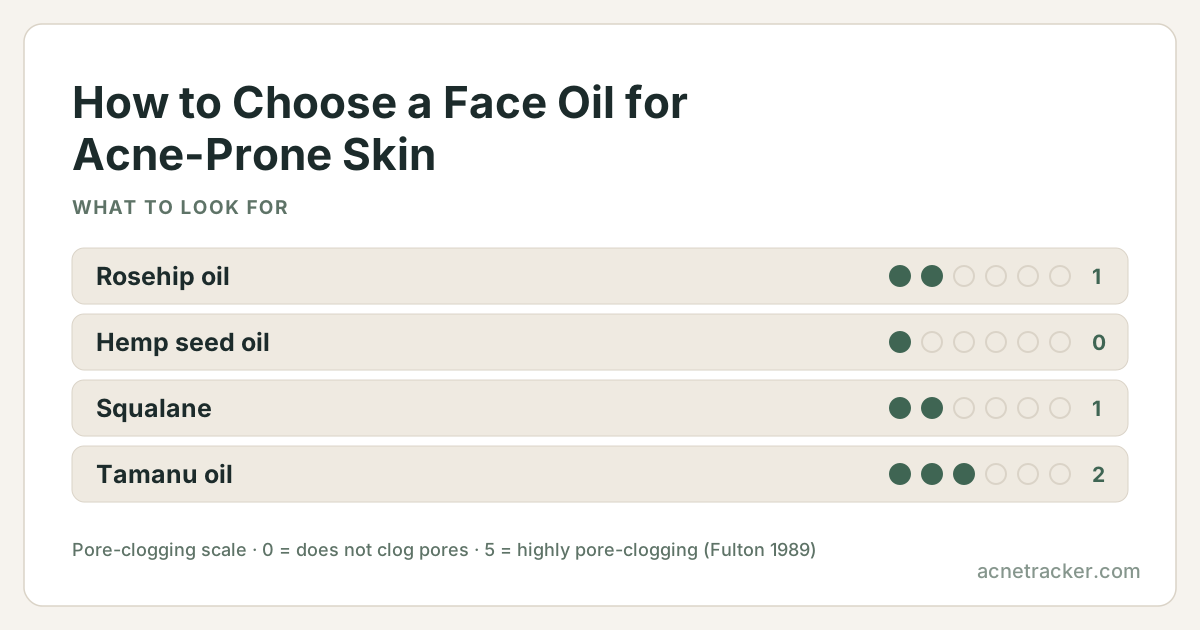
Ingredients to look for
| Ingredient | Why it matters |
|---|---|
| Rosehip oil | Around 45% linoleic and 35% linolenic acid — the archetypal high-linoleic oil. Reproduced tables list Rosa canina fruit oil at 1; it is not in Fulton's own table. |
| Hemp seed oil | Linoleic-dominant with a matte dry-down, and the closest thing to a neutral daily oil for congested skin. Reproduced rating 0. |
| Squalane | Fulton rates it 1. It has no fatty acid chains at all, which is why it stays inert on skin that reacts to almost everything else. |
| Tamanu oil | Traditionally used on inflamed skin, with small studies on wound healing. Fulton has no rating for it, so treat it as unrated rather than assuming it is safe. |
| Jojoba oil | A wax ester rather than a triglyceride; Fulton rates it 0, with a 0–2 range across reproduced sources. Often tolerated where triglyceride oils are not. |
Ingredients to avoid
| Ingredient | Why it matters |
|---|---|
| Coconut oil | The clearest case against. Lauric acid alone carries a Fulton rating of 4, and coconut oil is quoted at 4 in every reproduced table. For acne-prone skin this is the oil to skip. |
| Wheat germ oil | Reproduced tables give it 5. Nothing it offers justifies the top of the comedogenic scale on skin that already congests. |
| Flaxseed and peach kernel oils | Both are rated 4 in reproduced tables — an unexpected result for flaxseed given how high-linoleic it is, which is exactly why the tables are worth reading instead of guessing from fatty acids alone. |
| Isopropyl myristate and isopropyl linoleate | Fulton rates these 5 and 4 respectively. They are texture ingredients, not oils you would choose, but they hide in blends — check the full list. |
How to choose
Work through the list in this order. First, dominant fatty acid: prefer oils that are predominantly linoleic over oils that are predominantly oleic. Second, the published rating — but read it properly. Fulton (1989) applied his oils to the rabbit ear at high concentration, so a 2 in a blend at 5% is not the same risk as a 2 applied neat, and a rating is a signal rather than a verdict on you personally. Third, note where a rating is missing rather than assuming absence means safety: tamanu, marula and grapeseed all lack a Fulton row. Fourth, watch the surprises. Evening primrose oil is high-linoleic and still carries a Fulton rating of 3, which is a useful reminder that fatty acid profile predicts behaviour imperfectly. Finally, remember what an oil cannot do. If your acne is inflammatory, an oil is at best a barrier-friendly companion to an actual active such as benzoyl peroxide, salicylic acid, azelaic acid or a retinoid — never a substitute for one.
How to apply
Introduce a single oil at a time, on a small area, for two weeks before going full-face — comedones take weeks to surface, so a two-day patch test tells you nothing about clogging. Two or three drops at night after your treatment step, never before it: an oil layered underneath a retinoid or a BHA can slow its delivery. If you are using benzoyl peroxide, keep it on a separate evening or apply the oil only to the areas the treatment does not cover. Stop the oil for a month if you develop new closed comedones in a place you do not normally get them.
Frequently asked questions
Can face oil actually help acne-prone skin?
It can support the barrier, which matters when you are using drying actives, and the linoleic acid research gives a plausible mechanism. But no oil has evidence of clearing acne, and treating one as a treatment rather than a support is how people lose months.
Which face oil is least likely to clog pores?
Squalane has the best combination of a real published rating (1 by Fulton), no fatty acid chains and no oxidation problem. Jojoba at 0 and safflower at 0 are the next most defensible choices on published data.
Why do people say coconut oil breaks them out?
Because the data agrees with them. Coconut oil is rated 4 in the reproduced comedogenicity tables, Fulton rated coconut butter 4, and its main fatty acid, lauric acid, is rated 4 on its own. This is one of the few internet claims that holds up.
Is a high comedogenic rating a guarantee I will break out?
No. Fulton's assay used neat material on rabbit ears, and concentration, formulation and your own skin all change the outcome. Treat the number as a risk signal for a screening decision, not a prediction about your face.
Should the oil go before or after my acne treatment?
After. Actives work best on clean, dry skin with nothing between them and the stratum corneum. Put the oil on last, as the final step, so it seals rather than blocks.
Sources & further reading
There is no single study of this exact question. The guidance here is reasoned from the ingredient profiles below, each of which carries its own references:
- Rosehip Oil3 refs
- Hemp Seed Oil2 refs
- Squalane3 refs
- Tamanu Oil2 refs
- Jojoba Oil2 refs
Show every reference behind this page (8)
- European Commission CosIng database — Rosa Canina Fruit Oilcited by Rosehip Oil, Hemp Seed Oil, Squalane, Tamanu Oil, Jojoba Oil
- PubChem — Linoleic acid (major rosehip fatty acid)cited by Rosehip Oil
- Safety Assessment of Rosa canina-derived Ingredients as Used in Cosmetics (PubMed)cited by Rosehip Oil
- Hemp (Cannabis sativa L.) seed oil: analytical and phytochemical characterization of the unsaponifiable fraction (J. Agricultural and Food Chemistry, 2014)cited by Hemp Seed Oil
- PubChem — Squalane compound summarycited by Squalane
- DermNet — Emollients and moisturiserscited by Squalane
- Biological Activity of Polynesian Calophyllum inophyllum Oil Extract on Human Skin Cells (Planta Medica, 2016)cited by Tamanu Oil
- Pazyar N et al. Jojoba in dermatology: a succinct review. G Ital Dermatol Venereol 2013 Dec (PubMed)cited by Jojoba Oil
Medical disclaimer
Ingredients mentioned on this page
Find your personal acne triggers
Our free Acne Tracker lets you log breakouts, sleep, stress and diet, and shows you which factors correlate with your flare-ups.