How to Choose a Toner for Sensitive Skin
For sensitive skin, the safest toner is often no toner at all — but a well-made one can be a genuinely calming step. The catch is that the toner aisle is full of exactly what sensitive skin cannot tolerate: denatured alcohol, fragrance, essential oils and 'cooling' agents that read as refreshing but register as irritation. A good toner for sensitive skin is short, alcohol-free and fragrance-free, built around soothing ingredients that reduce reactivity. This guide describes that profile and its opposite, so you can screen a bottle in seconds. If your skin stings, burns or flushes easily, the priority is removing triggers, and a minimalist toner is judged on what it leaves out as much as what it adds.
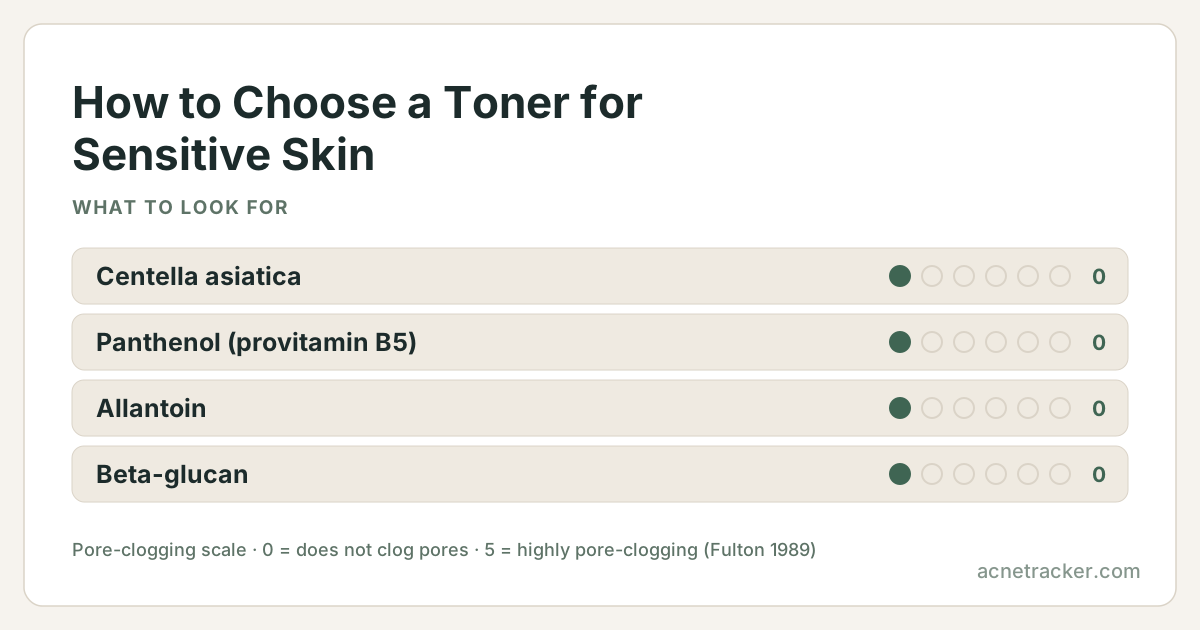
Ingredients to look for
| Ingredient | Why it matters |
|---|---|
| Centella asiatica | A well-liked soothing botanical for reactive skin, helping to calm redness and support a stressed barrier. |
| Panthenol (provitamin B5) | Softens and comforts while reinforcing the barrier, easing the tightness and sting sensitive skin is prone to. |
| Allantoin | A gentle conditioning agent that calms and smooths irritated, easily-provoked skin. |
| Beta-glucan | Hydrates and soothes with a very low irritation profile, a safe fit for reactive skin. |
| Madecassoside | A refined centella component known for calming redness and supporting barrier recovery in sensitive skin. |
Ingredients to avoid
| Ingredient | Why it matters |
|---|---|
| Denatured alcohol (alcohol denat.) | One of the most common triggers of stinging and tightness; it dries and destabilises an already reactive barrier. |
| Fragrance and essential oils | Leading causes of contact reactions; there is no upside for sensitive skin and real downside risk. |
| Peppermint, eucalyptus, menthol and camphor in 'refreshing' toners | The 'cooling' sensation is low-grade irritation, which sensitive skin registers as burning or flushing. |
| Strong exfoliating acids | High-strength AHA/BHA toners often overwhelm a reactive barrier; if you exfoliate, choose the gentlest option occasionally. |
How to choose
Read a toner for sensitive skin backwards: start with what it leaves out. A short ingredient list, clearly labelled alcohol-free and fragrance-free, is the strongest starting signal. Then confirm the soothers — centella, panthenol, allantoin, beta-glucan or madecassoside — rather than a long cocktail of extracts that raises the odds of a reaction. Be wary of 'natural' and 'botanical' framing, since essential oils are natural and among the most common irritants. Avoid acids and any cooling tingle. Simpler formulas are safer here: every extra ingredient is another thing your skin might react to. Above all, do not judge a toner by a single use. Patch test on the inner forearm or beside the ear for a few days first, because sensitive skin can react on delay, and a face-wide reaction is far harder to undo than a small test patch.
How to apply
Patch test any new toner for several days before using it on the whole face. Once cleared, apply to clean skin by gently pressing it in with your fingertips — skip cotton pads if friction bothers you. Keep the routine minimal: introduce only one new product at a time so you can identify a trigger if a reaction appears. Use it morning and night if it stays comfortable, and stop immediately at any sting, itch or flush. Follow with a simple barrier-supporting moisturizer, and wear SPF in the daytime, choosing a sunscreen formulated for sensitive skin.
Frequently asked questions
Does sensitive skin need a toner?
No. A toner is never essential, and for sensitive skin a minimalist routine is often best. If you want one, choose an alcohol-free, fragrance-free soothing toner — but skipping it entirely is a perfectly good option.
Why does my toner sting?
Usually denatured alcohol, fragrance or a cooling agent like menthol. Stinging is a warning sign, not a sign of effectiveness. Switch to a fragrance-free, alcohol-free formula and patch test before full use.
Is 'natural' toner safer for sensitive skin?
Not necessarily. Many essential oils are natural yet among the most common irritants for reactive skin. Judge a toner by its full ingredient list and its irritant-free claims, not by 'natural' or 'botanical' labelling.
How should I patch test a new toner?
Apply a little to the inner forearm or beside the ear once or twice daily for several days and watch for redness, itching or stinging. Sensitive skin can react on delay, so a few days is more telling than a single application.
Sources & further reading
There is no single study of this exact question. The guidance here is reasoned from the ingredient profiles below, each of which carries its own references:
- Centella Asiatica2 refs
- Panthenol3 refs
- Allantoin3 refs
- Beta-Glucan2 refs
- Madecassoside3 refs
Show every reference behind this page (9)
- Bylka W et al. Centella asiatica in dermatology: an overview. Phytother Res 2014 Aug (PubMed)cited by Centella Asiatica
- European Commission CosIng database — Centella Asiatica Extractcited by Centella Asiatica, Panthenol, Allantoin, Beta-Glucan, Madecassoside
- PubChem — Panthenol compound summarycited by Panthenol
- Safety Assessment of Panthenol, Pantothenic Acid, and Derivatives as Used in Cosmetics (PubMed)cited by Panthenol
- PubChem — Allantoin compound summarycited by Allantoin
- Final report of the safety assessment of allantoin and its related complexes (PubMed)cited by Allantoin
- PubMed — Improving skin function with CM-glucan, a biological response modifier from yeast (Int J Cosmet Sci, 1998)cited by Beta-Glucan
- PubChem — Madecassoside (CID 24825675)cited by Madecassoside
- Therapeutic properties and pharmacological activities of asiaticoside and madecassoside: A review (PubMed)cited by Madecassoside
Medical disclaimer
Ingredients mentioned on this page
Find your personal acne triggers
Our free Acne Tracker lets you log breakouts, sleep, stress and diet, and shows you which factors correlate with your flare-ups.