How to Choose a Face Mask for Sensitive Skin
Sensitive skin has a specific problem with masks that no other skin type has, and it is worth stating before any ingredient list. Holding a formula against the face for twenty minutes, often under a film, increases how much of it gets into the skin. That is the entire selling point of the format, and for a reactive face it is also the entire risk: the mask is not a gentler version of a product, it is a more concentrated exposure to one. A cream you tolerate rubbed in and absorbed in ninety seconds is not automatically a cream you tolerate sealed against your cheek for twenty minutes. Everything below follows from that.
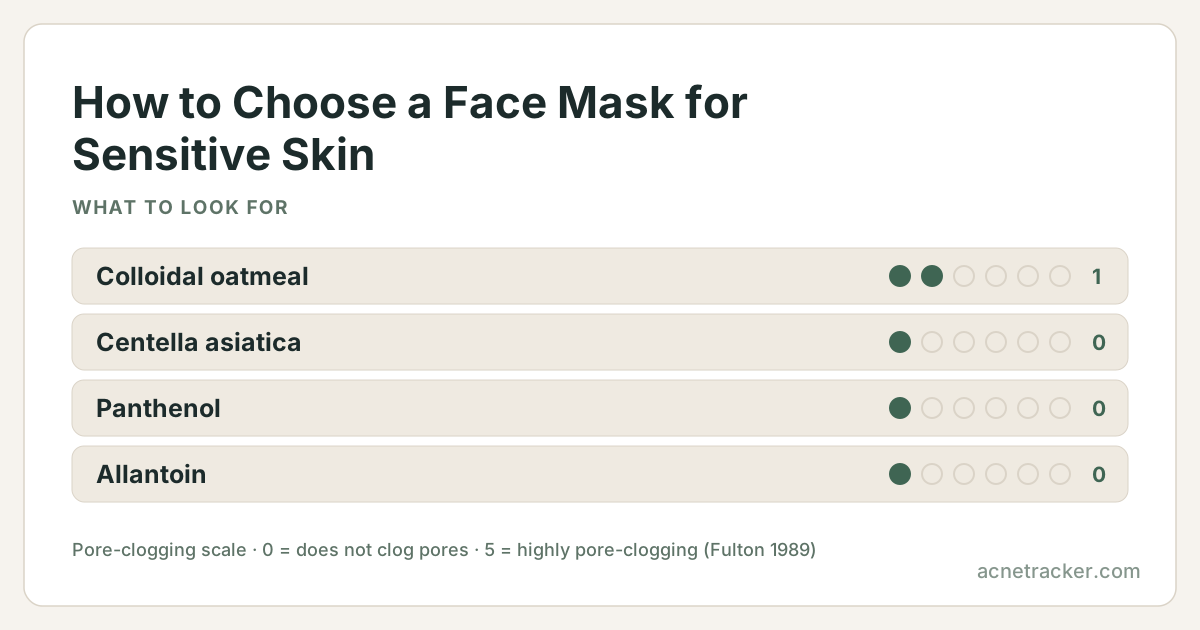
Ingredients to look for
| Ingredient | Why it matters |
|---|---|
| Colloidal oatmeal | An FDA-recognised OTC skin protectant with genuine anti-itch and barrier data behind it. There is no rating for it in Fulton's table, so we do not claim one. |
| Centella asiatica | Among the better-evidenced botanicals for irritated skin rather than a marketing plant. Still a botanical, so patch testing is not optional if you react widely. |
| Panthenol | Soothing and humectant, with data supporting barrier recovery. It rarely stings, which for this concern is the qualification that matters most. |
| Allantoin | A quiet ingredient with a long safety record and no fragrance, no acid, no tingle. Fulton rates it 0. Nothing about it is exciting, and that is the point. |
| Glycerin | Hydrates without a mechanism that can go wrong. In a sensitive-skin mask, the base doing nothing objectionable matters more than any hero ingredient. |
Ingredients to avoid
| Ingredient | Why it matters |
|---|---|
| Anything that tingles, warms or cools | Menthol, camphor, peppermint and 'self-heating' bases all work by irritating a nerve receptor. The sensation is marketed as activity and is, for sensitive skin, simply the injury. |
| Fragrance under occlusion | Fragrance allergens are the commonest cause of cosmetic contact dermatitis, and a mask is the format that pushes the most of them in. Linalool and limonene on the list are worth taking seriously here. |
| Essential-oil 'natural' masks | Tea tree, lavender and citrus oils are complex allergen mixtures. Natural describes an origin, not a tolerance profile, and these are among the most sensitising things in the aisle. |
| Multi-acid 'brightening' masks | Acids can be fine on reactive skin at low strength and short contact — but a blend of four of them for fifteen minutes is a formula whose reaction you cannot attribute to anything. |
How to choose
Start with the shortest ingredient list you can find, because with sensitive skin every additional ingredient is another thing that might be the problem. A twelve-ingredient cream mask you tolerate is more valuable than a forty-ingredient one that works brilliantly four times out of five, because when the fifth time goes wrong you learn nothing. Prefer 'fragrance-free' over 'unscented' — the second frequently means a masking fragrance was added to cover a raw material's smell, which is the same allergen risk with better wording. Treat 'hypoallergenic' as unregulated, because it is: no test has to be passed to print it. Sheet masks deserve particular caution despite their gentle reputation, since the occlusion is total and the essence is often heavily perfumed. And be sceptical of the whole premise for your skin. There is no benefit that only comes from a mask; every soothing ingredient above is available in a moisturiser you can apply thinly, test easily and take off in seconds. If a mask goes wrong, you have twenty minutes of penetration to undo. That asymmetry is why this is the one category where sensitive skin genuinely loses less by skipping it.
How to apply
Patch test on the inner forearm or behind the jaw for the full intended wear time — a two-minute dab tells you nothing about a twenty-minute exposure. Introduce one new mask at a time with at least a week between, or a reaction has too many suspects. Apply thinly on skin that is calm today, not on skin that is already flaring, and stop at the first sting rather than waiting to see if it settles. Never mask on the same day as an acid, a retinoid or a fresh treatment. Rinse with lukewarm water and follow with a plain moisturiser.
Frequently asked questions
Are face masks safe for sensitive skin?
Some are, but the format works against you: occlusion increases how much of the formula penetrates. A simple, fragrance-free cream mask is usually fine. The risk is not the mask category as such — it is that a mask amplifies whatever is in it.
Should a mask tingle?
No. Tingling is a nerve receptor responding to an irritant, and the industry has spent decades training people to read it as efficacy. On reactive skin it is a reason to rinse, not a sign the product is working.
Is 'hypoallergenic' a meaningful claim on a mask?
No. The term is not regulated in the EU or the US and no testing is required to use it. 'Fragrance-free' with a short ingredient list tells you far more than any claim on the front of the box.
Are sheet masks gentler than clay masks?
Not necessarily. A sheet is less drying, but the occlusion is complete and the essences are frequently fragranced. Gentle depends on the formula, not the format.
How do I test a new mask if my skin reacts to everything?
Apply it behind the jaw for the full recommended time, leave it two days, and repeat once before using it on your face. Delayed contact reactions can take 24–48 hours to appear, so a single immediate check misses the commonest pattern.
Sources & further reading
There is no single study of this exact question. The guidance here is reasoned from the ingredient profiles below, each of which carries its own references:
- Colloidal Oatmeal2 refs
- Centella Asiatica2 refs
- Panthenol3 refs
- Allantoin3 refs
- Glycerin3 refs
Show every reference behind this page (10)
- FDA OTC monograph — skin protectant drug products (colloidal oatmeal)cited by Colloidal Oatmeal
- PubMed — Colloidal oatmeal formulations as adjunct treatments in atopic dermatitis (J Drugs Dermatol, 2012)cited by Colloidal Oatmeal
- Bylka W et al. Centella asiatica in dermatology: an overview. Phytother Res 2014 Aug (PubMed)cited by Centella Asiatica
- European Commission CosIng database — Centella Asiatica Extractcited by Centella Asiatica, Panthenol, Allantoin, Glycerin
- PubChem — Panthenol compound summarycited by Panthenol
- Safety Assessment of Panthenol, Pantothenic Acid, and Derivatives as Used in Cosmetics (PubMed)cited by Panthenol
- PubChem — Allantoin compound summarycited by Allantoin
- Final report of the safety assessment of allantoin and its related complexes (PubMed)cited by Allantoin
- PubChem — Glycerol compound summarycited by Glycerin
- DermNet — Moisturiserscited by Glycerin
Medical disclaimer
Ingredients mentioned on this page
Find your personal acne triggers
Our free Acne Tracker lets you log breakouts, sleep, stress and diet, and shows you which factors correlate with your flare-ups.