How to Choose a Face Mask for Dehydrated Skin
Dehydration is a water problem, and it is the one concern in this category where the format most people buy is actually the right one. A sheet mask holds a humectant solution against the face under an occlusive film for fifteen minutes, which stops the water evaporating and gives the humectants time to pull moisture into the stratum corneum. That is a real mechanism with a real result, and it is also the reason skin looks plump immediately afterwards and ordinary again the next morning. Nothing is broken. You added water to a surface that leaks, and water leaves. Understanding that turns the sheet mask from a disappointment into a well-priced cosmetic tool with a known duration.
Ingredients to look for
| Ingredient | Why it matters |
|---|---|
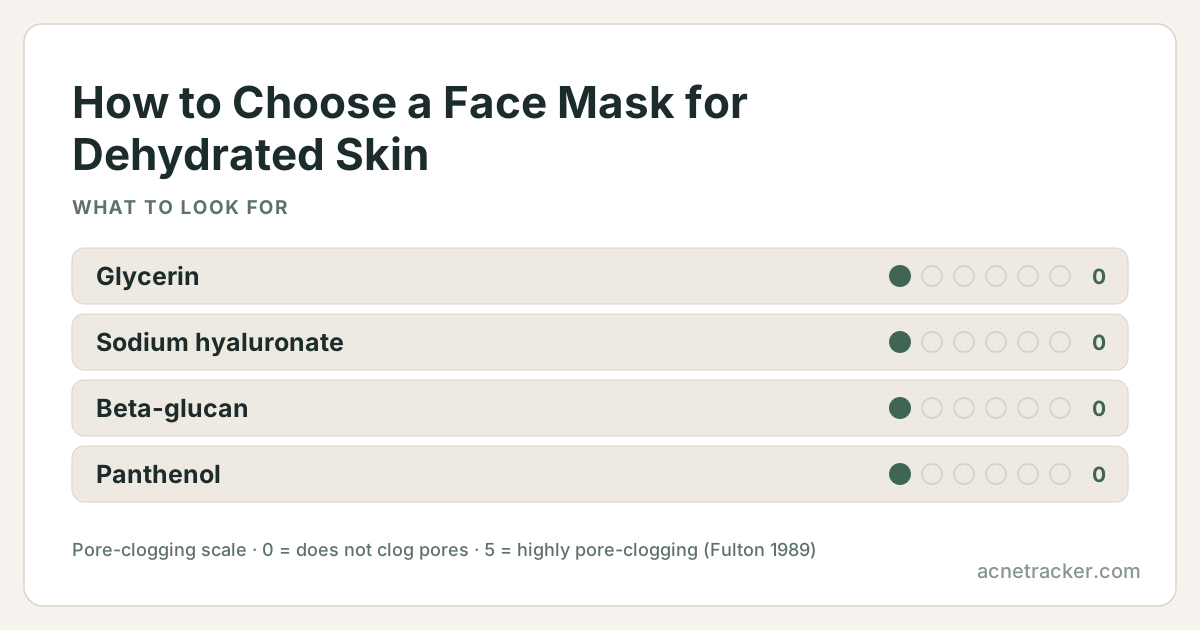
| Glycerin | The most studied humectant there is, and the one that survives contact with reality. If it appears in the first few ingredients of the essence, the sheet is worth its money. |
| Sodium hyaluronate | The salt form penetrates the surface layers better than the parent acid. Fulton rates it 0. It binds water where the mask can keep it. |
| Beta-glucan | A large polysaccharide that holds water and forms a soft film as the essence dries down. It is why some sheets leave a cushiony rather than sticky finish. |
| Panthenol | Humectant with reasonable evidence on barrier recovery, so it addresses the leak as well as the level. Fulton rates it 0. |
| Trehalose | A sugar that holds water tenaciously and is used in essences for exactly that reason. Modest, unglamorous, and it does what the label implies. |
Ingredients to avoid
| Ingredient | Why it matters |
|---|---|
| Buying the sheet material rather than the essence | Cellulose, biocellulose, hydrogel — the fabric changes how well the sheet clings and almost nothing else. The liquid it is soaked in is the entire product. |
| Leaving a sheet on until it dries out | Once the sheet is drier than your face, evaporation reverses and it starts taking water back. Fifteen to twenty minutes is not a suggestion, it is the whole window. |
| Alcohol-forward 'refreshing' essences | The cooling is evaporation, and evaporation from an already-leaking surface is the opposite of the reason you bought the mask. |
| Carrageenan and algae-thickened gel masks if you are also breakout-prone | Reproduced comedogenicity tables rate carrageenan and algae extract 5 — those numbers are not from Fulton's own table, but they are high enough to be worth knowing before you sit in one twice a week. |
How to choose
Turn the packet over and read the essence as if it were a serum, because that is what it is. Glycerin, a hyaluronic acid salt or a polysaccharide in the top five means the mask can hold water; a list that opens with water, alcohol, fragrance and a plant name means you are buying a wet wipe with a story. Then look for whether anything in the formula addresses why you are dehydrated rather than only topping you up. Dehydration usually has a cause outside the bottle — indoor heating, over-washing, a retinoid ramped too fast, a lot of alcohol or a lot of flying — and a mask never touches any of those. It is worth being blunt about the arithmetic. A sheet mask costs several times what a comparable serum costs per use and delivers a fraction of the actives, because most of what you pay for is packaging and liquid you throw away. What you get in exchange is the occlusion, which is genuinely useful and lasts about a day. Buy it as an evening, not as a strategy, and seal it with a moisturiser or you will have watered a leaking bucket.
How to apply
Apply to clean, slightly damp skin — a hydrating toner underneath gives the essence more to work with. Fifteen to twenty minutes, then take it off while it is still wet. Do not rinse: pat the remaining essence in and immediately follow with a moisturiser, because the film that stops evaporation left with the sheet. Sheet masking is not an exposure the way an acid or a clay is, so daily use is safe if you want it; it is just rarely worth the money. The leftover essence in the packet is real product — use it on the neck.
Frequently asked questions
How long does a sheet mask keep skin hydrated?
Roughly a day, and less in dry indoor air. You are adding water to the surface layers, and the surface layers give it up again. The plumpness is real while it lasts and it does not accumulate over weeks.
What is the difference between dry skin and dehydrated skin?
Dry skin lacks lipids and is a skin type; dehydrated skin lacks water and is a temporary state that any skin type can be in, including oily skin. That is why an oily face can flake — the two are separate axes.
Are expensive sheet masks better than cheap ones?
Rarely, and the difference is usually fabric and scent. Compare the essence lists side by side: if both open with water, glycerin and a hyaluronic acid salt, you are looking at the same product in different packaging.
Should you moisturise after a sheet mask?
Always, and skipping it wastes the mask. The sheet was doing the occluding, and once it comes off there is nothing holding the water in. The cream is what converts twenty minutes into a day.
Can you use a sheet mask every day?
Physically yes — there is no cumulative exposure to worry about, provided the essence is not full of fragrance or alcohol. Whether it is worth it is a budget question, and the honest answer for most people is no.
Sources & further reading
There is no single study of this exact question. The guidance here is reasoned from the ingredient profiles below, each of which carries its own references:
- Glycerin3 refs
- Sodium Hyaluronate2 refs
- Beta-Glucan2 refs
- Panthenol3 refs
- Trehalose3 refslimited evidence
The ingredients below are described here on the basis of laboratory, systemic or traditional-use sources rather than trials of topical use. Advice on this page that depends on them is correspondingly less certain.
- Trehalose — Trehalose is an effective humectant and a well-documented cell-protectant during freezing and drying, which is why it appears in formulations. The clinical use cited here is in ophthalmology; we found no trial establishing the soothing or antioxidant effects on skin that cosmetic descriptions often attribute to it.
Show every reference behind this page (9)
- PubChem — Glycerol compound summarycited by Glycerin
- DermNet — Moisturiserscited by Glycerin
- European Commission CosIng database — Glycerincited by Glycerin, Sodium Hyaluronate, Beta-Glucan, Panthenol, Trehalose
- PubMed — Effectiveness of topical hyaluronic acid of different molecular weights in xerosis cutis treatment in elderly: a double-blind, randomized controlled trial (Arch Dermatol Res, 2024)cited by Sodium Hyaluronate
- PubMed — Improving skin function with CM-glucan, a biological response modifier from yeast (Int J Cosmet Sci, 1998)cited by Beta-Glucan
- PubChem — Panthenol compound summarycited by Panthenol
- Safety Assessment of Panthenol, Pantothenic Acid, and Derivatives as Used in Cosmetics (PubMed)cited by Panthenol
- PubChem — Trehalose compound summary (CID 7427)cited by Trehalose
- Trehalose in ophthalmology (PubMed)cited by Trehalose
Medical disclaimer
Ingredients mentioned on this page
Find your personal acne triggers
Our free Acne Tracker lets you log breakouts, sleep, stress and diet, and shows you which factors correlate with your flare-ups.