Can You Mix Hyaluronic Acid and Sodium Hyaluronate?
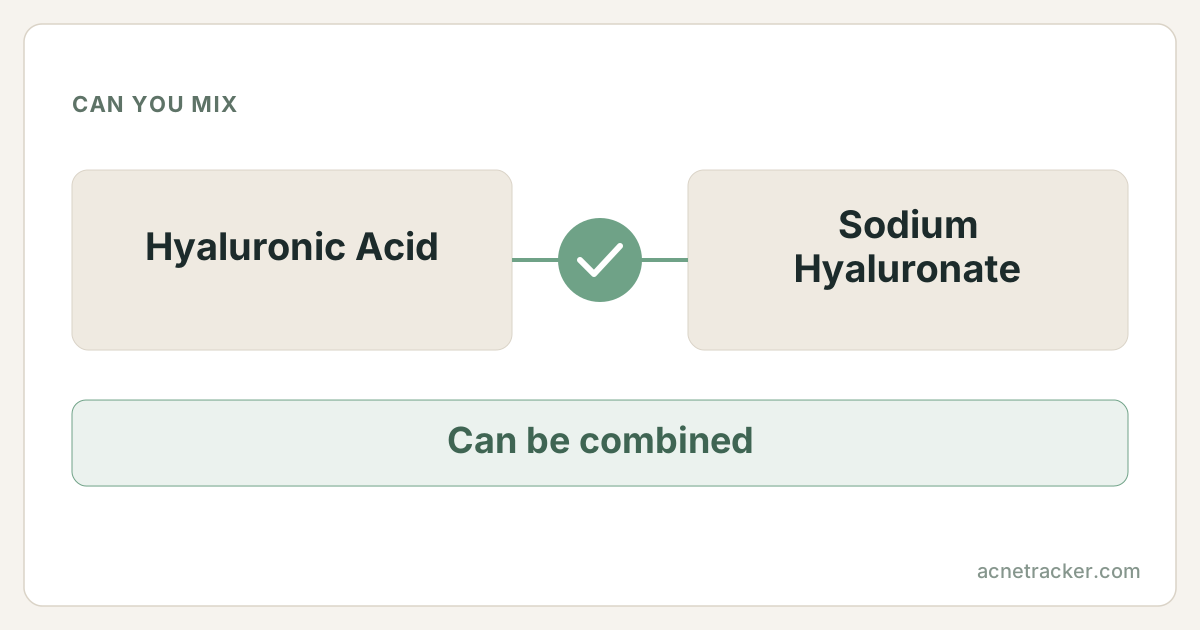
Yes, and the question hides a category error: these are not two ingredients that need combining. Sodium hyaluronate is the sodium salt of hyaluronic acid — the same polymer chain, supplied in the form that dissolves and stores better. Nearly every serum sold as hyaluronic acid lists sodium hyaluronate on its INCI. Seeing both on one label means the formulator used two grades, not two ingredients.
How this pairing resolves
The two ingredients, their published numbers, and where they land together.
The numbers beside each ingredient are its published comedogenic rating and effective pH window, taken from its own profile page.
Show the numbers
| Ingredients | Metric | 0–5 |
|---|---|---|
| Hyaluronic Acid | Comedogenic rating | 0/5 |
| Hyaluronic Acid | Effective pH | no published pH |
| Sodium Hyaluronate | Comedogenic rating | 0/5 |
| Sodium Hyaluronate | Effective pH | no published pH |
Why
Hyaluronic acid is hyaluronan: a repeating chain of glucuronic acid and N-acetylglucosamine, produced industrially by bacterial fermentation rather than extracted from rooster combs as it was decades ago. Every repeating unit carries a carboxyl group, and that group is what the naming turns on. In the free acid form those carboxyls are protonated; the polymer is awkward to dissolve and less forgiving in storage. Neutralise it with sodium and you get sodium hyaluronate, which disperses cleanly in water, survives a shelf life and costs a formulator less trouble. That is why it dominates ingredient lists. The distinction largely dissolves on contact anyway: in the water of the formula, and on skin sitting around pH 4.7–5.5, the carboxyl groups are substantially ionised whichever raw material went in. Your face cannot tell which drum it was shipped in. What genuinely separates two hyaluronates is molecular weight — anything from a few thousand daltons to well over a million — and that is a completely different axis from salt form. It is also why multi-weight serums list sodium hyaluronate two or three times over, each with its own specification.
How to combine them
There is nothing to layer here, because there is nothing to separate. If your bottle names hyaluronic acid and sodium hyaluronate together, or stacks sodium hyaluronate next to hydrolysed sodium hyaluronate and sodium hyaluronate crosspolymer, you are reading a molecular-weight blend: an attempt to deliver a surface film, mid-depth hydration and a slower-release reservoir from one bottle. Treat the entire list as a single humectant step. Apply it while skin is still damp from cleansing or a spritz of water, then follow with a lipid-containing moisturiser — the humectant does the water-binding, the moisturiser supplies the barrier that keeps the water from leaving again. What you should not do is buy a hyaluronic acid serum and a sodium hyaluronate serum and layer one over the other expecting a compound effect. You will get the same hydration, two preservative systems and a tackier finish. If you want a genuine second act in the routine, reach for a different class of ingredient, not a second grade of the same one.
Example routine
| When | Steps |
|---|---|
| Morning | Cleanser → Hyaluronate serum on damp skin → Moisturiser → SPF 30+ |
| Evening | Cleanser → Hyaluronate serum on damp skin → Moisturiser |
| Reading the label | Two hyaluronate entries = one ingredient in two molecular weights |
| Do not | Buy both as separate serums and layer them for a 'double' effect |
Warning signs
Frequently asked questions
Is sodium hyaluronate just a cheap substitute for hyaluronic acid?
No. It is the same polymer supplied as its sodium salt, chosen because it dissolves and stores better. Plenty of expensive serums use it for precisely that reason, so price tells you nothing about which form is inside.
Why does my serum list both names on the label?
Almost always because two different molecular-weight grades went into the batch and the supplier paperwork named them differently. It signals a blend, not an accidental duplicate.
Which one absorbs better into skin?
Neither, as a function of salt form. Absorption tracks molecular weight: small fragments settle into the upper stratum corneum, long chains form a film that stays on the surface. The useful question is about daltons, not about sodium.
Should I use a hyaluronic acid product and a sodium hyaluronate product together?
There is no additive benefit worth the money. One well-built humectant step, sealed with a moisturiser, does everything the pair of them would.
Is either form better for oily or acne-prone skin?
The forms are equivalent. Texture decides it: a thin gel suits oily skin better than a viscous one, whether the label says acid or hyaluronate. Neither has a comedogenic rating of concern.
Sources & further reading
There is no single study of this exact question. The guidance here is reasoned from the ingredient profiles below, each of which carries its own references:
- Hyaluronic Acid3 refs
- Sodium Hyaluronate2 refs
Show every reference behind this page (4)
- PubChem — Hyaluronic acid compound summarycited by Hyaluronic Acid
- European Commission CosIng database — Hyaluronic Acidcited by Hyaluronic Acid, Sodium Hyaluronate
- DermNet — Moisturisers and humectantscited by Hyaluronic Acid
- PubMed — Effectiveness of topical hyaluronic acid of different molecular weights in xerosis cutis treatment in elderly: a double-blind, randomized controlled trial (Arch Dermatol Res, 2024)cited by Sodium Hyaluronate
Medical disclaimer
Ingredients mentioned on this page
Find your personal acne triggers
Our free Acne Tracker lets you log breakouts, sleep, stress and diet, and shows you which factors correlate with your flare-ups.