How to Choose a Face Mask for Acne-Prone Skin
A mask sits on the face for ten minutes and then leaves. That single fact governs everything on this page. Acne is driven by follicular plugging, sebum, Cutibacterium acnes and inflammation — processes that run twenty-four hours a day — and a product with ten minutes of contact time twice a week cannot meaningfully interrupt them. What a mask can do is take some load off the routine: absorb a shine, deliver a short pulse of an acid, calm a hot patch. Those are worthwhile jobs. They are just much smaller than the category's advertising suggests, and treating a mask as your acne plan is the most common way people waste a year.
Ingredients to look for
| Ingredient | Why it matters |
|---|---|
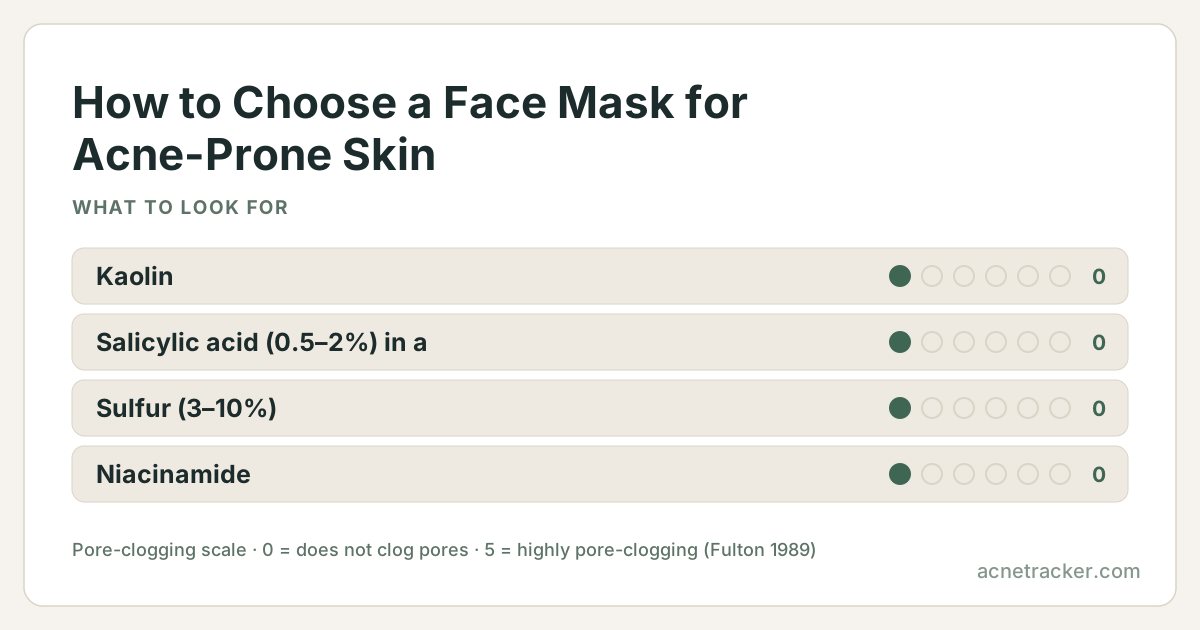
| Kaolin | A soft mineral clay that soaks up sebum sitting on the surface. Fulton (1989) rates kaolin 0 — it is not itself a pore-clogger, which is why it survives in acne formulas. |
| Salicylic acid (0.5–2%) in a wash-off mask | Oil-soluble, so ten minutes of contact does reach into a follicle. A short pulse, not a substitute for a leave-on BHA. |
| Sulfur (3–10%) | One of the oldest evidenced acne actives, with keratolytic and anti-inflammatory activity. Fulton rates precipitated sulfur 0; the water-soluble form is rated 3. |
| Niacinamide | Turns up in mask bases because it is stable and well tolerated. Contact time limits it, but it makes the formula less likely to leave you tight. |
| Zinc PCA | Mildly sebum-modulating and soothing. A sensible passenger in a clay base, not a reason on its own to buy a mask. |
Ingredients to avoid
| Ingredient | Why it matters |
|---|---|
| Any mask sold as a 'detox' or 'impurity purge' | There are no toxins in a follicle to remove and nothing to purge. The word is doing marketing work, not describing an action. |
| Peel-off masks | The film that peels away is mostly polyvinyl alcohol glue holding vellus hair and loose surface cells. It is not lifting out plugs, and the tug irritates inflamed skin. |
| Walnut shell and apricot kernel scrub-masks | Angular fragments abrade inflamed skin, and abrasion has no effect on the material sitting inside a follicle. |
| Fragrance-heavy sheet essences | Occlusion under a sheet increases penetration of everything in the essence, fragrance included. Irritation on acne-prone skin drives more inflammation, not less. |
How to choose
Decide first what job you are hiring the mask for, because the three honest jobs need different products. If the job is oil control before an event, a plain kaolin or bentonite mask does it, and the price difference between a cheap one and an expensive one buys you texture and scent, not performance. If the job is a treatment pulse, look for salicylic acid or sulfur listed above the preservatives, and read the contact time as a safety instruction rather than a suggestion — the label saying ten minutes is the tested exposure. If the job is calming, you want a hydrating gel or cream base with something like niacinamide or an oat extract, and no clay at all. Then check frequency honestly: twice a week is a ceiling for anything absorbent, and if your skin feels tight afterwards you have already crossed it. The most useful thing this page can tell you is what a mask is not. It is not a replacement for a daily leave-on active. If your acne is inflamed, persistent or scarring, a mask is a footnote and a doctor's appointment is the plan.
How to apply
Apply to clean skin in a thin, even layer — thick enough to see, not thick enough to crack. Cracking clay means it has dried past the point where it is doing anything useful and has started pulling water out of the stratum corneum. Rinse with lukewarm water before it goes fully matte, and follow immediately with a moisturiser. Never mask on the same evening as a strong leave-on active such as a retinoid or benzoyl peroxide; stack them and you get irritation you cannot attribute to either. Patch test any acid mask on the jaw first.
Frequently asked questions
Can a face mask clear acne?
No mask has been shown to clear acne on its own. Contact time is too short to change how a follicle behaves over weeks. Masks support a routine built on daily leave-on actives; they do not replace it.
How often should acne-prone skin use a clay mask?
Once or twice a week at most, and less if your skin feels tight afterwards. Frequent absorbent masking is a reliable way to end up with a compromised barrier and skin that looks worse than when you started.
Do clay masks pull impurities out of the skin?
They do not. Clay adsorbs oil that is already on the surface, which is a real but shallow effect. Nothing in a mask reaches into the dermis, and there is nothing there for it to extract if it did.
Is a sulfur mask better than a clay mask for breakouts?
They are doing different things. Clay manages surface shine; sulfur is an actual acne active with decades of use behind it. If you want the mask to treat rather than mattify, sulfur is the more defensible choice — it just smells like it.
Should I mask before or after exfoliating?
Ideally on different days. Both are exposures, and combining them in one session is how mild routines become irritating ones. If you must do both, exfoliate one evening and mask another.
Sources & further reading
There is no single study of this exact question. The guidance here is reasoned from the ingredient profiles below, each of which carries its own references:
- Kaolin3 refs
- Salicylic Acid2 refs
- Sulfur2 refs
- Niacinamide2 refs
- Zinc PCA3 refs
Show every reference behind this page (9)
- European Commission CosIng database — Kaolincited by Kaolin, Niacinamide, Zinc PCA
- PubChem — Kaolincited by Kaolin
- Fulton JE. Comedogenicity and irritancy of commonly used ingredients in skin care products. J Soc Cosmet Chem 40:321–333 (1989) — Table I, pp. 324–326 (source of the comedogenic rating)cited by Kaolin
- Salicylic acid as a peeling agent: a comprehensive review (PubMed)cited by Salicylic Acid
- FDA OTC monograph — acne drug products (salicylic acid 0.5–2%)cited by Salicylic Acid, Sulfur
- PubChem — Sulfur (CID 5362487)cited by Sulfur
- Niacinamide: mechanisms of action and its topical use in dermatology (PubMed)cited by Niacinamide
- PubChem — Zinc PCA (zinc pyrrolidone carboxylate)cited by Zinc PCA
- Zinc l-pyrrolidone carboxylate inhibits the UVA-induced production of matrix metalloproteinase-1 by in vitro cultured skin fibroblasts, whereas it enhances their collagen synthesis (PubMed)cited by Zinc PCA
Medical disclaimer
Ingredients mentioned on this page
Find your personal acne triggers
Our free Acne Tracker lets you log breakouts, sleep, stress and diet, and shows you which factors correlate with your flare-ups.