How to Choose an Eye Cream for Fine Lines
Here is a distinction that will change how you shop: a large share of what people call fine lines under the eye are not structural at all. They are crepey creases in dehydrated skin, and they visibly soften within an hour of applying something that holds water. True fine lines — early etched creases in the dermis — do not do that, and they need a slower, different intervention. The good news is you can separate them with a mirror and a glass of water rather than a purchase. This page explains the test, then covers what genuinely moves each type and how long it takes.
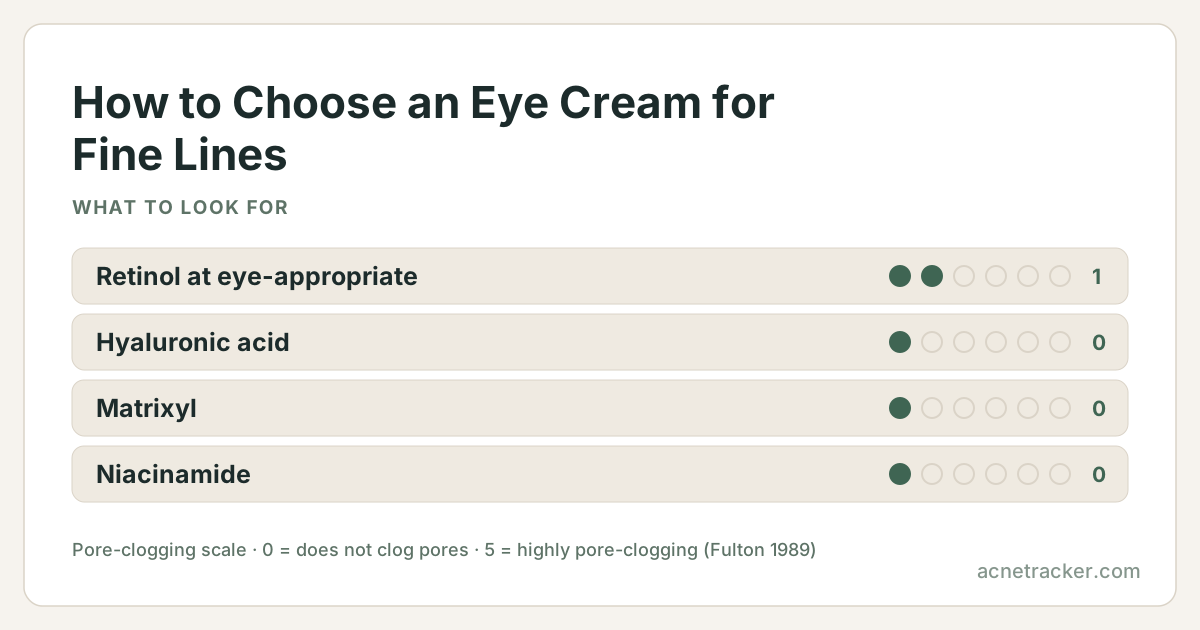
Ingredients to look for
| Ingredient | Why it matters |
|---|---|
| Retinol at eye-appropriate strength (0.01–0.1%) | The OTC ingredient class with the most repeated controlled evidence for reducing line depth. Eye formulas run roughly a tenth of face strength because lid skin will not tolerate more. |
| Hyaluronic acid | The fast lever. Where a line is a dehydration crease rather than a dermal one, hydration fills it within hours — which is exactly why so many eye creams appear to work instantly. |
| Matrixyl | A collagen-signalling peptide with modest but real published support. Less powerful than a retinoid and considerably better tolerated, which makes it a reasonable choice if retinoids sting you. |
| Niacinamide | Improves barrier lipids so the skin holds water better, and studies at cosmetic concentrations report improvements in fine surface lines. It also plays well with everything else here. |
| Ceramides | Lid skin has very few oil glands and leaks water readily. Replacing barrier lipids stops the dehydration that generates the crepey lines in the first place. |
Ingredients to avoid
| Ingredient | Why it matters |
|---|---|
| Face-strength retinoid serums used near the eye | 0.5–1% retinol on lid skin typically produces flaking, redness and stinging, and irritated skin looks more lined rather than less. Strength is not the variable that helps here. |
| Hyaluronic acid alone in dry indoor air | A humectant with nothing sealing it can lose water to the environment as readily as it gains it. Always layer something with lipids or an occlusive over it. |
| Alcohol-heavy 'fast-absorbing' eye gels | The quick-dry feel comes from solvent evaporation, which is dehydrating in the exact area where dehydration is causing your lines. |
| Judging a product after two weeks | Two weeks measures hydration only. Any claim about collagen needs twelve weeks minimum to mean anything, and most people abandon the one ingredient that works before it has had a chance. |
How to choose
Run the test first. Look at the lines, then apply a plain humectant moisturiser and look again an hour later. Lines that are noticeably softer are dehydration creases, and your problem is barrier and water, not collagen — buy glycerin, hyaluronic acid, ceramides, and use a humidifier in winter. Lines still crisply visible are etched, and only a retinoid has the evidence to reduce them. If you land in the second group, look for a retinoid at eye-appropriate strength rather than the highest number on the shelf; encapsulated or ester forms are gentler and the concentration that you tolerate nightly beats the strong one you abandon. Check for fragrance-free, since irritation undoes the benefit. Then check the packaging — retinoids and vitamin C both degrade in light and air, so a jar with a wide opening is a genuine formulation problem rather than a snobbery. Finally, be realistic about the ceiling: controlled trials on retinoids show meaningful but moderate reductions in line depth over months, not erasure, and no cream outperforms simply wearing sunscreen for the previous decade.
How to apply
Apply to slightly damp skin so humectants have water to grab, then follow with something occlusive enough to hold it there. Retinoid goes on at night, on dry skin, starting twice a week and building only as your skin allows — around the eye, going slowly is not caution, it is the difference between a routine you keep and a rash you quit. Sandwich it between moisturiser layers if it stings. Sunscreen every morning is not optional if you are using a retinoid; you are thinning the stratum corneum while asking the dermis to rebuild.
Frequently asked questions
Are fine lines under the eyes reversible?
Partly. Lines caused by dehydration reverse completely and quickly, which is why hydration feels miraculous for a day. Lines etched into the dermis can be reduced but not deleted, with retinoids showing moderate measured improvements over three to six months of consistent use.
What is the best ingredient for fine lines around the eyes?
A retinoid, on the weight of evidence — it is the only widely available class with repeated controlled trials showing reduced line depth. The caveat is that the right strength for lid skin is a fraction of face strength, and tolerability decides whether you get any result at all.
Why do my under-eyes look crepey?
Crepiness is usually water rather than age. Eyelid skin has almost no sebaceous glands, so it loses moisture quickly, and dehydrated skin folds into fine parallel creases. Central heating, air travel and alcohol make it obvious overnight, and it improves just as fast.
Can you use retinol under your eyes?
Yes, at appropriate strength and with patience. Products formulated for the eye area typically use a tenth of face concentrations, and they are placed on the orbital bone rather than the lid because the product migrates upward on its own. Stinging and flaking mean back off, not push through.
Do eye creams for fine lines actually do anything?
Some do, and less than the packaging suggests. The instant improvement almost everyone notices is hydration, which is real but resets daily. The slow improvement is retinoid-driven and modest. A page promising erased lines is describing the first effect while charging for the second.
Sources & further reading
There is no single study of this exact question. The guidance here is reasoned from the ingredient profiles below, each of which carries its own references:
- Retinol2 refs
- Hyaluronic Acid3 refs
- Matrixyl2 refs
- Niacinamide2 refs
- Ceramides3 refs
Show every reference behind this page (9)
- Improvement of naturally aged skin with vitamin A (retinol) (PubMed)cited by Retinol
- European Commission SCCS opinion on vitamin A in cosmeticscited by Retinol
- PubChem — Hyaluronic acid compound summarycited by Hyaluronic Acid
- European Commission CosIng database — Hyaluronic Acidcited by Hyaluronic Acid, Matrixyl, Niacinamide, Ceramides
- DermNet — Moisturisers and humectantscited by Hyaluronic Acid
- PubMed — Peptides: Emerging Candidates for the Prevention and Treatment of Skin Senescence: A Review (Biomolecules, 2025)cited by Matrixyl
- Niacinamide: mechanisms of action and its topical use in dermatology (PubMed)cited by Niacinamide
- DermNet — Skin barrier functioncited by Ceramides
- PubChem — Ceramide compound summarycited by Ceramides
Medical disclaimer
Ingredients mentioned on this page
Find your personal acne triggers
Our free Acne Tracker lets you log breakouts, sleep, stress and diet, and shows you which factors correlate with your flare-ups.