Argireline: Comedogenic Rating & Ingredient Analysis
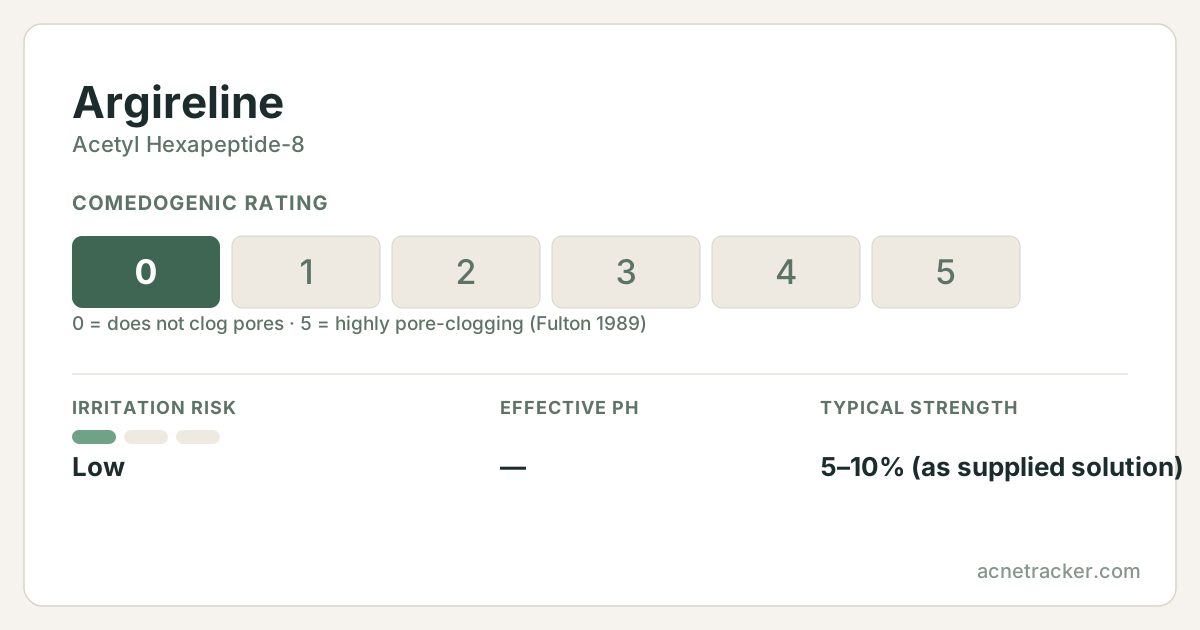
Argireline, the trade name for acetyl hexapeptide-8, is the peptide often marketed as Botox in a bottle for its supposed ability to relax expression lines. That comparison sets expectations far too high, but argireline is a real and gentle cosmetic peptide with a plausible mechanism and a place in anti-aging serums aimed at fine lines around the forehead and eyes. It has a comedogenic rating of 0 and low irritation risk, so it is comfortable to use. As with every topical peptide, honest framing matters: a serum cannot replicate an injectable, and results are subtle at best.
Quick facts
- Comedogenic rating
- our estimate — not measured
- Irritation risk
- Low
- Effective pH
- —
- Typical strength
- 5–10% (as supplied solution)
- Pregnancy
- Ask your doctor
- Suits skin types
- drycombinationnormalsensitivemature
Where this number comes from
No one has published a comedogenic rating for this ingredient. Fulton's 1989 table tested about 250 raw materials and this was not among them, and we found no later study measuring it. The figure shown is our own reasoning from the ingredient's chemistry and how it is used — treat it as an estimate, not a measurement.
Fulton read his own scale as 0-1 not significant, 2-3 borderline, 4-5 positive. The assay is the rabbit ear at 10% dilution, which the paper itself calls extremely sensitive and not fully predictive of human skin. Ratings describe the raw ingredient; concentration and formulation change real-world behaviour.
Caution profile
The four published fields on this page, on one 0–5 scale. Further from the centre means more care is needed — never that the ingredient is worse.
Derived, not measured: pore-clogging is the published comedogenic rating; irritation maps low/moderate/high to 1/3/5; pregnancy maps safe/caution/avoid to 0/3/5; skin-type limits is how many of the seven skin types this entry does NOT list. Every input is printed in words in the quick-facts card above.
Show the numbers
| Metric | 0–5 | Published field |
|---|---|---|
| Pore-clogging | 0 | 0/5 |
| Irritation | 1 | Low |
| Skin-type limits | 1.4 | 5/7 |
| Pregnancy | 3 | Ask your doctor |
Working pH and typical strength
Where this ingredient is formulated to sit, and at what concentration.
Both bars come from the fields above: the pH window and the typical strength range published for this ingredient. The tinted column is healthy skin's surface pH (about 4.7–5.75).
Show the numbers
| Metric | 0–5 |
|---|---|
| Typical strength | 5–10% (as supplied solution) |
What is it?
Acetyl hexapeptide-8 is a chain of six amino acids designed to interfere, in a small way, with the signaling that causes facial muscles to contract, the idea being that softening those micro-contractions could reduce the expression lines they create. This is a very different mechanism from collagen-boosting peptides like matrixyl. However, a topically applied peptide penetrates only the upper layers of skin and cannot reach muscles the way an injection does, which is why the Botox comparison is misleading. Supporting studies are mostly small or manufacturer-led and report modest smoothing of fine lines rather than the dramatic muscle relaxation the marketing implies.
Benefits
Softens the look of expression lines
Argireline is aimed at gently smoothing fine expression lines, such as those on the forehead and around the eyes, with consistent daily use.
Smooths skin texture
Alongside its line-softening claim, it contributes to a smoother-looking surface as part of a well-rounded anti-aging routine.
Gentle and non-irritating
With a rating of 0 and low irritation risk, it adds anti-aging support without the dryness or stinging of stronger actives.
Layers easily
Being non-acidic and mild, it combines readily with hydrators, other peptides and most actives, fitting neatly into existing routines.
How to use
Argireline is used in serums, applied after cleansing to the areas where you notice fine expression lines, morning or night. It layers well with hydrators, niacinamide and firming peptides like matrixyl, and many products combine several peptides for a broader effect. As with all peptides, patience is essential — any benefit builds gradually over months of consistent use. For the most reliable anti-aging results, use argireline as one supporting piece alongside daily sunscreen and, if tolerated, a retinoid.
Side effects
Argireline is well tolerated and side effects are rare. The same shallow penetration that makes the Botox comparison misleading also makes the peptide uneventful to wear: no stinging, no dryness, no added sun sensitivity. The most important caveat is not safety but expectation: it is a mild cosmetic peptide, not an alternative to injectable treatments, and its real-world effect on lines is subtle. Any reaction to an argireline serum is usually due to other ingredients in the formula rather than the peptide.
Who should avoid it
There is no strong safety reason for most people to avoid argireline. Those expecting injectable-level results will be disappointed and may prefer to invest in proven actives. As a general precaution some prefer to avoid newer cosmetic peptides during pregnancy given limited data; confirm with your doctor if unsure.
Frequently asked questions
Is argireline really like Botox?
No. It is a peptide that may slightly soften expression lines, but a topical product cannot reach facial muscles the way an injection does. The 'Botox in a bottle' label greatly overstates it.
Does argireline actually work?
Small studies report modest smoothing of fine expression lines with consistent use. Treat it as gentle, gradual support rather than a dramatic wrinkle eraser.
Can I use argireline with other peptides?
Yes. It is commonly combined with firming peptides like matrixyl and with hydrators and niacinamide, which is a sensible way to broaden a peptide routine.
Does argireline clog pores?
No. It has a comedogenic rating of 0 and is used at low levels, so it is suitable even for blemish-prone skin, though it targets expression lines.
Is argireline safe during pregnancy?
Topical use is generally considered low risk, but because data is limited some prefer caution during pregnancy. Argireline is a newer cosmetic peptide, and thin data is not the same as reassurance — ask your doctor before keeping it in a pregnancy routine.
Where this ingredient shows up here
Counted across this database, not the web — these are the pages on this site that reason about this ingredient.
Buying guides 1
Sources & further reading
Medical disclaimer
Find your personal acne triggers
Our free Acne Tracker lets you log breakouts, sleep, stress and diet, and shows you which factors correlate with your flare-ups.