How to Choose a Toner for Hyperpigmentation
Hyperpigmentation — dark marks, sun spots and post-acne discolouration — fades when you do two things consistently: gently speed the turnover of pigmented surface cells and interrupt the pigment-making process, all while protecting the skin from the sun that re-darkens it. A toner is a modest tool in this, not the main event, but a well-chosen brightening or gently exfoliating toner can support the work of serums and sunscreen. This guide explains which toner ingredients genuinely help fade marks, why aggressive exfoliation backfires by triggering more pigment, and why no pigmentation routine works without daily sun protection. Persistent or spreading pigment can have medical causes worth checking with a professional.
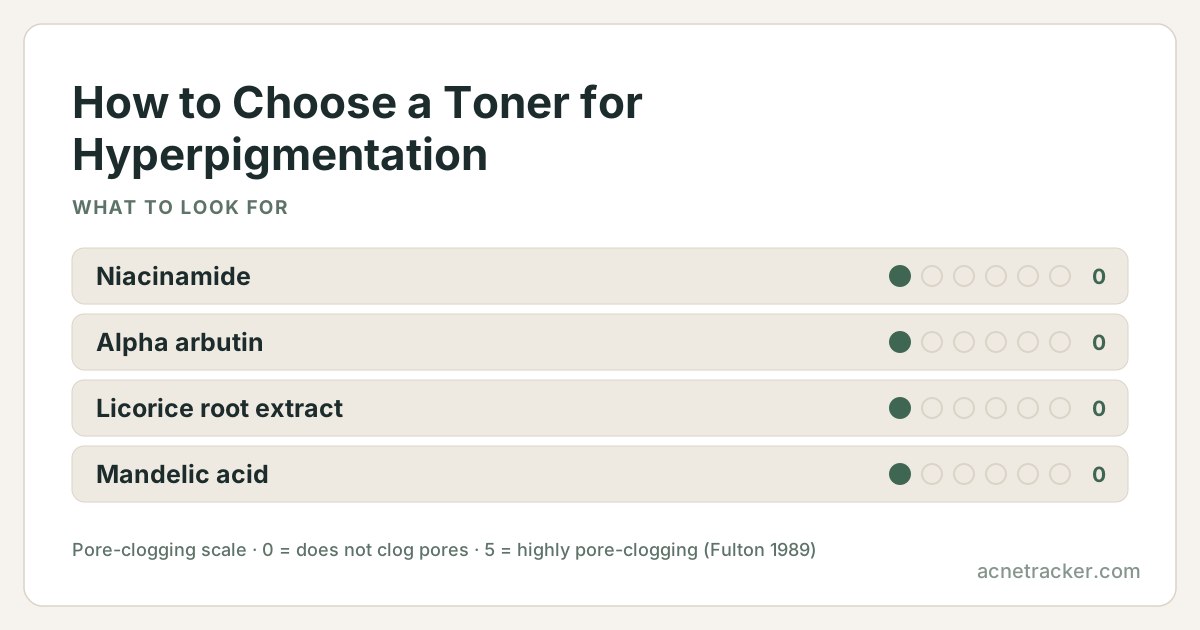
Ingredients to look for
| Ingredient | Why it matters |
|---|---|
| Niacinamide | Helps limit the transfer of pigment to surface cells and evens tone, a well-tolerated brightening support in a toner. |
| Alpha arbutin | A gentle, stable brightening agent that interrupts pigment formation and helps fade marks with low irritation risk. |
| Licorice root extract | A botanical brightener that helps calm and even discoloured, uneven skin. |
| Mandelic acid | A large-molecule AHA that resurfaces pigmented cells with less irritation, a safer exfoliant for tones prone to post-inflammatory marks. |
| Lactic acid | A gentle AHA that speeds turnover of pigmented surface cells while hydrating, helping marks fade gradually. |
Ingredients to avoid
| Ingredient | Why it matters |
|---|---|
| High-strength acids used aggressively | Over-exfoliation inflames skin, and inflammation drives more pigment — especially in medium and deeper tones, where it rebounds. |
| Denatured alcohol and other irritants | Irritation of any kind can trigger post-inflammatory pigmentation, working directly against the goal of fading marks. |
| Fragrance and essential oils | Common irritants that risk provoking the inflammation that darkens skin, with no brightening benefit. |
| Any brightening routine without sunscreen | UV re-darkens marks faster than any toner can fade them, making sun-unprotected effort largely wasted. |
How to choose
Keep expectations realistic: a toner supports a pigmentation routine but will not erase marks alone, and the serums and sunscreen do the heavy lifting. Look for a brightening toner built on well-tolerated actives such as niacinamide, alpha arbutin or licorice root, which interrupt pigment without much irritation. If you want gentle exfoliation to speed fading, mandelic or lactic acid used a couple of evenings a week is safer than strong glycolic peels, particularly on medium to deep skin tones prone to rebound darkening. Avoid harsh, irritating formulas entirely, because inflammation itself causes pigment. Read past 'whitening', 'brightening' and 'even-tone' claims to the actual ingredients. Most importantly, treat daily broad-spectrum SPF as part of the routine, not an optional add-on — without it, marks simply return no matter what the toner does.
How to apply
Apply a brightening toner to clean skin, morning and evening, over the whole area rather than dabbing only on marks, so you avoid creating patchy tone. If it contains an exfoliating acid, limit it to a couple of evenings a week and do not stack it with other strong actives. Follow with any pigment-focused serum and a moisturizer. The most important step is applying broad-spectrum SPF every morning and reapplying through the day, because sun exposure undoes fading. Expect gradual results over two to three months, and stop if skin becomes irritated, since irritation worsens pigmentation.
Frequently asked questions
Can a toner fade dark marks?
A brightening toner can support fading by delivering ingredients like niacinamide, alpha arbutin or gentle acids, but it works slowly and as part of a routine. Serums and, above all, daily sunscreen do more, so treat the toner as a helper, not a solution.
Which toner ingredients are best for hyperpigmentation?
Well-tolerated brighteners such as niacinamide, alpha arbutin and licorice root, optionally with a gentle exfoliating acid like mandelic or lactic acid. These fade marks with a lower risk of the irritation that can trigger more pigment.
Can an acid toner make pigmentation worse?
Yes, if it is used too hard — and the risk is easy to underestimate precisely because a toner feels like a mild step you would happily take daily. Over-exfoliation inflames the skin, and inflammation stimulates pigment, especially in medium and deep tones. This causes post-inflammatory hyperpigmentation. Gentle acids used sparingly fade marks without provoking this rebound, so daily use is not automatically safe just because the format is light.
Is a brightening toner worth using at all if I am not consistent with SPF?
Honestly, no — and that order of priorities is worth stating plainly. UV re-darkens marks faster than any brightening toner can fade them, so daily broad-spectrum SPF is the single most important part of the routine. Skipping it means working against yourself every day. If you only have the energy for one new habit, make it the sunscreen and add the toner later; the reverse order mostly buys disappointment.
Sources & further reading
There is no single study of this exact question. The guidance here is reasoned from the ingredient profiles below, each of which carries its own references:
- Niacinamide2 refs
- Alpha-Arbutin3 refs
- Licorice Root Extract2 refs
- Mandelic Acid2 refs
- Lactic Acid3 refs
Show every reference behind this page (8)
- Niacinamide: mechanisms of action and its topical use in dermatology (PubMed)cited by Niacinamide
- European Commission CosIng database — Niacinamidecited by Niacinamide, Alpha-Arbutin, Licorice Root Extract, Lactic Acid
- PubChem — Arbutincited by Alpha-Arbutin
- A comprehensive review of the therapeutic potential of α-arbutin (PubMed)cited by Alpha-Arbutin
- PubMed — Glabridin promotes melanosome degradation and alleviates melanosome-induced mitochondrial dysfunction in keratinocytes via autophagy (Biochem Biophys Res Commun, 2026)cited by Licorice Root Extract
- Mandelic acid — PubChem compound summarycited by Mandelic Acid
- DermNet — Alpha hydroxy acidscited by Mandelic Acid, Lactic Acid
- PubChem — Lactic acid compound summarycited by Lactic Acid
Medical disclaimer
Ingredients mentioned on this page
Find your personal acne triggers
Our free Acne Tracker lets you log breakouts, sleep, stress and diet, and shows you which factors correlate with your flare-ups.