How to Choose a Face Mask for Hyperpigmentation
This page has to start by talking you partly out of the purchase, because the evidence leaves no honest alternative. Melanin sits in the basal layer of the epidermis, produced by melanocytes that respond to UV, heat and inflammation over weeks. Every intervention shown to fade it works by inhibiting that production repeatedly, day after day, for two to six months. A mask is used twice a week for fifteen minutes. The mismatch is not a matter of formulation quality — it is arithmetic, and no ingredient overcomes it. Masks still have a place here. It is just a supporting one, and the products that will actually change your pigmentation are cheaper and duller than the mask you were about to buy.
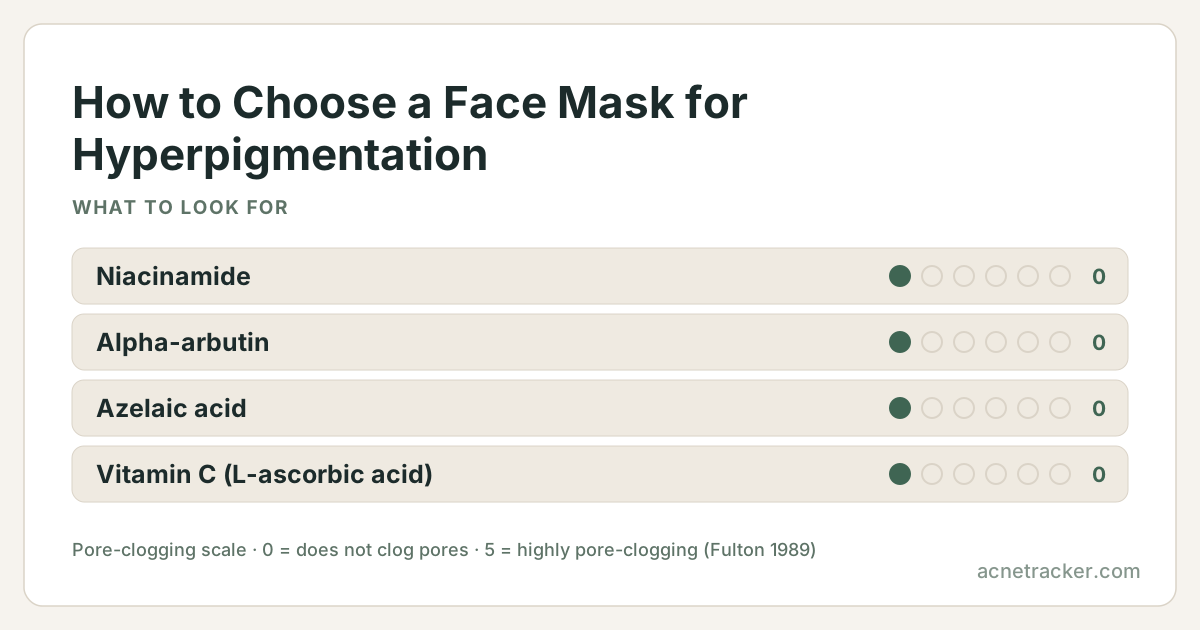
Ingredients to look for
| Ingredient | Why it matters |
|---|---|
| Niacinamide | Blocks the transfer of pigment from melanocytes to skin cells rather than bleaching what is there. The evidence uses daily leave-on application, which a mask does not replicate. |
| Alpha-arbutin | A tyrosinase inhibitor with a decent tolerability record. Same caveat: the data comes from consistent daily use over months, not from a weekly sitting. |
| Azelaic acid | Selectively targets overactive melanocytes and is among the better options for pigment on deeper skin tones. Rare in masks, and better used as a leave-on anyway. |
| Vitamin C (L-ascorbic acid) | Antioxidant and tyrosinase inhibitor, but unstable in water and prone to oxidising in a jar. A mask is a poor delivery format for it, whatever the front of the box says. |
| Lactic acid | The most defensible mask ingredient here — accelerating surface turnover removes pigmented cells that were already on their way out. Modest, real, and slow. |
Ingredients to avoid
| Ingredient | Why it matters |
|---|---|
| Hydroquinone in any unregulated mask | It is prescription-only in the EU for cosmetic skin lightening and banned from over-the-counter cosmetics. A mask offering it is operating outside the law, and unsupervised use risks ochronosis. |
| Mercury-containing skin-lightening products | Still found in some imported lightening masks and creams despite being banned everywhere that regulates. It is a genuine poisoning risk, not a cosmetic concern. |
| Aggressive acid masks on deeper skin tones | Irritation itself triggers melanin production, so an over-strong mask can leave you darker than before. This is the central trap of treating pigment on Fitzpatrick IV–VI. |
| Lemon juice and other DIY lightening masks | Citrus contains furocoumarins that cause phototoxic burns, and a burn heals with post-inflammatory pigment. It is the single most reliable way to make this worse. |
How to choose
Buy the mask only after the two things that matter are already in place, because without them it contributes nothing measurable. The first is daily broad-spectrum sunscreen, reapplied. Every pigment mechanism is driven by UV, and treating pigment without sun protection is emptying a bath with the tap running — this is not a slogan, it is why dermatology trials that omit sunscreen fail. The second is a leave-on active used nightly for at least three months. Once those exist, a wash-off lactic or mandelic acid mask once a week is a reasonable adjunct that speeds surface turnover slightly. Then read labels with a specific scepticism. 'Brightening' on a mask usually describes light reflection from a smoother surface, which is a texture claim wearing a pigment claim's clothes, and the two are routinely conflated because one is achievable in fifteen minutes and the other is not. Also identify what you have: melasma behaves differently from post-inflammatory pigment and from sun spots, it is driven by hormones and heat as well as light, and it recurs. If your pigment is patchy, symmetrical across the cheeks, or arrived during pregnancy or on the pill, see a dermatologist before you buy anything — melasma treated with the wrong product gets worse, and it is the pattern most often self-misdiagnosed.
How to apply
Use a wash-off exfoliating mask once weekly at most, on a night when you skip your leave-on active rather than in addition to it. Follow the stated contact time exactly; longer does not remove more pigment and irritation actively creates it. Rinse with lukewarm water — heat is an independent trigger for melasma, so hot water and steam are working against you. Sunscreen the following morning is mandatory rather than advisable, since exfoliated skin burns faster and a burn undoes months of progress in an afternoon.
Frequently asked questions
Can a face mask fade dark spots?
Not meaningfully on its own. Fading pigment requires suppressing melanin production consistently over months, and a twice-weekly fifteen-minute product cannot deliver that. A mask can slightly speed the shedding of already-pigmented surface cells, which is a supporting role.
How many masks would it take to see a difference in pigment?
The question has no answer, and that is the point. Pigment shifts over three to six months of daily suppression, so there is no number of weekly fifteen-minute sittings that adds up to the exposure the evidence describes. Anything promising results in days is describing surface glow.
Is a vitamin C mask worth it for pigmentation?
Rarely. L-ascorbic acid is unstable in water and degrades once a jar is opened, and it needs daily contact at a workable pH to inhibit tyrosinase. A well-formulated serum used every morning does far more than a weekly mask.
Why did my skin get darker after using a brightening mask?
Because irritation stimulates melanin. If a mask stings, burns or leaves you red, the inflammation can trigger post-inflammatory pigment — especially on deeper skin tones. Gentler and more consistent beats stronger every time here.
Does sunscreen matter more than the mask?
By a wide margin. UV drives the pigment production you are trying to reverse, so daily broad-spectrum sunscreen is the single highest-value product for this concern. Without it, nothing else you apply will hold its ground.
Sources & further reading
There is no single study of this exact question. The guidance here is reasoned from the ingredient profiles below, each of which carries its own references:
- Niacinamide2 refs
- Alpha-Arbutin3 refs
- Azelaic Acid3 refs
- Vitamin C3 refs
- Lactic Acid3 refs
Show every reference behind this page (10)
- Niacinamide: mechanisms of action and its topical use in dermatology (PubMed)cited by Niacinamide
- European Commission CosIng database — Niacinamidecited by Niacinamide, Alpha-Arbutin, Azelaic Acid, Vitamin C, Lactic Acid
- PubChem — Arbutincited by Alpha-Arbutin
- A comprehensive review of the therapeutic potential of α-arbutin (PubMed)cited by Alpha-Arbutin
- PubChem — Azelaic acid compound summarycited by Azelaic Acid
- DermNet — Azelaic acidcited by Azelaic Acid
- PubChem — Ascorbic Acid compound summarycited by Vitamin C
- DermNet — Topical vitamin Ccited by Vitamin C
- PubChem — Lactic acid compound summarycited by Lactic Acid
- DermNet — Alpha hydroxy acidscited by Lactic Acid
Medical disclaimer
Ingredients mentioned on this page
Find your personal acne triggers
Our free Acne Tracker lets you log breakouts, sleep, stress and diet, and shows you which factors correlate with your flare-ups.