How to Choose a Face Oil for Oily Skin
Putting oil on oily skin sounds like a mistake, and with the wrong oil it is one. But sebum is not the same substance as a plant oil, and oily skin is frequently dehydrated underneath — stripped by strong cleansers, then producing more shine to compensate. A well-chosen lightweight oil can break that loop by giving the surface something to hold onto so the skin stops over-compensating. The decisive factor is fatty acid composition, and secondarily the published comedogenicity of the specific oil. Below is the profile that behaves on shiny skin, the profile that does not, and where the research simply has no answer.
Ingredients to look for
| Ingredient | Why it matters |
|---|---|
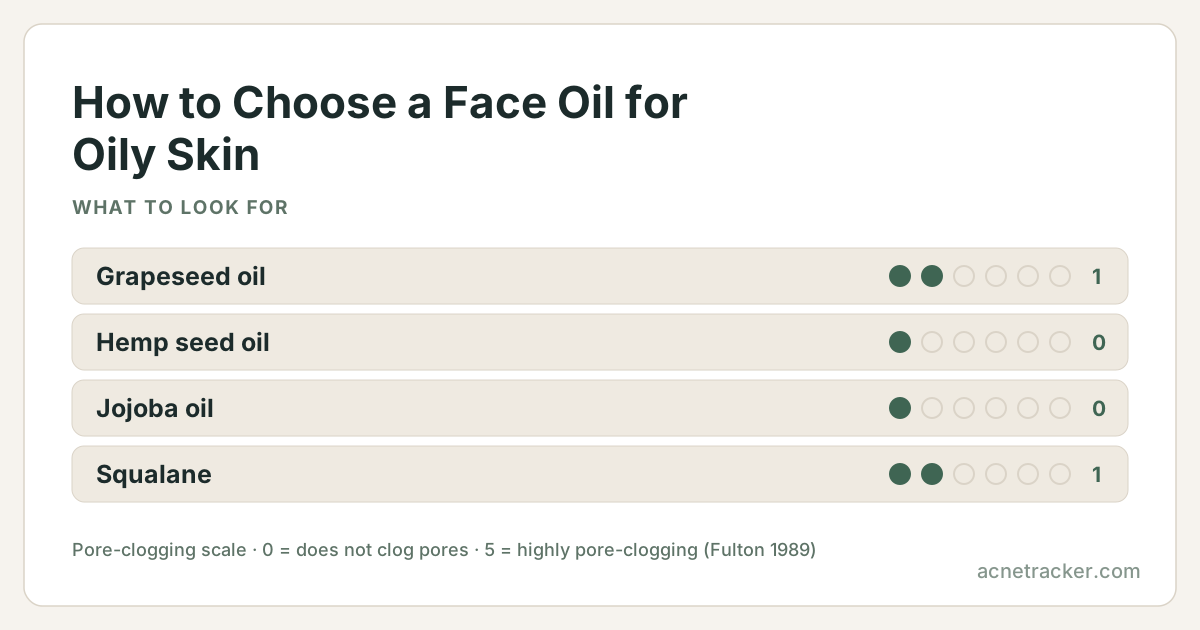
| Grapeseed oil | Around 70% linoleic acid — one of the fastest-absorbing plant oils. Note honestly: Fulton (1989) has no row for grapeseed, so no published rating exists for it. |
| Hemp seed oil | Roughly 55% linoleic and 20% linolenic acid; dries down matte rather than glossy. Reproduced tables list it at 0, outside Fulton's own table. |
| Jojoba oil | Technically a liquid wax ester, structurally close to human sebum. Fulton rates it 0, with reproduced sources ranging up to 2. |
| Squalane | Rated 1 by Fulton. Weightless, odourless, does not oxidise, and adds slip without the shine that heavier oils leave by mid-afternoon. |
| Safflower oil (high-linoleic type) | Fulton rates safflower seed oil 0. The high-linoleic cultivar is one of the lightest oils available and one of the few with a real published zero. |
Ingredients to avoid
| Ingredient | Why it matters |
|---|---|
| Coconut oil | High in lauric acid and rated 4 in reproduced tables; Fulton's own table gives coconut butter 4. On oily skin this is the single most reliable way to make things worse. |
| Cocoa butter | Fulton rates it 4. It is a fine body ingredient and a bad face ingredient for anyone whose pores already congest. |
| Isopropyl myristate | Fulton's rating is 5 — the top of the scale. It appears in blends as a texture enhancer precisely because it spreads well, which is not worth the risk here. |
| Heavy oleic oils (olive, marula, avocado) | They sit on the surface by design. Olive is rated 2 by Fulton, avocado 3, and all of them read as greasy on skin that is already producing plenty of its own oil. |
How to choose
Judge the oil by its dominant fatty acid first. Anything above roughly half linoleic acid — grapeseed, hemp, safflower, sunflower, rosehip — sinks in within a minute or two and leaves a matte-to-satin finish. Anything above half oleic acid stays put and reads as grease. Second, use the published comedogenic table rather than the front of the box: 'non-comedogenic' is an unregulated claim, whereas Fulton's numbers, for the oils he actually tested, are real data. Third, respect the gaps. Several oils marketed specifically at oily skin — grapeseed and marula among them — have no row in Fulton at all, so anyone quoting a rating for them is quoting something invented downstream. Fourth, prefer small dark bottles: high-linoleic oils are the most oxidation-prone, and an oxidised oil is more irritating than a fresh one. Finally, check what the oil is dissolved in. A 'balancing face oil' whose second ingredient is a fragrance blend is a perfume with an oil base, not a treatment.
How to apply
Less is the whole trick. Two to three drops at night, pressed onto damp skin after your serum, is enough for an entire oily face. Skip the morning application if you wear sunscreen — oils under SPF encourage pilling and can thin the film you rely on. If you break out along the jaw or hairline, pull the oil back to the drier cheek areas and leave the T-zone bare; oily skin is often combination skin that has not been mapped properly. Give any new oil four weeks before judging it, and change only one product at a time so you know what caused what.
Frequently asked questions
Does face oil make oily skin oilier?
Not inherently. A heavy oleic oil will look greasy, but a light linoleic oil absorbs. There is no good evidence that topical oil signals your sebaceous glands to produce more or less sebum — the effect people notice is about finish, not gland activity.
Is there any oil with a published comedogenic rating of zero?
Yes, a few. Fulton (1989) rates safflower seed oil, sunflower seed oil and jojoba seed oil at 0. Squalane sits at 1. Those four have real numbers behind them rather than repeated internet consensus.
What about grapeseed oil's comedogenic rating?
There is not one in Fulton's table. Grapeseed simply was not tested in that paper, so any specific number you see quoted for it did not come from the primary source. We would rather say that than invent a figure.
Should oily skin use face oil in the morning?
Generally no. Oil under sunscreen tends to pill and can compromise how the SPF film sets. Keep the oil for the evening, when it has all night to absorb and nothing has to layer over it.
Sources & further reading
There is no single study of this exact question. The guidance here is reasoned from the ingredient profiles below, each of which carries its own references:
- Grapeseed Oil3 refs
- Hemp Seed Oil2 refs
- Jojoba Oil2 refs
- Squalane3 refs
- Safflower Oil2 refs
Show every reference behind this page (8)
- European Commission CosIng database — Vitis Vinifera Seed Oilcited by Grapeseed Oil, Hemp Seed Oil, Jojoba Oil, Squalane, Safflower Oil
- PubChem — Linoleic acid (major grapeseed fatty acid)cited by Grapeseed Oil
- Vitis vinifera (Vine Grape) as a Valuable Cosmetic Raw Material (PubMed)cited by Grapeseed Oil
- Hemp (Cannabis sativa L.) seed oil: analytical and phytochemical characterization of the unsaponifiable fraction (J. Agricultural and Food Chemistry, 2014)cited by Hemp Seed Oil
- Pazyar N et al. Jojoba in dermatology: a succinct review. G Ital Dermatol Venereol 2013 Dec (PubMed)cited by Jojoba Oil
- PubChem — Squalane compound summarycited by Squalane
- DermNet — Emollients and moisturiserscited by Squalane
- PubMed — Safety Assessment of Plant-Derived Fatty Acid Oils (CIR, Int J Toxicol 2017)cited by Safflower Oil
Medical disclaimer
Ingredients mentioned on this page
Find your personal acne triggers
Our free Acne Tracker lets you log breakouts, sleep, stress and diet, and shows you which factors correlate with your flare-ups.