How to Choose a Face Mask for Mature Skin
Mature skin makes less sebum, holds less water, renews itself more slowly and has thinner, less organised collagen than it did at twenty. Only some of that is within a mask's reach, and the split is unusually clean. Hydration, surface smoothness and light reflection all live in the top layers and respond to twenty minutes of occlusion — which is why a good mask genuinely makes a face look better tonight. Collagen lives in the dermis and responds to sustained daily stimulation over months, which is why nothing you rinse off will change it. The category sells the second and delivers the first. Knowing which you are getting makes it a fair trade instead of a disappointment.
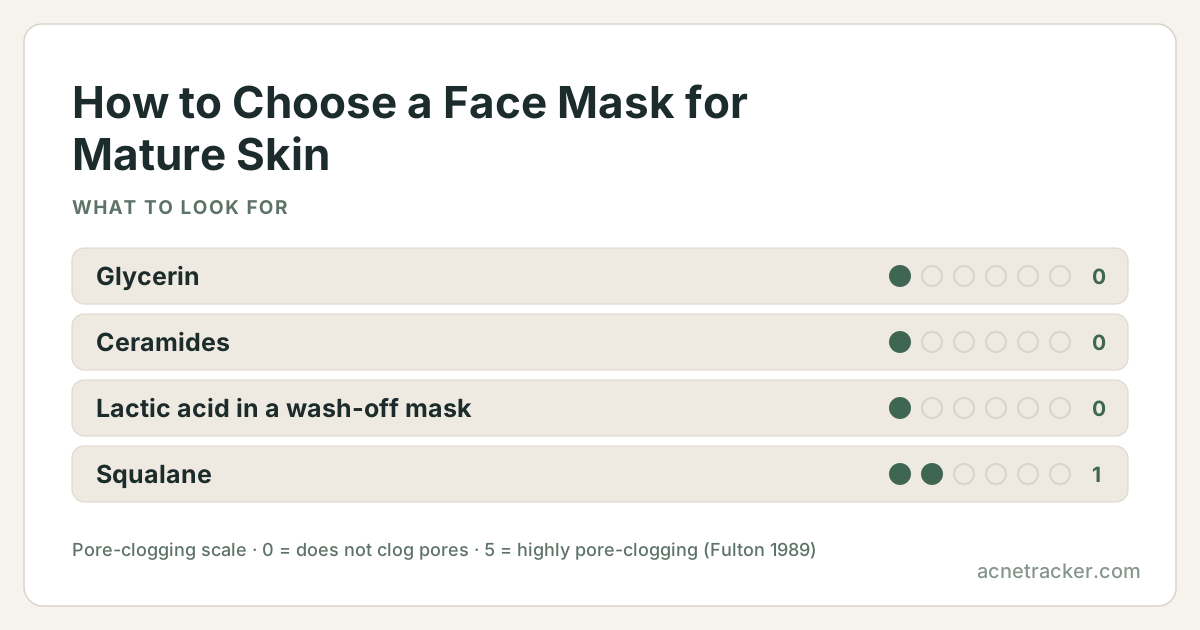
Ingredients to look for
| Ingredient | Why it matters |
|---|---|
| Glycerin | Fine lines look deeper on a dehydrated surface and shallower on a hydrated one. That is a real, immediate and entirely temporary effect, and it is most of what a mask delivers here. |
| Ceramides | Barrier lipid production declines with age, and topping up the missing material is one of the few age-related deficits a topical genuinely addresses. |
| Lactic acid in a wash-off mask | Slower turnover means dead cells linger. An AHA mask weekly removes them and is the best-evidenced thing in this aisle, though the effect is on texture, not structure. |
| Squalane | Skin's own squalene output falls with age. Squalane is the stable hydrogenated version, sits well under makeup and does not oxidise. Fulton rates it 1. |
| Niacinamide | Well-tolerated and multi-purpose, with data on barrier, pigment and fine lines from daily leave-on use — the caveat, as ever, being daily and leave-on. |
Ingredients to avoid
| Ingredient | Why it matters |
|---|---|
| 'Lifting', 'firming' and 'instant facelift' masks | The tightening you feel is a film-forming polymer such as PVP or an albumin drying and contracting on the surface. It looks smoother while it is on, and it washes off with it. |
| Collagen listed as a mask ingredient | The collagen molecule is far too large to cross the stratum corneum, and even if it did, your skin does not install donated collagen. In a mask it is a humectant with a persuasive name. |
| Peel-off masks on thinning skin | Skin gets more fragile and less elastic with age, and the mechanical tug of a peel-off film is a genuine trauma risk on it — bruising and tearing are not theoretical. |
| Layering an acid mask onto a retinoid routine | Mature skin is often already using a retinoid, and the barrier is slower to recover than it was. This is the commonest route to a sensitised face in this group. |
How to choose
Decide whether you want tonight or the long run, and buy accordingly — the two goals want different products and the confusion between them is what makes this category feel dishonest. For tonight, a rich hydrating or occlusive mask is excellent and nothing is wrong with buying one for that reason: plumping the stratum corneum genuinely softens the appearance of fine lines for several hours, and there is no dishonesty in an effect that works exactly as long as it works. For the long run, the products with real data are a nightly retinoid and daily sunscreen, and neither is a mask; photoageing accounts for the majority of visible facial ageing, so sun protection outperforms every jar on the shelf by a margin the industry has no incentive to mention. Between those, a weekly wash-off AHA mask is a defensible middle: cell turnover does slow with age, and clearing the surface helps light reflect evenly. Read firming claims as film-forming claims and they stop being annoying — you are buying a temporary polymer, priced as biology. And treat the word collagen on a mask as a marketing decision, since topical collagen cannot enter the skin and would not be incorporated if it did.
How to apply
Apply a hydrating mask to damp skin and do not rinse a cream formula off — massage the residue in, because the emollients are the product. Twenty minutes is enough. Reserve an exfoliating mask for one night a week and skip your retinoid that evening rather than stacking them. Include the neck and the backs of the hands, which age visibly and get treated half as often. If a mask stings on skin that never used to sting, that is thinning barrier rather than the product working, and it is a reason to go gentler.
Frequently asked questions
Can a face mask reduce wrinkles?
It can make fine lines look shallower for a few hours by hydrating the surface, which is real and temporary. It cannot change established wrinkles, because those are dermal collagen and elastin, and nothing rinsed off after twenty minutes reaches that layer.
Do firming and lifting masks work?
They work as advertised only if you read the advert literally. A film-forming polymer dries and contracts, which tightens the surface while the mask is on. Nothing is lifted, and the effect leaves with the rinse water.
Is collagen in a mask useful?
Not for building collagen. The molecule is far too large to penetrate the stratum corneum, and applied collagen is not used as raw material by your skin. It works as a surface humectant — a fine ingredient with a misleading implication.
What actually helps mature skin long term?
Daily broad-spectrum sunscreen and a nightly retinoid have the strongest evidence, and most visible facial ageing is photoageing rather than chronological. Both are unglamorous, cheap and slow, and they outperform any mask by a wide margin.
Are sheet masks worth it for mature skin?
For an evening, yes — the occlusion plumps the surface and skin sits better under makeup for a night. As a strategy, no. You are paying for a single-use serum plus packaging, and the benefit is gone by the following day.
Sources & further reading
There is no single study of this exact question. The guidance here is reasoned from the ingredient profiles below, each of which carries its own references:
- Glycerin3 refs
- Ceramides3 refs
- Lactic Acid3 refs
- Squalane3 refs
- Niacinamide2 refs
Show every reference behind this page (9)
- PubChem — Glycerol compound summarycited by Glycerin
- DermNet — Moisturiserscited by Glycerin, Squalane
- European Commission CosIng database — Glycerincited by Glycerin, Ceramides, Lactic Acid, Squalane, Niacinamide
- DermNet — Skin barrier functioncited by Ceramides
- PubChem — Ceramide compound summarycited by Ceramides
- PubChem — Lactic acid compound summarycited by Lactic Acid
- DermNet — Alpha hydroxy acidscited by Lactic Acid
- PubChem — Squalane compound summarycited by Squalane
- Niacinamide: mechanisms of action and its topical use in dermatology (PubMed)cited by Niacinamide
Medical disclaimer
Ingredients mentioned on this page
Find your personal acne triggers
Our free Acne Tracker lets you log breakouts, sleep, stress and diet, and shows you which factors correlate with your flare-ups.