How to Choose an Eye Cream for Mature Skin
The mature eye area presents three problems at once, and they get bundled together in a way that guarantees disappointment. Skin quality declines: the dermis thins, collagen falls, and the surface becomes crepey and translucent. Tissue laxity increases: the lid and the skin below it loosen and gather. Volume shifts: fat pads descend or protrude and the orbital rim becomes more visible. A cream can genuinely improve the first. It cannot alter the second or third. Splitting the problem this way is the most useful thing this page can offer, because it lets you spend your money and patience where they actually return something.
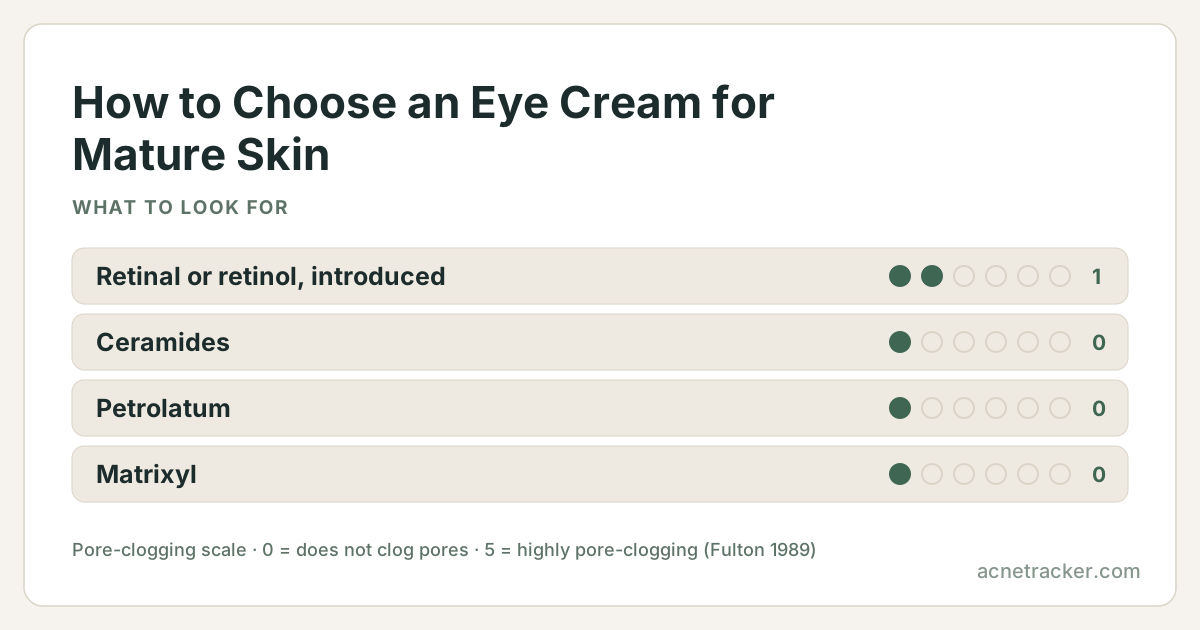
Ingredients to look for
| Ingredient | Why it matters |
|---|---|
| Retinal or retinol, introduced slowly | The best-evidenced route to the one problem that responds: thicker dermis, more collagen, better texture over six to twelve months. Mature lid skin is thinner and more reactive, so start lower than you think. |
| Ceramides | Barrier lipids decline with age and the eye area has almost no sebaceous glands to compensate. Replacing them addresses the crepiness that gets blamed on collagen but is often simply water loss. |
| Petrolatum | The most effective occlusive available and rated 0 in the reproduced comedogenicity lists rather than in Fulton's own table. Unfashionable, cheap, and the thing that stops a thin barrier leaking overnight. |
| Matrixyl | Worth including when retinoid tolerance is the limiting factor, which it often is on ageing lid skin. Modest published support for collagen signalling, and a low irritation profile. |
| Glycerin | Ageing skin holds water poorly, and this is the humectant with the longest track record of simply working. It costs almost nothing and belongs high on the ingredient list. |
Ingredients to avoid
| Ingredient | Why it matters |
|---|---|
| Lifting and firming claims on a cream | Laxity is tissue descent under gravity. Nothing applied to the skin surface repositions tissue, and the visible 'lift' in advertising is a film former drying tight for a few hours. |
| Rich creams containing fragrance | Skin sensitivity tends to rise with age while lid skin thins further, and fragrance is the single most common cause of eyelid contact dermatitis. Luxury texture with parfum is a bad trade here. |
| Aggressive acid exfoliation of the eye area | Thinning an already thin, translucent area increases both crepiness and the visibility of underlying vessels — the opposite of what you are paying for. |
| Starting a retinoid at face strength | Mature eyelid skin frequently reacts where it once tolerated. The failure mode is a fortnight of dermatitis followed by abandoning the only class with good evidence. |
How to choose
Sort your own concerns into the three buckets first, using a mirror. Crepey texture and fine surface lines go in the treatable bucket. Loose skin gathering on the lid, and hollows or bulges below, go in the buckets a cream does not reach — and if those bother you enough to spend real money, that is a consultation with a qualified doctor rather than a purchase. For the treatable bucket, the shopping list is short and boring: a retinoid at eye strength for the dermis, ceramides and glycerin for the barrier, an occlusive to stop overnight water loss, and sunscreen every morning because photoageing is the main driver of everything in this bucket. Texture should be richer than a twenty-year-old needs, since lid skin at sixty makes almost no oil of its own. Ignore price as a quality signal; there is no correlation between cost per millilitre and the presence of an evidenced active. Do read the fine print on packaging, because retinoids degrade in jars. And give it twelve weeks minimum before any judgement, with a photograph rather than a memory as the comparison.
How to apply
Apply to slightly damp skin morning and night, patting a rice grain along the orbital bone with the ring finger. Keep the retinoid to evenings, twice weekly at first, always below the lash line by a centimetre — it migrates. If the skin protests, buffer by applying moisturiser first and the retinoid on top. In a dry heated home, a heavier occlusive at night makes more visible difference to crepiness than any active does. Sunscreen to the orbital rim every morning, and sunglasses, which are the cheapest anti-ageing product for this area.
Frequently asked questions
What is the best eye cream ingredient after 50?
A retinoid, if you can tolerate it, because it addresses the dermal thinning that drives crepiness and fine lines. If you cannot, ceramides plus a good occlusive still improve the appearance meaningfully, since a lot of what reads as ageing here is simply chronic water loss.
Can eye cream tighten loose skin on eyelids?
No. Loose eyelid skin is excess tissue and lax attachment, and no topical repositions tissue. Retinoids may modestly improve skin quality over many months, which can make the area look better without making it tighter. Anything advertising an actual lift is describing a temporary drying film.
Should mature skin use a richer eye cream?
Usually yes. The eye area has very few oil glands to begin with and sebum production declines further with age, so a texture that felt heavy at thirty is often about right at sixty. The main caveat is that richer should not mean fragranced, since lid skin gets more reactive, not less.
Is it too late to start using eye cream at 60?
No, and the evidence is fairly clear on this: retinoid trials in older participants still show measurable collagen and texture changes. The gains are on skin quality rather than structure, so the realistic outcome is smoother, less crepey skin rather than a changed eye shape.
When should changes around the ageing eye be seen by a doctor?
If upper lid skin droops enough to interfere with your field of vision, if one lid changes noticeably and the other does not, if a lesion appears and does not heal, or if you notice soft yellowish plaques on the lids, which can be a marker worth investigating. Any sudden drooping or double vision deserves prompt attention rather than a cosmetic response.
Sources & further reading
There is no single study of this exact question. The guidance here is reasoned from the ingredient profiles below, each of which carries its own references:
- Retinal3 refs
- Ceramides3 refs
- Petrolatum3 refs
- Matrixyl2 refs
- Glycerin3 refs
Show every reference behind this page (10)
- European Commission CosIng database — Retinalcited by Retinal, Ceramides, Petrolatum, Matrixyl, Glycerin
- PubChem — Retinaldehydecited by Retinal
- Kwon HS et al. Efficacy and safety of retinaldehyde 0.1% and 0.05% creams used to treat photoaged skin: A randomized double-blind controlled trial. J Cosmet Dermatol 2018 Jun (PubMed)cited by Retinal
- DermNet — Skin barrier functioncited by Ceramides
- PubChem — Ceramide compound summarycited by Ceramides
- PubChem — Petrolatum (petroleum jelly)cited by Petrolatum
- Petroleum jelly: A comprehensive review of its history, uses, and safety (PubMed)cited by Petrolatum
- PubMed — Peptides: Emerging Candidates for the Prevention and Treatment of Skin Senescence: A Review (Biomolecules, 2025)cited by Matrixyl
- PubChem — Glycerol compound summarycited by Glycerin
- DermNet — Moisturiserscited by Glycerin
Medical disclaimer
Ingredients mentioned on this page
Find your personal acne triggers
Our free Acne Tracker lets you log breakouts, sleep, stress and diet, and shows you which factors correlate with your flare-ups.