How to Choose a Moisturizer for Dry Skin
Dry skin lacks oil, water, or — most often — both, and a moisturizer only fixes it if the formula covers three jobs at once: pulling water into the skin, smoothing the gaps between skin cells, and sealing everything in so it cannot evaporate. Those three jobs belong to three ingredient families — humectants, emollients and occlusives — and the difference between a moisturizer that works for eight hours and one that stops working by lunch is almost always which of the three the formula skimps on. This page explains the profile to look for on the label, whatever the brand.
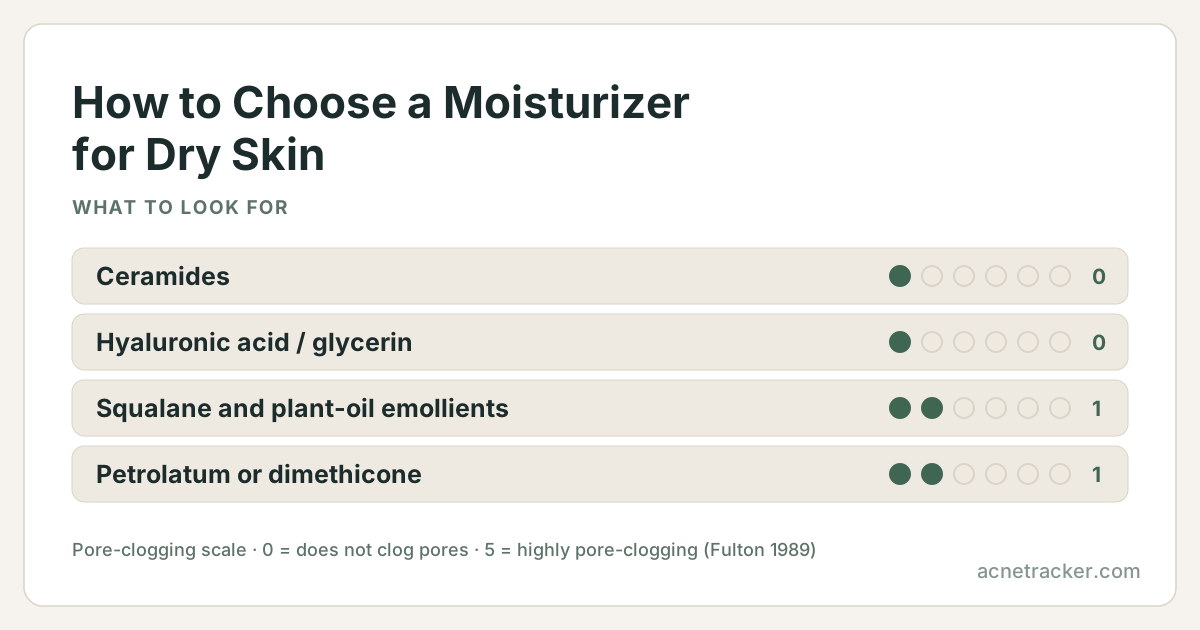
Ingredients to look for
| Ingredient | Why it matters |
|---|---|
| Ceramides | The lipids your barrier is built from; dry skin is typically ceramide-deficient. A cream that lists them is designed for repair, not just surface feel. |
| Hyaluronic acid / glycerin (humectants) | Bind water into the upper skin layers. Glycerin is unglamorous but the most reliable humectant in existence. |
| Squalane and plant-oil emollients | Fill the microscopic cracks between skin cells, converting rough and flaky into smooth and supple. |
| Petrolatum or dimethicone (occlusives) | The evaporation seal. Petrolatum reduces trans-epidermal water loss by up to 98% — no elegant-sounding alternative comes close. |
| Niacinamide | Boosts the skin's own ceramide production over weeks, making the cream's effect cumulative rather than purely cosmetic. |
Ingredients to avoid
| Ingredient | Why it matters |
|---|---|
| Alcohol denat. among the first few ingredients | Evaporates aggressively and undoes the cream's own moisture work; a small amount low on the list is harmless. |
| Fragrance and essential oils in leave-on products | The most common trigger of stinging and low-grade irritation on skin whose barrier is already cracked. |
| Water-thin lotions marketed as '24h hydration' | Without a meaningful occlusive, the water and glycerin evaporate within hours regardless of the claim on the front. |
| High concentrations of exfoliating acids in your only moisturizer | Dry skin often needs gentle exfoliation, but it belongs in a separate step you control — not baked into every application of your barrier cream. |
How to choose
Match richness to your dryness, not to a marketing tier. Tightness after washing but no flaking calls for a medium cream with glycerin, ceramides and dimethicone. Visible flaking, rough patches or winter-cracked skin needs a true occlusive — look for petrolatum, shea butter or mineral oil in the top third of the list. For overnight repair, the simplest effective trick in dermatology is 'slugging': a thin layer of plain petrolatum over your normal cream a few nights per week. Texture preferences are legitimate — a cream you dislike is a cream you skip — but check that a pleasant gel-cream aimed at dry skin still carries a real occlusive. Finally, ignore 'dermatologist-tested' (unregulated) and instead trust short ingredient lists, fragrance-free labelling, and the presence of the three families above.
How to apply
Apply within three minutes of washing, while skin is still damp — humectants need that surface water to trap, and the occlusive layer seals it in. Use more than you think: a proper layer for the whole face is roughly two fingertip-lengths of product. In cold, dry months, layer a hydrating serum underneath and consider slugging at night. Reapply on hands and around the nose after every wash; no formula survives repeated soap contact.
Frequently asked questions
What ingredient is most important in a moisturizer for dry skin?
If you can only check one thing, look for a real occlusive (petrolatum or dimethicone) plus glycerin. Humectants without a seal evaporate; a seal without humectants locks in too little.
Is hyaluronic acid enough for dry skin?
Alone, no. Hyaluronic acid binds water but does not stop it evaporating — in dry air it can even draw water out of the skin. It works when layered under a cream with occlusives.
Should dry skin use a different moisturizer at night?
A richer texture at night is practical rather than biological: you tolerate heavier occlusives while asleep, and overnight is when barrier repair peaks. A day cream that sits well under SPF plus a rich night cream is a sensible split.
Can a moisturizer cause breakouts on dry skin?
Yes — rich formulas can clog pores in acne-prone areas. If you are dry and breakout-prone, choose ceramide creams with lighter emollients (squalane rather than heavy butters) and check comedogenic ratings of the top ingredients.
Why does my skin feel tight an hour after moisturizing?
The formula is likely all humectant and no seal, or a cleanser upstream is stripping your barrier faster than the cream repairs it. Fix the cleanser first, then add an occlusive-containing cream.
Sources & further reading
There is no single study of this exact question. The guidance here is reasoned from the ingredient profiles below, each of which carries its own references:
- Ceramides3 refs
- Hyaluronic Acid3 refs
- Squalane3 refs
- Dimethicone3 refs
- Niacinamide2 refs
Show every reference behind this page (9)
- DermNet — Skin barrier functioncited by Ceramides
- PubChem — Ceramide compound summarycited by Ceramides
- European Commission CosIng database — Ceramide NPcited by Ceramides, Hyaluronic Acid, Squalane, Dimethicone, Niacinamide
- PubChem — Hyaluronic acid compound summarycited by Hyaluronic Acid
- DermNet — Moisturisers and humectantscited by Hyaluronic Acid, Squalane
- PubChem — Squalane compound summarycited by Squalane
- PubChem — Dimethicone (polydimethylsiloxane)cited by Dimethicone
- Final report on the safety assessment of stearoxy dimethicone, dimethicone, methicone, amino bispropyl dimethicone, aminopropyl dimethicone, amodimethicone, amodimethicone hydroxystearate, behenoxy dimethicone, C24-28 alkyl methicone, C30-45 alkyl methicone, C30-45 alkyl dimethicone, cetearyl methicone, cetyl dimethicone, dimethoxysilyl ethylenediaminopropyl dimethicone, hexyl methicone, hydroxypropyldimethicone, stearamidopropyl dimethicone, stearyl dimethicone, stearyl methicone, and vinyldimethicone (PubMed)cited by Dimethicone
- Niacinamide: mechanisms of action and its topical use in dermatology (PubMed)cited by Niacinamide
Medical disclaimer
Ingredients mentioned on this page
Find your personal acne triggers
Our free Acne Tracker lets you log breakouts, sleep, stress and diet, and shows you which factors correlate with your flare-ups.