How to Choose a Face Mask for Redness
Redness is blood, visible through skin. Vessels in the dermis dilate — because of inflammation, because of a barrier that is letting irritants through, because of heat, or because they simply do that in your face — and more blood closer to the surface reads as red. That physical picture immediately sorts the aisle, because most masks marketed for redness work on sensation rather than circulation. They make your face feel cool, which your brain files as calm, while the vessels underneath are untouched or actively provoked. The masks that genuinely help are duller: they either reduce the inflammation driving the dilation, or they repair the barrier that let the irritation start.
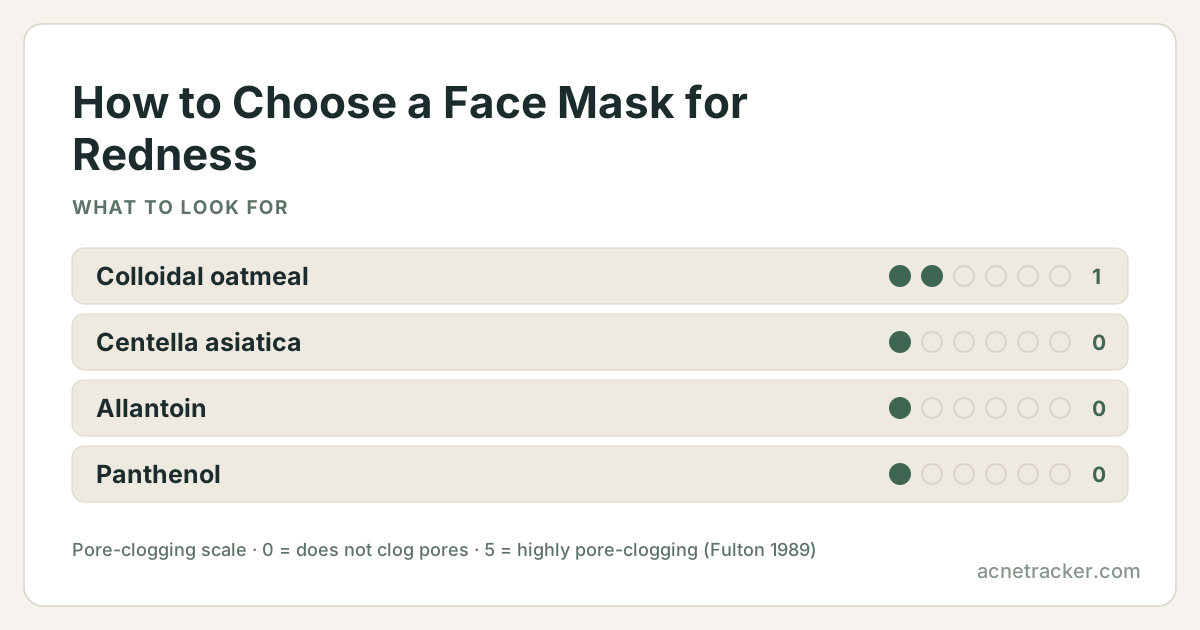
Ingredients to look for
| Ingredient | Why it matters |
|---|---|
| Colloidal oatmeal | Contains avenanthramides with anti-inflammatory activity, and it is recognised by the FDA as an OTC skin protectant. Fulton's table has no entry for it, so no rating is claimed. |
| Centella asiatica | Madecassoside and asiaticoside have reasonable data on inflammation and barrier repair — this is one of the few botanicals whose reputation is broadly earned. |
| Allantoin | Soothing, non-sensitising, no fragrance and no tingle. Fulton rates it 0. It does not feel like anything, which for redness is a recommendation. |
| Panthenol | Supports barrier recovery, and a repaired barrier lets fewer irritants through — which addresses the cause of the dilation rather than the colour. |
| Licorice root extract | Glycyrrhizin and its derivatives have anti-inflammatory activity with decent backing, and it is a common and defensible inclusion in calming masks. |
Ingredients to avoid
| Ingredient | Why it matters |
|---|---|
| Menthol, camphor, peppermint and eucalyptus | These trigger cold receptors — the face feels chilled while the vessels are unaffected or dilated further. Cooling and calming are different words for a reason, and this category conflates them constantly. |
| 'Self-heating' and warming masks | Heat dilates vessels. A mask that warms your face is doing the exact thing your redness is made of, whatever the box says about opening pores. |
| Clay masks over the red areas | Absorbency strips lipids, a weakened barrier admits more irritants, and more irritants means more inflammation. This is the loop that turns occasional redness into permanent redness. |
| Alcohol-heavy and fragranced 'soothing' masks | Both are common in products marketed as calming. Fragrance is the leading cosmetic contact allergen, and an allergic response is redness by definition. |
How to choose
Ask what the mask does to your blood vessels, not what it does to your nerve endings, and most of the shelf answers itself. A cream or gel mask with oatmeal, centella or allantoin in a plain, fragrance-free base is doing real if modest anti-inflammatory work. Anything that tingles, warms or delivers a menthol chill is trading on sensation and should be judged as an irritant. Then look past the mask to the cause, because redness is a symptom with several very different sources and the right response depends entirely on which you have. A compromised barrier from over-exfoliation is the commonest and the most fixable — stop the actives, simplify to a cleanser and a moisturiser, and the redness usually settles in a couple of weeks without any mask at all. Contact allergy needs the trigger identified and removed, and no soothing product substitutes for that. Flushing and visible vessels across the central face may be rosacea, which is a medical condition that responds to prescription treatment and is unhelped by cosmetics. Redness confined to spots is acne. The value of a calming mask, honestly stated, is that it makes an unhappy face more comfortable while the actual repair happens. That is worth something. It is not a treatment, and if your redness is persistent, worsening, or comes with visible vessels, burning or eye irritation, a doctor will do more for you than this aisle.
How to apply
Use on skin that is already flaring only if the formula is genuinely bland — a reactive face is not the place to try a new botanical. Apply thinly, lukewarm water only, and rinse gently with fingertips rather than a cloth, since friction is its own vasodilator. Cool water is fine and mildly constricting; ice is not, because rebound dilation follows. Stop at any sting. If the redness is barrier-related, the most useful thing you can do is nothing: no acids, no retinoids, no masks for two weeks, and a plain moisturiser twice daily.
Frequently asked questions
Do cooling masks reduce facial redness?
Not usually. Menthol and camphor stimulate cold receptors so the skin feels cool while the dilated vessels causing the redness are unchanged, and both are irritants that can worsen it. The relief is a sensation, not a mechanism.
Why is my face red after a face mask?
Most often irritation — from an acid, a fragrance, an essential oil, or a mask left on too long. Some flushing from the rinsing itself is normal and settles in twenty minutes. Redness still there an hour later means the mask did not suit you.
Are clay masks bad for redness?
Generally yes, on the red areas. Clay removes lipids, and a barrier short of lipids admits more of what is irritating you. If your face is red and you love clay, keep it on an oily nose and off the affected zones.
Can a mask fix redness permanently?
It depends entirely on the cause, and mostly no. Barrier-related redness resolves when you stop irritating the skin — masks are optional comfort. Rosacea and visible vessels need medical treatment. No cosmetic mask changes vascular anatomy.
Is redness after exfoliating normal?
Brief mild pinkness that fades within an hour is common. Redness that persists, stings or comes with tightness and flaking is over-exfoliation, and the answer is to stop — not to layer a calming mask on top and continue.
Sources & further reading
There is no single study of this exact question. The guidance here is reasoned from the ingredient profiles below, each of which carries its own references:
- Colloidal Oatmeal2 refs
- Centella Asiatica2 refs
- Allantoin3 refs
- Panthenol3 refs
- Licorice Root Extract2 refs
Show every reference behind this page (9)
- FDA OTC monograph — skin protectant drug products (colloidal oatmeal)cited by Colloidal Oatmeal
- PubMed — Colloidal oatmeal formulations as adjunct treatments in atopic dermatitis (J Drugs Dermatol, 2012)cited by Colloidal Oatmeal
- Bylka W et al. Centella asiatica in dermatology: an overview. Phytother Res 2014 Aug (PubMed)cited by Centella Asiatica
- European Commission CosIng database — Centella Asiatica Extractcited by Centella Asiatica, Allantoin, Panthenol, Licorice Root Extract
- PubChem — Allantoin compound summarycited by Allantoin
- Final report of the safety assessment of allantoin and its related complexes (PubMed)cited by Allantoin
- PubChem — Panthenol compound summarycited by Panthenol
- Safety Assessment of Panthenol, Pantothenic Acid, and Derivatives as Used in Cosmetics (PubMed)cited by Panthenol
- PubMed — Glabridin promotes melanosome degradation and alleviates melanosome-induced mitochondrial dysfunction in keratinocytes via autophagy (Biochem Biophys Res Commun, 2026)cited by Licorice Root Extract
Medical disclaimer
Ingredients mentioned on this page
Find your personal acne triggers
Our free Acne Tracker lets you log breakouts, sleep, stress and diet, and shows you which factors correlate with your flare-ups.