How to Choose a Moisturizer for Redness-Prone Skin
Facial redness has many causes — a weakened barrier, irritation from harsh products, environmental triggers, or an underlying condition like rosacea — but a well-chosen moisturizer helps most of them by calming inflammation and strengthening the barrier so the skin overreacts less. The goal is a gentle, soothing formula free of the fragrances, alcohols and 'cooling' actives that provoke flushing. This page describes the calming profile to look for and how to build a routine that reduces redness rather than adding to it. Persistent or patterned redness can signal a medical condition, so pair this with a doctor's view if it does not settle.
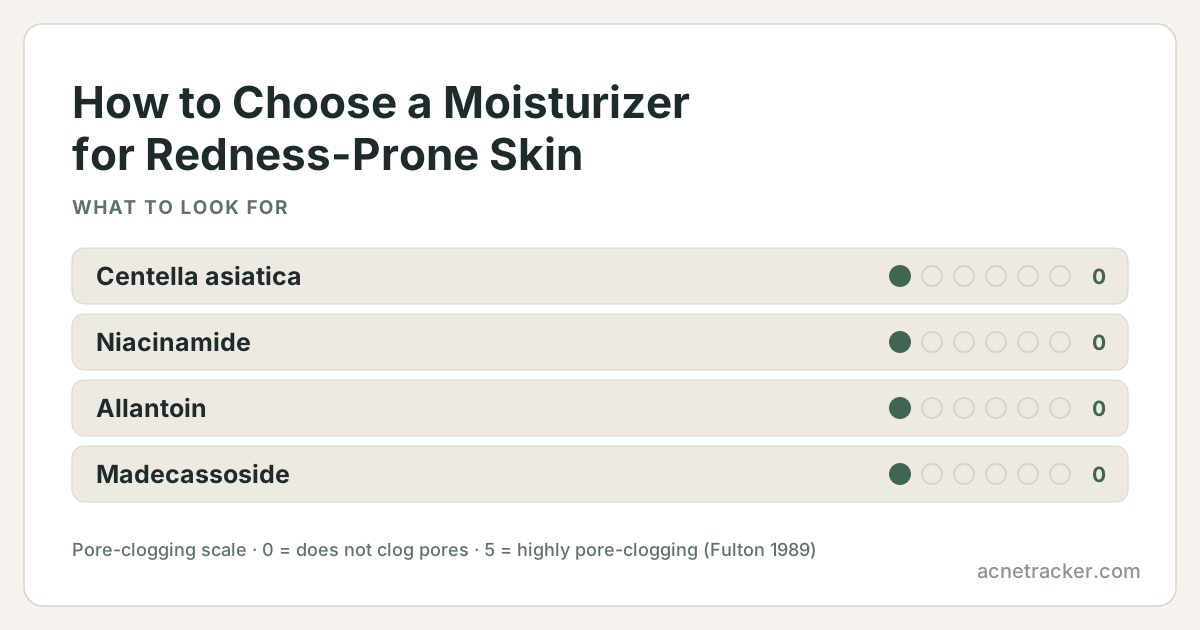
Ingredients to look for
| Ingredient | Why it matters |
|---|---|
| Centella asiatica | A well-tolerated botanical with evidence for calming redness and supporting the barrier, a strong anchor for reactive skin. |
| Niacinamide | Has anti-inflammatory action and strengthens the barrier, helping reduce both flushing and background redness over weeks. |
| Allantoin | A gentle soothing agent that calms irritated, reddened skin while it recovers. |
| Madecassoside | A purified centella compound specifically studied for reducing visible redness in sensitive skin. |
| Colloidal oatmeal | A skin-protectant that eases the itch and irritation that often accompany redness. |
Ingredients to avoid
| Ingredient | Why it matters |
|---|---|
| Fragrance and essential oils | Common irritants that provoke or worsen redness on reactive skin, even in small amounts. |
| Menthol, camphor and peppermint 'cooling' agents | They feel soothing but dilate vessels and are a frequent cause of the flushing you are trying to reduce. |
| Denatured alcohol high on the list | Its drying, irritating action undermines the barrier and tends to increase redness over time. |
| Scrubs and strong acids in a daily cream | Mechanical or strong chemical exfoliation inflames redness-prone skin and can trigger a lasting flush. |
How to choose
Choose for calm and barrier support. A good moisturizer for redness combines a soothing anti-inflammatory ingredient — centella, madecassoside, niacinamide or allantoin — with barrier support and a fragrance-free, short ingredient list. Avoid anything that tingles or cools, since that sensation usually means irritation on reactive skin. A green-tinted formula can visually neutralise redness, which is purely cosmetic but can help while the underlying calm builds. Because redness is often a symptom rather than a diagnosis, pay attention to the pattern: temporary redness from a harsh product usually settles once you simplify, while persistent central-face redness, visible vessels or bumps may point to rosacea or another condition worth a doctor's assessment. Sun protection matters too, as UV worsens most redness. Judge products by their soothing ingredients and what they leave out, not by 'anti-redness' claims on the front.
How to apply
Apply gently to slightly damp skin morning and evening, patting rather than rubbing to avoid mechanical flushing. Use lukewarm rather than hot water when cleansing, since heat dilates facial vessels. In the morning, follow with a mineral sunscreen once the cream absorbs, because sun is a leading redness trigger. If your skin is visibly irritated, cut back to just a gentle cleanser and this moisturizer for a week or two, and avoid introducing new actives until the redness settles.
Frequently asked questions
What ingredients calm facial redness?
Soothing anti-inflammatory ingredients like centella, madecassoside, niacinamide, allantoin and colloidal oatmeal help calm redness, especially when paired with barrier support and a fragrance-free formula.
Why does my skin get red after using skincare?
Redness after products usually signals irritation, often from fragrance, alcohol, strong acids or over-exfoliation. Simplifying to a gentle cleanser and a soothing moisturizer generally settles it.
Can a moisturizer get rid of redness permanently?
It can reduce redness by calming inflammation and strengthening the barrier, but it will not cure redness with a medical cause like rosacea. For persistent redness, see a doctor for targeted treatment.
Do cooling or menthol products help redness?
No, they usually make it worse. Menthol, camphor and peppermint feel refreshing but dilate blood vessels and irritate reactive skin, which increases flushing rather than reducing it.
When should facial redness be seen by a doctor?
If redness is persistent, centred on the cheeks and nose, comes with visible vessels or bumps, or does not settle with gentle care, see a doctor. It may be rosacea or another treatable condition.
Sources & further reading
There is no single study of this exact question. The guidance here is reasoned from the ingredient profiles below, each of which carries its own references:
- Centella Asiatica2 refs
- Niacinamide2 refs
- Allantoin3 refs
- Madecassoside3 refs
- Colloidal Oatmeal2 refs
Show every reference behind this page (9)
- Bylka W et al. Centella asiatica in dermatology: an overview. Phytother Res 2014 Aug (PubMed)cited by Centella Asiatica
- European Commission CosIng database — Centella Asiatica Extractcited by Centella Asiatica, Niacinamide, Allantoin, Madecassoside
- Niacinamide: mechanisms of action and its topical use in dermatology (PubMed)cited by Niacinamide
- PubChem — Allantoin compound summarycited by Allantoin
- Final report of the safety assessment of allantoin and its related complexes (PubMed)cited by Allantoin
- PubChem — Madecassoside (CID 24825675)cited by Madecassoside
- Therapeutic properties and pharmacological activities of asiaticoside and madecassoside: A review (PubMed)cited by Madecassoside
- FDA OTC monograph — skin protectant drug products (colloidal oatmeal)cited by Colloidal Oatmeal
- PubMed — Colloidal oatmeal formulations as adjunct treatments in atopic dermatitis (J Drugs Dermatol, 2012)cited by Colloidal Oatmeal
Medical disclaimer
Ingredients mentioned on this page
Find your personal acne triggers
Our free Acne Tracker lets you log breakouts, sleep, stress and diet, and shows you which factors correlate with your flare-ups.