How to Choose a Micellar Water for Redness
Facial redness has many causes — a compromised barrier, over-exfoliation, cold wind, reactive flushing — but they share one aggravator: cleansing done roughly. Micellar water can help by removing the day without hot water, foam or hard scrubbing, yet it can just as easily make redness worse if the formula stings or the cotton pad drags. This page focuses on the profile that keeps a micellar water calming for redness-prone skin, the ingredients that inflame rather than clean, and a technique built around minimal friction. It is worth being clear from the start: a cleanser cannot cancel redness, it can only avoid provoking more. We assess ingredient profiles instead of ranking brands, since redness answers to what touches the skin, not to a logo.
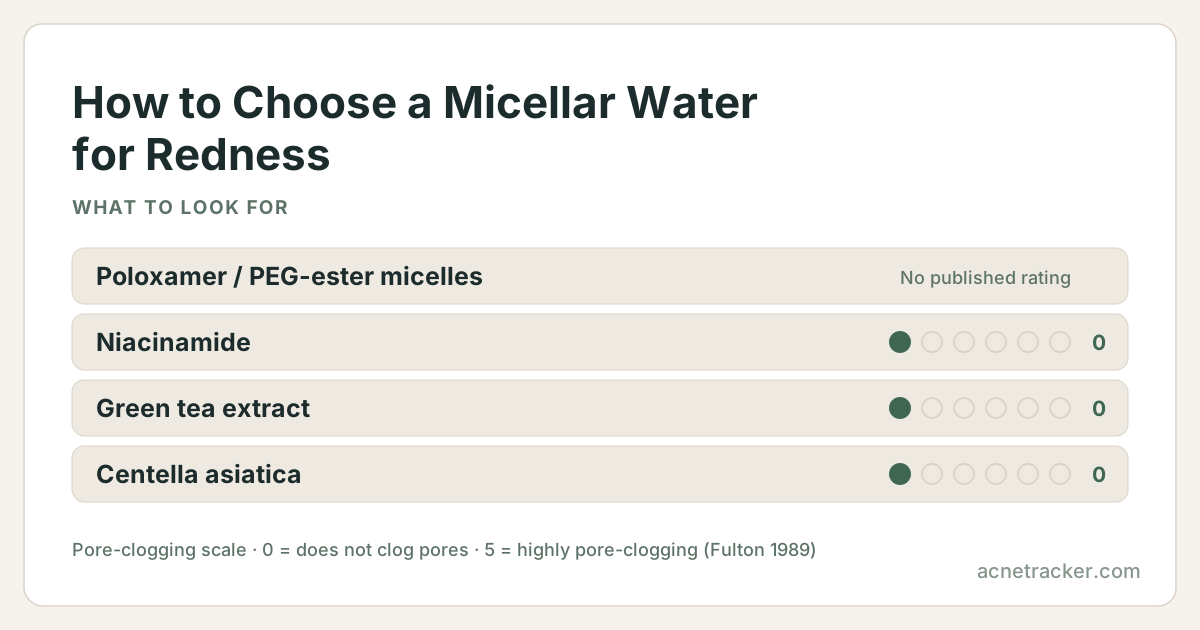
Ingredients to look for
| Ingredient | Why it matters |
|---|---|
| Poloxamer / PEG-ester micelles | The gentle non-ionic surfactants that lift grime at low strength, cleaning without the barrier disruption that shows up as redness. |
| Niacinamide | Only a bonus in a wiped-off product, but a well-studied ingredient associated with a calmer, less reddened complexion over time. |
| Green tea extract | An antioxidant botanical linked to reduced visible redness, a sensible extra in a leave-on formula. |
| Centella asiatica | A soothing botanical popular in calming skincare, suited to skin that reddens easily. |
| Allantoin | A mild agent that eases the sensation of irritation behind a lot of everyday redness. |
| Bisabolol | A chamomile-derived calmer that suits reactive, easily-reddened skin. |
Ingredients to avoid
| Ingredient | Why it matters |
|---|---|
| Denatured alcohol high on the list | The sting and rapid drying it causes is a direct route to more redness, not less. |
| Added fragrance and essential oils | Common sensitisers that can turn a faint pink into a visible flush, with no cleansing role. |
| Menthol, camphor and 'cooling' actives | The tingle is irritation; on redness-prone skin it deepens the colour it seems to soothe. |
| Coarse pads and repeated wiping | Mechanical friction dilates surface vessels and reddens the skin regardless of how mild the liquid is. |
How to choose
Assess a redness-focused micellar water by whether its whole design avoids provocation. The core should be minimal — water, a mild poloxamer/PEG surfactant, a humectant like glycerin, and a preservative — with calming extras such as niacinamide, green tea, centella or allantoin as bonuses rather than headline treatments. Rule out denatured alcohol near the top, all added fragrance, and any 'cooling' agent, because each of these commonly deepens redness. Trust a clear fragrance-free claim over soothing imagery on the label. Texture matters too: a slightly milky, cushioned water leaves a humectant film that comforts inflamed skin, while a thin, fast-drying one is more likely to rely on alcohol. Keep expectations honest — even the gentlest micellar water will not erase redness, so its job is purely to clean without adding to it, and it works best when paired with the leave-on treatments and barrier care that actually target the cause.
How to apply
Flood the pad so it never drags — friction is the fastest way to redden already-reactive skin. Lay it flat against the face for a few seconds to loosen makeup, then draw it across once in a single direction without pressing. Reach for a fresh pad rather than scrubbing a stubborn area. Because leftover surfactant can keep low-grade redness simmering, a quick lukewarm rinse afterwards is a good habit, particularly in the morning before actives and sunscreen. Finish with a barrier moisturiser while the skin is still damp; the sooner redness-prone skin is comforted, the calmer it stays.
Frequently asked questions
Can micellar water get rid of facial redness?
No. Micellar water is a gentle cleanser, so it cannot remove redness or treat its cause. The most it offers redness-prone skin is a way to clean without provoking more colour, which depends on a non-stinging formula and a light touch.
Why does my skin look redder after using micellar water?
Usually it is friction or an irritating ingredient rather than the micelles. A dry or coarse pad dragged across the face flushes the skin, and fragrance or alcohol can sting it pink. Saturate the pad, wipe once, and switch to a fragrance-free formula.
Which micellar water ingredients help redness-prone skin?
Calming additions like niacinamide, green tea, centella and allantoin are sensible, and glycerin keeps the surface comfortable. None of them treats the redness, but they avoid adding to it while the cleaning gets done.
Should I rinse micellar water off redness-prone skin?
A brief lukewarm rinse is worthwhile, since residual surfactant can keep mild redness simmering. Rinse and then apply a barrier moisturiser promptly, especially before sunscreen in the morning.
Is micellar water better than a foaming cleanser for redness?
Often yes, because it skips the hot water and vigorous lathering that can flush reactive skin. The trade-off is the cotton-pad friction, so the gentleness only holds if you wipe softly and choose a non-irritating formula.
Sources & further reading
There is no single study of this exact question. The guidance here is reasoned from the ingredient profiles below, each of which carries its own references:
- Niacinamide2 refs
- Green Tea Extract3 refs
- Centella Asiatica2 refs
- Allantoin3 refs
- Bisabolol3 refs
Show every reference behind this page (9)
- Niacinamide: mechanisms of action and its topical use in dermatology (PubMed)cited by Niacinamide
- European Commission CosIng database — Niacinamidecited by Niacinamide, Green Tea Extract, Centella Asiatica, Allantoin, Bisabolol
- PubChem — Epigallocatechin gallate (EGCG)cited by Green Tea Extract
- Green tea and the skin (PubMed)cited by Green Tea Extract
- Bylka W et al. Centella asiatica in dermatology: an overview. Phytother Res 2014 Aug (PubMed)cited by Centella Asiatica
- PubChem — Allantoin compound summarycited by Allantoin
- Final report of the safety assessment of allantoin and its related complexes (PubMed)cited by Allantoin
- PubChem — Bisabolol (CID 1549992)cited by Bisabolol
- RIFM fragrance ingredient safety assessment, α-bisabolol, CAS registry number 515-69-5 (PubMed)cited by Bisabolol
Medical disclaimer
Ingredients mentioned on this page
Find your personal acne triggers
Our free Acne Tracker lets you log breakouts, sleep, stress and diet, and shows you which factors correlate with your flare-ups.