How to Choose a Face Mask for Post-Acne Marks
Before choosing anything, work out which of three things you are looking at, because they are routinely confused and they need opposite expectations. Red or purple flat marks are post-inflammatory erythema — dilated capillaries left behind after the inflammation settled. Brown or grey flat marks are post-inflammatory hyperpigmentation — melanin deposited during healing. Both are flat, both are temporary, and both fade on their own given long enough. Indented or raised marks are scars, which are collagen damage and do not fade at all. Run a fingertip over the mark: if the surface is level, time is on your side and a mask is optional. If it is not level, no topical product in any category will fix it.
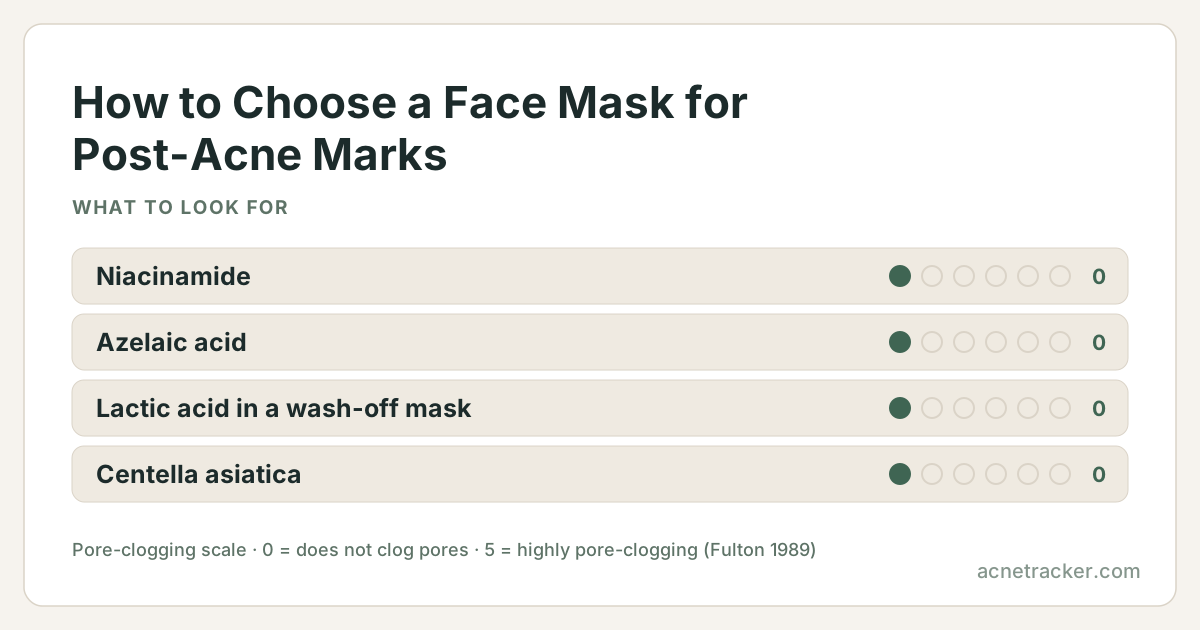
Ingredients to look for
| Ingredient | Why it matters |
|---|---|
| Niacinamide | One of the few ingredients with a claim on both mark types — it interrupts pigment transfer and has anti-inflammatory activity. Daily leave-on use is where the evidence sits. |
| Azelaic acid | Unusually well suited here because it targets pigment and inflammation at once, which is exactly the two-headed problem post-acne marks present. |
| Lactic acid in a wash-off mask | Speeds the shedding of pigment-laden surface cells. A genuine if small contribution to brown marks, and no help at all for red ones. |
| Centella asiatica | The more defensible choice for the red kind, since erythema is a vascular and inflammatory story rather than a pigment one. Evidence is modest but it exists. |
| Licorice root extract | Contains glabridin, a tyrosinase inhibitor with real in-vitro backing. Cosmetic concentrations are low, so treat it as a bonus rather than the reason to buy. |
Ingredients to avoid
| Ingredient | Why it matters |
|---|---|
| Picking, squeezing and extracting between masks | The most important line on this page. Every mark you have is the memory of an inflamed lesion, and mechanical trauma deepens and prolongs the mark. This undoes more progress than any product recovers. |
| Strong acid masks used to 'burn off' marks | Irritation is what created post-inflammatory pigment in the first place. Applying more inflammation to fade a mark caused by inflammation is a loop, and it is a common one. |
| Expecting a mask to fix indented scarring | Rolling, boxcar and icepick scars are structural collagen loss. They need needling, resurfacing or subcision from a professional. No mask, acid or oil reaches that layer. |
| Vitamin E oil straight from a capsule | A persistent scar-fading folk remedy with poor evidence, a meaningful contact dermatitis rate, and a comedogenic risk on skin that is still breaking out. |
How to choose
Match the product to the colour, because this is the distinction the aisle ignores. Brown marks are a pigment problem and respond to the same slow toolkit as any hyperpigmentation: daily sunscreen, a nightly leave-on active, and months of patience — a wash-off acid mask once a week is a legitimate accelerant, and it is nowhere near the main event. Red marks are a vascular problem and are largely immune to the entire mask category. They fade as the dilated capillaries constrict over three to six months, and there is no strong evidence that any topical meaningfully speeds that; what helps is not irritating the area and not getting new lesions on top of it. Sunscreen matters more than it sounds for both, since UV darkens brown marks and sustains redness in healing skin, so an unprotected mark simply takes longer. Above all, keep the acne under control. Marks are the receipt for lesions you already had, and treating marks while new spots keep arriving means adding new receipts as fast as the old ones fade. If your acne is still active, the mark product is the second purchase and the acne treatment is the first — and if the acne is inflamed, nodular or scarring, that first purchase should be a dermatologist appointment, because preventing marks is enormously easier than fading them.
How to apply
Once weekly for an exfoliating mask, on a night off from your leave-on active, never on skin with open or inflamed lesions — acid on a broken spot buys you a longer mark, not a shorter one. Apply across the whole area rather than dabbing individual marks: spot-treating an acid creates a halo of over-exfoliated skin around each mark. Rinse, moisturise, and use sunscreen the next morning. If you are prone to hyperpigmentation, patch test on the jaw and start every acid at the lowest strength you can find.
Frequently asked questions
Will masking speed up how fast my marks fade?
Only slightly, and only the brown ones. Red marks settle over roughly three to six months and brown marks over six to twelve regardless of what you apply — both go on their own. A weekly acid mask nudges the brown timeline; nothing transforms it.
What is the difference between a post-acne mark and an acne scar?
Texture. A mark is flat discolouration and will eventually go. A scar is a change in the skin's surface — indented or raised — caused by collagen damage, and it will not resolve on its own or with any topical product.
Do masks help red acne marks?
Barely. Red marks are dilated capillaries, not pigment or texture, and that is the one mechanism nothing in this aisle addresses. Soothing ingredients keep you comfortable while the redness fades on its own schedule.
Can an acid mask make post-acne marks worse?
Yes, and this is the trap. Post-inflammatory pigment is caused by inflammation, so an over-strong mask that leaves skin red and irritated can deepen the very marks you are treating — particularly on deeper skin tones.
Should I mask over an active breakout to prevent marks?
No. The way to prevent marks is to control the acne and leave the lesions alone. Masking an inflamed spot with an acid adds irritation to a follicle that is already inflamed, which tends to produce a longer-lasting mark.
Sources & further reading
There is no single study of this exact question. The guidance here is reasoned from the ingredient profiles below, each of which carries its own references:
- Niacinamide2 refs
- Azelaic Acid3 refs
- Lactic Acid3 refs
- Centella Asiatica2 refs
- Licorice Root Extract2 refs
Show every reference behind this page (8)
- Niacinamide: mechanisms of action and its topical use in dermatology (PubMed)cited by Niacinamide
- European Commission CosIng database — Niacinamidecited by Niacinamide, Azelaic Acid, Lactic Acid, Centella Asiatica, Licorice Root Extract
- PubChem — Azelaic acid compound summarycited by Azelaic Acid
- DermNet — Azelaic acidcited by Azelaic Acid
- PubChem — Lactic acid compound summarycited by Lactic Acid
- DermNet — Alpha hydroxy acidscited by Lactic Acid
- Bylka W et al. Centella asiatica in dermatology: an overview. Phytother Res 2014 Aug (PubMed)cited by Centella Asiatica
- PubMed — Glabridin promotes melanosome degradation and alleviates melanosome-induced mitochondrial dysfunction in keratinocytes via autophagy (Biochem Biophys Res Commun, 2026)cited by Licorice Root Extract
Medical disclaimer
Ingredients mentioned on this page
Find your personal acne triggers
Our free Acne Tracker lets you log breakouts, sleep, stress and diet, and shows you which factors correlate with your flare-ups.