How to Choose a Face Mask for Cystic Acne
This page exists to be honest rather than useful, because the useful answer is not a product. A cyst is a deep inflammatory lesion in the dermis, formed when a follicle wall ruptures below the surface and its contents spill into surrounding tissue. It is millimetres down, walled off, and physically unreachable by anything you rinse off after fifteen minutes. There is no mask, no clay, no active and no formulation trick that changes that — it is anatomy, not a gap in the market. Cystic acne is also the form that scars, and scarring is permanent. So the recommendation on this page is a dermatologist appointment, made sooner rather than later, and everything else is a footnote to it.
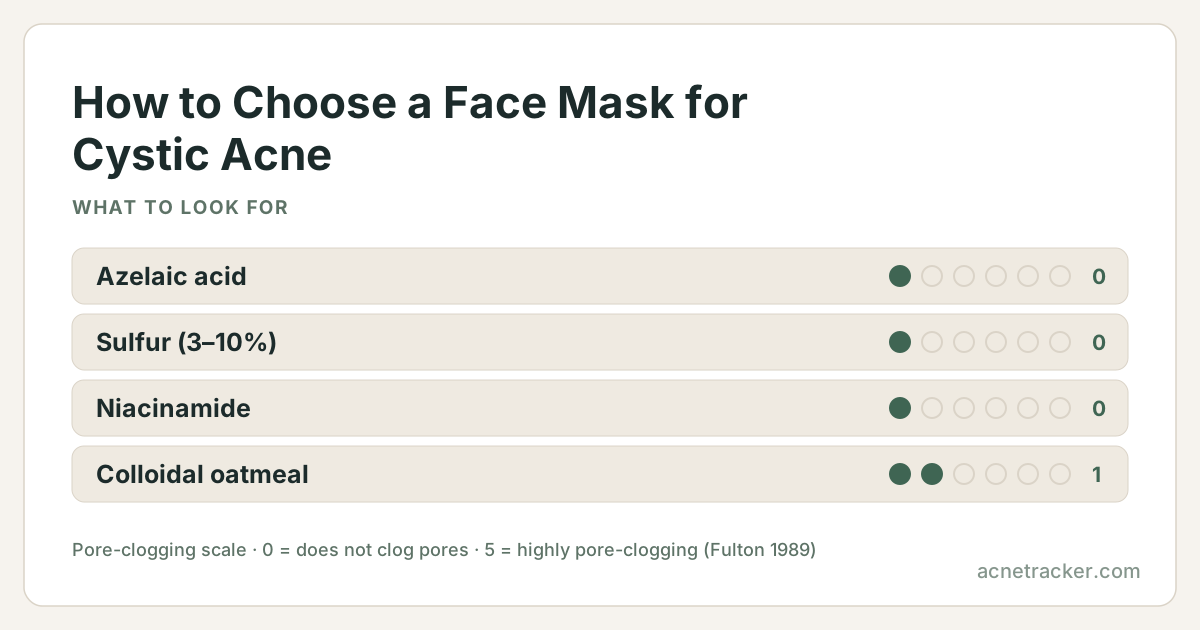
Ingredients to look for
| Ingredient | Why it matters |
|---|---|
| Azelaic acid | Anti-inflammatory and anticomedogenic with genuine acne evidence, and safe in pregnancy. It works on the surrounding skin, not the cyst, and it is better used daily than in a mask. |
| Sulfur (3–10%) | The most defensible mask active for acne-prone skin generally. Fulton rates precipitated sulfur 0. It manages the non-cystic lesions around the cysts and does not reach the cysts. |
| Niacinamide | Anti-inflammatory and well tolerated, useful for keeping the skin around an active flare comfortable — a supporting role, honestly labelled. |
| Colloidal oatmeal | For comfort on skin that is sore and often also dried out by prescription treatment. It has no row in Fulton's 1989 table, and we would rather say that than invent a number. |
| Centella asiatica | Reasonable evidence for irritated skin, and cystic acne is frequently accompanied by a barrier struggling under benzoyl peroxide or a retinoid. |
Ingredients to avoid
| Ingredient | Why it matters |
|---|---|
| Trying to draw a cyst out with clay | The core misconception. Clay adsorbs oil from the surface; a cyst is inflammation millimetres below it. There is nothing to draw, no path to draw it through, and the attempt only dries the skin on top of it. |
| Squeezing, needling or applying pressure to a cyst | The most damaging thing on this list. A cyst has no exit path, and force ruptures it further into the dermis — more inflammation, a longer lesion and a much higher chance of a permanent scar. |
| Strong acid masks over active cysts | Acids work on the surface and cannot reach the lesion, so all you get is irritation on inflamed skin, which increases post-inflammatory pigment on a lesion already likely to leave a mark. |
| Delaying treatment while working through cosmetics | The most expensive item here, and it is not a product. Scarring is happening while you experiment. Every month spent on masks is a month a dermatologist could have been treating it. |
| Toothpaste, garlic and other DIY 'cyst' remedies | All cause chemical irritation or burns, none reach the dermis, and the resulting damage sits on top of skin already destined to mark. |
How to choose
The honest framing is that you are not choosing a mask, you are choosing whether to keep spending months on the wrong category. Cystic acne responds to medical treatment — isotretinoin, hormonal options such as combined oral contraceptives or spironolactone, prescription topicals, intralesional corticosteroid injections for an individual lesion — and each of those is a conversation with a doctor rather than a purchase. They work, which is precisely why delaying them is costly: scars are collagen loss and no topical repairs them, so the time spent trying masks is time in which permanent damage accumulates. If you want a mask alongside proper treatment, choose it for comfort and for the skin around the lesions, not for the lesions. A bland, fragrance-free soothing mask is the sensible choice, particularly since prescription acne treatment is drying and a calming product genuinely helps you tolerate the thing that is actually working. A sulfur mask once a week is reasonable for the non-cystic lesions. Skip clay over active cysts, skip acids entirely during a flare, and ignore anything advertising extraction, drawing out or purging — those words describe a mechanism that does not exist, and here they describe it about a lesion the product cannot even reach. See a dermatologist. That is the whole page.
How to apply
If you use a soothing mask, apply it around and between lesions rather than on top of them, thinly, with no massage and no pressure. Lukewarm water, fingertips only, no cloths. Never mask on a day you have had an injection or started a new prescription. Do not use a mask to justify touching your face: the strongest thing you can do for a cyst is leave it completely alone, because the difference between a lesion that fades and a scar that does not is usually mechanical trauma.
Frequently asked questions
Can a face mask help cystic acne?
Not the cysts themselves. A cyst is deep dermal inflammation and no rinse-off product reaches it. A soothing mask can make the surrounding skin more comfortable alongside medical treatment, which is worth something and is not a treatment.
Will a clay mask draw out a cyst?
No. Clay adsorbs oil sitting on the surface — that is the whole mechanism. A cyst is millimetres below, walled off in the dermis, with no path to the surface. 'Drawing out' is marketing language, not a description of anything happening.
What actually treats cystic acne?
Prescription medicine. Isotretinoin, hormonal treatments, prescription topicals, and cortisone injections for individual lesions all have real evidence behind them. All of them come from a doctor, and none from a shelf.
Why should I see a dermatologist quickly for cystic acne?
Because cystic acne scars, and scars are permanent. Effective treatment exists, so every month spent on cosmetics is a month in which avoidable collagen damage accumulates. Early treatment is the single best predictor of how your skin looks in ten years.
Is it safe to use acids or exfoliating masks during a cystic flare?
It is generally a bad idea. Acids act on the surface and cannot reach the lesion, so you gain nothing and add irritation to inflamed skin — which raises the risk of post-inflammatory pigment on lesions already prone to marking.
Sources & further reading
There is no single study of this exact question. The guidance here is reasoned from the ingredient profiles below, each of which carries its own references:
- Azelaic Acid3 refs
- Sulfur2 refs
- Niacinamide2 refs
- Colloidal Oatmeal2 refs
- Centella Asiatica2 refs
Show every reference behind this page (8)
- PubChem — Azelaic acid compound summarycited by Azelaic Acid
- DermNet — Azelaic acidcited by Azelaic Acid
- European Commission CosIng database — Azelaic Acidcited by Azelaic Acid, Niacinamide, Centella Asiatica
- FDA OTC monograph — acne drug products (sulfur 3–10%)cited by Sulfur, Colloidal Oatmeal
- PubChem — Sulfur (CID 5362487)cited by Sulfur
- Niacinamide: mechanisms of action and its topical use in dermatology (PubMed)cited by Niacinamide
- PubMed — Colloidal oatmeal formulations as adjunct treatments in atopic dermatitis (J Drugs Dermatol, 2012)cited by Colloidal Oatmeal
- Bylka W et al. Centella asiatica in dermatology: an overview. Phytother Res 2014 Aug (PubMed)cited by Centella Asiatica
Medical disclaimer
Ingredients mentioned on this page
Find your personal acne triggers
Our free Acne Tracker lets you log breakouts, sleep, stress and diet, and shows you which factors correlate with your flare-ups.