How to Choose a Face Mask for Combination Skin
Combination skin is the concern where the mask format has a genuine structural advantage over almost everything else in a routine, and it is not the advantage the marketing talks about. You cannot easily wear one moisturiser on your nose and another on your cheeks; the products migrate and you end up compromising. A mask is thick, it stays where you put it, and it is rinsed off before it goes anywhere. That makes it the one product you can honestly zone. The industry named this multi-masking and sold it as an elaborate ritual with four jars. It is a good idea attached to an inflated price, and it works with two.
Ingredients to look for
| Ingredient | Why it matters |
|---|---|
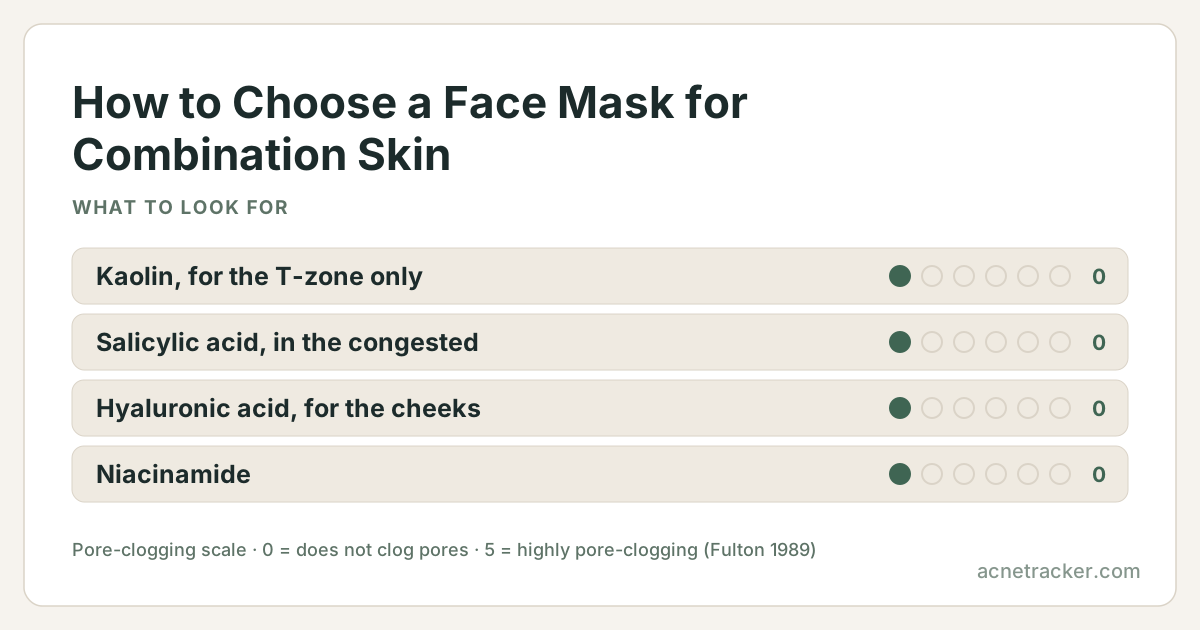
| Kaolin, for the T-zone only | Enough absorbency for a shiny forehead and nose without the stiffness bentonite can leave. Fulton rates it 0. The gentler clay suits a face that is only partly oily. |
| Salicylic acid, in the congested zone | Oil-soluble, so it goes where the congestion is. Applying it only to the T-zone spares cheeks that never needed it and often cannot take it. |
| Hyaluronic acid, for the cheeks | The other half of the face usually needs water, not absorption. A hydrating gel on the cheeks while clay sits on the nose is the whole technique. |
| Niacinamide | One of the few ingredients that suits both halves — it is tolerated on dry areas and has published sebum data on oily ones. Useful when you want a single mask. |
| Glycerin | In a clay base it stops the absorbency from overshooting, which matters more on combination skin because the mask edges reach areas that are not oily. |
Ingredients to avoid
| Ingredient | Why it matters |
|---|---|
| Full-face clay by default | The commonest mistake in this category: a mask chosen for the nose gets applied to cheeks that are already dry, and the flaking is then blamed on the weather. |
| Buying four masks to multi-mask 'properly' | Two covers it — one absorbent, one hydrating. The four-jar version is a merchandising idea, and the extra two are the same two with different botanicals. |
| Balancing and 'normalising' claims | No mask regulates sebaceous glands toward some average. Your T-zone is oily and your cheeks are not because the glands are distributed unevenly, which is anatomy, not imbalance. |
| Strong acids across the whole face | The cheeks and the nose have different tolerances. One contact time cannot be correct for both, and it is the cheeks that pay for a setting chosen for the nose. |
How to choose
Think in zones and buy for the extremes, not the average. The mistake combination skin keeps making is looking for one product that handles the whole face, which produces a mask that is too drying for the cheeks and too weak for the nose — a compromise that serves neither. Two products, applied to different real estate on the same evening, cost about the same and actually fit the face. For the T-zone, choose by clay: kaolin if you want moderate absorbency, bentonite if your nose genuinely runs oily by midday. For the cheeks, choose a hydrating gel or cream mask and ignore anything absorbent. If you would rather have one jar, a hydrating mask used everywhere plus a thin skim of clay on the nose alone is a better single-purchase strategy than the reverse, because under-treating oil costs you a shiny afternoon while over-treating dryness costs you a compromised barrier for a week. Two ideas do not survive the honesty test: nothing balances or normalises sebum production, and clay does not draw anything out of the follicle — it takes oil off the top, and that oil is back on its own schedule.
How to apply
Cleanse, then apply the absorbent mask to the forehead, nose and chin in a thin layer, staying inside the shiny area rather than blending outward. Apply the hydrating mask to the cheeks and around the eyes. Rinse the clay first if the timings differ — they usually do, since clay wants ten minutes and a hydrating mask is happy with twenty. Moisturise everywhere afterwards, including the T-zone. Once a week is plenty for the clay side; the hydrating side has no meaningful limit.
Frequently asked questions
What is multi-masking?
Applying different masks to different areas in one session — typically clay on the oily T-zone and something hydrating on drier cheeks. The idea is sound, and it is the one real advantage the mask format has for combination skin. It does not require four products.
Can I use a clay mask on my whole face if I have combination skin?
You can, and your cheeks will pay for it. Clay is designed to remove oil, and the areas that do not have surplus oil lose barrier lipids instead. Keep it inside the shiny zone.
Do face masks balance combination skin?
No. Sebaceous gland density is highest on the forehead, nose and chin, which is why those areas shine — it is anatomy. No topical product redistributes glands or brings them toward an average.
Which mask should I rinse off first when multi-masking?
The clay, almost always. Absorbent masks have a shorter safe window and start pulling water from the skin once the surface oil is gone, while hydrating masks are comfortable for the full twenty minutes.
How often should combination skin mask?
Once a week for the absorbent half, and as often as you like for the hydrating half. The limit applies to the clay, not the technique — there is nothing cumulative about a glycerin gel on your cheeks.
Sources & further reading
There is no single study of this exact question. The guidance here is reasoned from the ingredient profiles below, each of which carries its own references:
- Kaolin3 refs
- Salicylic Acid2 refs
- Hyaluronic Acid3 refs
- Niacinamide2 refs
- Glycerin3 refs
Show every reference behind this page (9)
- European Commission CosIng database — Kaolincited by Kaolin, Hyaluronic Acid, Niacinamide, Glycerin
- PubChem — Kaolincited by Kaolin
- Fulton JE. Comedogenicity and irritancy of commonly used ingredients in skin care products. J Soc Cosmet Chem 40:321–333 (1989) — Table I, pp. 324–326 (source of the comedogenic rating)cited by Kaolin
- Salicylic acid as a peeling agent: a comprehensive review (PubMed)cited by Salicylic Acid
- FDA OTC monograph — acne drug products (salicylic acid 0.5–2%)cited by Salicylic Acid
- PubChem — Hyaluronic acid compound summarycited by Hyaluronic Acid
- DermNet — Moisturisers and humectantscited by Hyaluronic Acid, Glycerin
- Niacinamide: mechanisms of action and its topical use in dermatology (PubMed)cited by Niacinamide
- PubChem — Glycerol compound summarycited by Glycerin
Medical disclaimer
Ingredients mentioned on this page
Find your personal acne triggers
Our free Acne Tracker lets you log breakouts, sleep, stress and diet, and shows you which factors correlate with your flare-ups.