Urea: Comedogenic Rating & Ingredient Analysis
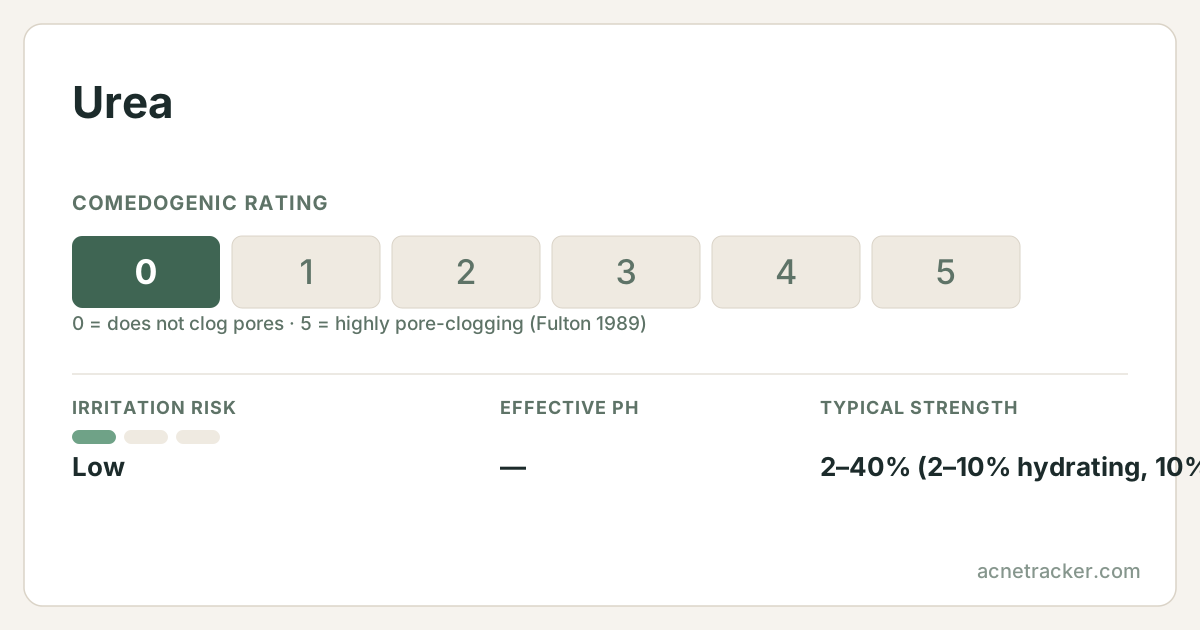
Urea is one of dermatology's most versatile and dependable ingredients, prized for a rare dual personality that depends entirely on concentration. It is a natural component of the skin's own moisturizing system — part of what dermatologists call natural moisturizing factor — so applying it topically simply tops up something the skin already uses. At low percentages it is a humectant that pulls and holds water in the outer layers, leaving dry, tight skin soft and comfortable. At higher percentages it becomes keratolytic, softening and dissolving thickened, hardened skin. That range is why you find urea in everything from gentle body lotions to heavy-duty foot and heel creams.
Quick facts
- Comedogenic rating
- our estimate — not measured
- Irritation risk
- Low
- Effective pH
- —
- Typical strength
- 2–40% (2–10% hydrating, 10%+ keratolytic)
- Pregnancy
- Considered safe
- Suits skin types
- drysensitivenormalmaturecombination
Where this number comes from
No one has published a comedogenic rating for this ingredient. Fulton's 1989 table tested about 250 raw materials and this was not among them, and we found no later study measuring it. The figure shown is our own reasoning from the ingredient's chemistry and how it is used — treat it as an estimate, not a measurement.
Fulton read his own scale as 0-1 not significant, 2-3 borderline, 4-5 positive. The assay is the rabbit ear at 10% dilution, which the paper itself calls extremely sensitive and not fully predictive of human skin. Ratings describe the raw ingredient; concentration and formulation change real-world behaviour.
Caution profile
The four published fields on this page, on one 0–5 scale. Further from the centre means more care is needed — never that the ingredient is worse.
Derived, not measured: pore-clogging is the published comedogenic rating; irritation maps low/moderate/high to 1/3/5; pregnancy maps safe/caution/avoid to 0/3/5; skin-type limits is how many of the seven skin types this entry does NOT list. Every input is printed in words in the quick-facts card above.
Show the numbers
| Metric | 0–5 | Published field |
|---|---|---|
| Pore-clogging | 0 | 0/5 |
| Irritation | 1 | Low |
| Skin-type limits | 1.4 | 5/7 |
| Pregnancy | 0 | Considered safe |
Working pH and typical strength
Where this ingredient is formulated to sit, and at what concentration.
Both bars come from the fields above: the pH window and the typical strength range published for this ingredient. The tinted column is healthy skin's surface pH (about 4.7–5.75).
Show the numbers
| Metric | 0–5 |
|---|---|
| Typical strength | 2–40% (2–10% hydrating, 10%+ keratolytic) |
What is it?
Chemically known as carbamide, urea is a small, water-loving molecule that behaves differently across its concentration range. Below roughly 10% it works mainly as a humectant, binding water in the stratum corneum and improving the skin's ability to stay hydrated, which is why it is a staple in moisturizers for dry, flaky and eczema-prone skin. Above about 10% it takes on keratolytic activity, loosening the protein bonds in hardened, built-up skin so that thick calluses, rough heels and scaly patches can be smoothed away. Higher still, at 20–40%, it is used medically to soften and help remove damaged nails and very thick skin. Unlike acids, urea has no dependence on a specific low pH to function.
Benefits
Deep, lasting hydration
As a natural moisturizing factor, urea binds water into the outer skin layers, relieving the tightness, roughness and flaking of dry and dehydrated skin far more durably than occlusion alone.
Softens thick, hardened skin
At 10% and above its keratolytic action loosens compacted dead cells, smoothing calluses, cracked heels, rough elbows and scaly patches that ordinary moisturizers cannot budge.
Helps soothe eczema-prone skin
Because it restores a substance the dry, barrier-impaired skin is short of, urea is widely used in emollients for eczema and very dry skin to reduce itching and improve comfort.
Boosts other ingredients
By exfoliating and hydrating the surface, urea helps other actives and moisturizers absorb more evenly, which is why it often appears alongside ceramides, glycerin and lactic acid.
How to use
Match the strength to the job. For everyday face and body hydration, a moisturizer with 2–10% urea can be used once or twice daily on damp skin, ideally with ceramides or glycerin to lock the water in. For thick, rough areas — heels, elbows, knees — a 10–25% cream applied to the affected skin works as a targeted keratolytic; the very high strengths (20–40%) are best reserved for medical use on nails or severe callus. Higher-percentage products can sting on cracked or broken skin, so start conservatively there. Urea is fragrance-compatible and layers well under other moisturizers and sunscreen.
Side effects
Low-strength urea is very well tolerated. The main issue at higher, keratolytic percentages is a temporary stinging or burning sensation, especially when applied to cracked, raw or freshly shaved skin. This usually settles quickly but signals that you should use less or choose a lower strength. Genuine allergy is uncommon. If a high-urea product causes persistent redness or discomfort on the face, switch to a low-percentage formula intended for facial use.
Who should avoid it
Urea suits almost everyone, including during pregnancy, where it is regarded as a safe moisturizing ingredient. The main caution is around high-strength keratolytic products on broken, weeping or infected skin, where they can sting sharply — treat the wound first. On very reactive facial skin, keep to lower concentrations. As always, patch test a new high-percentage product before spreading it widely.
Pairs well with
Frequently asked questions
What does urea do for your skin?
It depends on strength. Below about 10% urea hydrates by binding water into the skin; above 10% it also exfoliates, softening thick, hard or scaly skin. It is a natural part of the skin's own moisturizing system.
What percentage of urea should I use?
For face and body hydration, 2–10% is ideal. For rough heels, elbows and calluses, 10–25% works as a keratolytic. Very high strengths of 20–40% are mainly for medical use on nails or severe thickening.
Is urea good for eczema and very dry skin?
Yes. Because it replenishes a natural moisturizing factor the dry skin is lacking, urea-containing emollients are widely used to relieve the itch, tightness and flaking of eczema-prone and very dry skin.
Does urea exfoliate the skin?
At concentrations of roughly 10% and above it is keratolytic, meaning it loosens and softens built-up dead skin. At lower concentrations it mainly hydrates rather than exfoliates.
Is urea safe to use during pregnancy?
Yes. Topical urea is considered a safe, non-irritating moisturizing ingredient during pregnancy and breastfeeding. As always, confirm with your doctor for your specific situation.
Where this ingredient shows up here
Counted across this database, not the web — these are the pages on this site that reason about this ingredient.
Sources & further reading
Medical disclaimer
Find your personal acne triggers
Our free Acne Tracker lets you log breakouts, sleep, stress and diet, and shows you which factors correlate with your flare-ups.