How to Choose a Face Oil for Rosacea-Prone Skin
Rosacea-prone skin has a low tolerance threshold and a long memory: a product that stings on Tuesday can leave the face reactive for the rest of the week. Face oils are a mixed proposition here. The barrier in rosacea is measurably impaired, and a bland occlusive oil supports it — which is genuinely helpful, because much of the burning and stinging people blame on 'sensitivity' is barrier failure. But the oil aisle is full of botanical extracts and essential oils that provoke flushing, and rosacea skin is unusually good at finding them. The rule here is boring formulas only.
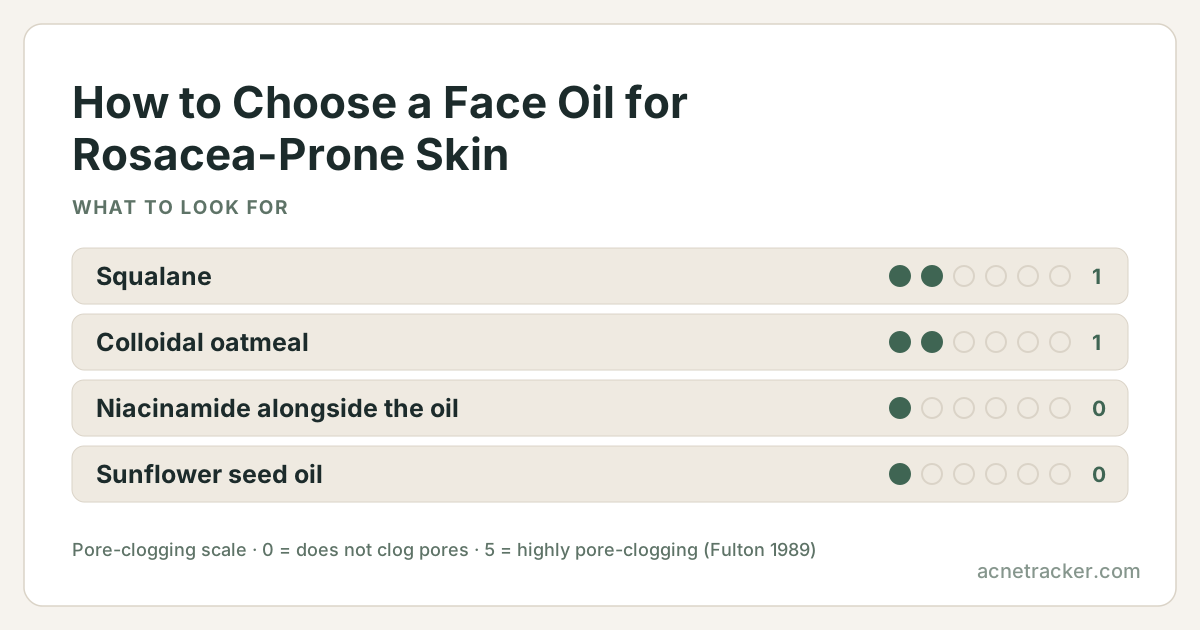
Ingredients to look for
| Ingredient | Why it matters |
|---|---|
| Squalane | The default choice: odourless, fragrance-free, chemically inert, and rated 1 by Fulton. There is very little in it for rosacea skin to react to. |
| Colloidal oatmeal | Long-standing use in barrier-impaired, reactive skin, with an anti-inflammatory literature behind it and no fragrance load. |
| Niacinamide alongside the oil | Studies on 2–5% niacinamide report improved barrier function and reduced water loss, which is the relevant target in rosacea-prone skin. |
| Sunflower seed oil | Fulton rates it 0, it is fragrance-free by nature, and its linoleic content supports barrier lipids without the heaviness of an oleic oil. |
| Allantoin | A soothing, extremely low-reactivity ingredient that shows up in bland blends and gives you nothing new to react against. |
Ingredients to avoid
| Ingredient | Why it matters |
|---|---|
| Essential oils, especially peppermint, eucalyptus and menthol-type | These act on cold receptors and vasculature, and are among the most reliable flushing triggers in rosacea. The cooling sensation is the warning, not the benefit. |
| Cinnamon, clove and spice-derived oils | Potent sensitisers and vasodilators. They belong nowhere near a face that flushes. |
| Witch hazel and alcohol-containing oils | The astringent tightening is followed by rebound redness, and rosacea skin does not recover from that cycle quickly. |
| Warming or 'invigorating' facial oils | The warmth is vasodilation, which is precisely the mechanism you are trying to avoid provoking. |
How to choose
Read the list backwards, from the fragrance allergens at the bottom upwards. If linalool, limonene, geraniol or eugenol appear at all, put it down — those are declared because they sensitise, and rosacea skin is the wrong place to test your luck. Then look at length: the shorter the list, the fewer the triggers, and a one-ingredient bottle of squalane is a perfectly respectable answer here. Third, avoid anything promising a sensation. Cooling, warming, tingling and 'refreshing' all describe an effect on your nerves or your blood vessels, and both are already dysregulated in rosacea. Fourth, remember that an oil is supportive, not therapeutic. Rosacea has real treatments — topical ivermectin, azelaic acid, metronidazole, brimonidine and others — and these are conversations to have with a doctor, not choices to make from an ingredient list. If your face is persistently red, has visible vessels, or has developed papules and pustules, a diagnosis is worth more than any product decision, since the subtypes respond to different treatments.
How to apply
Patch test on the jaw or behind the ear for several days before the cheeks — the central face is the most reactive area and the worst place to discover a trigger. Apply gently: no rubbing, no massage, no hot water beforehand, and let the skin be barely damp rather than wet. Two or three drops pressed on at night is enough. Introduce nothing else in the same fortnight, so if a flush happens you know what caused it. If a product stings on application, wash it off; in rosacea, stinging is not something to push through, and a formula that stings once will usually sting again.
Frequently asked questions
Are face oils bad for rosacea?
Not as a category. Bland, fragrance-free oils support a barrier that is measurably impaired in rosacea. The problem is the botanical and essential-oil-heavy formulas that dominate the shelf, which provoke flushing reliably.
Which face oil is least likely to trigger a flush?
Squalane. It has no scent, no fragrance allergens, no unsaturated bonds to oxidise, and a Fulton rating of 1. When rosacea skin reacts to almost everything, a single-ingredient bottle removes most of the variables.
Why does my face burn when I apply oil?
Usually an essential oil or fragrance component, or a barrier so impaired that everything penetrates too fast. Check the list for declared allergens first, then simplify the whole routine before reintroducing anything.
Can rosacea be managed with skincare alone?
Gentle skincare and sun protection reduce flares and are worth doing, but rosacea has prescription treatments with real evidence behind them. If redness is persistent or bumps are appearing, see a doctor rather than reformulating your shelf.
Sources & further reading
There is no single study of this exact question. The guidance here is reasoned from the ingredient profiles below, each of which carries its own references:
- Squalane3 refs
- Colloidal Oatmeal2 refs
- Niacinamide2 refs
- Sunflower Seed Oil3 refs
- Allantoin3 refs
Show every reference behind this page (10)
- PubChem — Squalane compound summarycited by Squalane
- DermNet — Emollients and moisturiserscited by Squalane
- European Commission CosIng database — Squalanecited by Squalane, Niacinamide, Sunflower Seed Oil, Allantoin
- FDA OTC monograph — skin protectant drug products (colloidal oatmeal)cited by Colloidal Oatmeal
- PubMed — Colloidal oatmeal formulations as adjunct treatments in atopic dermatitis (J Drugs Dermatol, 2012)cited by Colloidal Oatmeal
- Niacinamide: mechanisms of action and its topical use in dermatology (PubMed)cited by Niacinamide
- PubChem — Linoleic acid (major sunflower fatty acid)cited by Sunflower Seed Oil
- Safety Assessment of Helianthus annuus (Sunflower)-Derived Ingredients as Used in Cosmetics (PubMed)cited by Sunflower Seed Oil
- PubChem — Allantoin compound summarycited by Allantoin
- Final report of the safety assessment of allantoin and its related complexes (PubMed)cited by Allantoin
Medical disclaimer
Ingredients mentioned on this page
Find your personal acne triggers
Our free Acne Tracker lets you log breakouts, sleep, stress and diet, and shows you which factors correlate with your flare-ups.