How to Choose a Face Oil for Combination Skin
Combination skin is the hardest brief in this category, because a single bottle has to satisfy two contradictory demands: a T-zone that produces plenty of oil and cheeks that produce too little. Most people solve this badly, either by using a rich oil everywhere and getting congestion across the forehead, or by using a featherlight one and leaving the cheeks as dry as before. There are two workable answers — a genuinely balanced oil applied evenly, or two oils applied by zone — and this page explains how to tell which you need and what to look for either way.
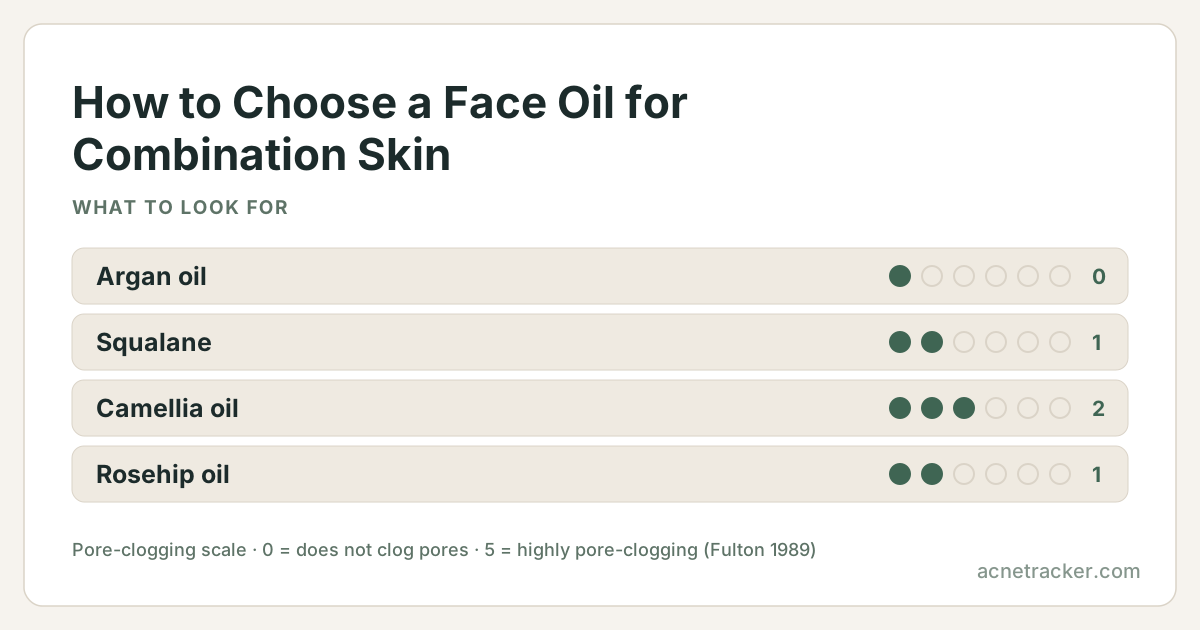
Ingredients to look for
| Ingredient | Why it matters |
|---|---|
| Argan oil | Close to an even split of oleic and linoleic acid, which is exactly why it is the classic single-bottle answer for two-zone skin. Reproduced tables list it at 0. |
| Squalane | Fulton rates it 1. It behaves identically on both zones — cushioning on the cheeks, invisible on the T-zone — because it has no fatty acids to tip it either way. |
| Camellia oil | Oleic-dominant but unusually fast to absorb, which makes it richer than it feels. A good compromise if argan is too light for your cheeks. |
| Rosehip oil | High-linoleic, so it is the one to reserve for the T-zone if you go the two-oil route. Reproduced rating 1; not present in Fulton's own table. |
| Jojoba oil | Rated 0 by Fulton. Its sebum-like wax ester structure sits well on the oily zone without abandoning the dry one. |
Ingredients to avoid
| Ingredient | Why it matters |
|---|---|
| Heavy butters in the blend (cocoa, mango) | Cocoa butter is rated 4 by Fulton. Anything that solid will congest the T-zone long before it does much for the cheeks. |
| One rich oil applied everywhere | The most common combination-skin mistake. It fixes the cheeks and clogs the forehead, then gets blamed for 'not working'. |
| Alcohol-thinned 'balancing' oils | The fast finish comes from a solvent, not from the oil's own weight. Your dry zone pays for the T-zone's matte look. |
| Sesame and avocado oils | Both are rated 3 by Fulton — fine on a genuinely dry face, but too much for a face that has an oily half. |
How to choose
First, decide whether you actually have combination skin or dehydrated oily skin. If your cheeks feel tight but look normal and your whole face gets shiny by afternoon, that is dehydration, and one light oil solves it. If your cheeks visibly flake while your nose shines, that is genuine combination skin, and you have a zoning problem. For the single-bottle route, look for an oil where oleic and linoleic acid are roughly balanced — argan is the reference point — rather than an oil that is 70% either way. For the two-oil route, buy one high-linoleic oil and one high-oleic oil and treat them as different products; this costs more but works better on strongly divided faces. In both cases the comedogenic ratings still apply to the T-zone, so the whole blend has to clear that bar even if you only ever put it on your cheeks — oils migrate overnight. Ignore the word 'balancing' on the front: it describes a hope, not a formulation property.
How to apply
Zone it deliberately. Two drops pressed into the cheeks and jaw where the dryness lives, and either nothing or a single drop of a lighter oil across the T-zone. Apply at night, after your moisturiser rather than before if your cheeks are properly dry, and give the T-zone a couple of minutes before you lie down so the oil is absorbed rather than migrating. If your forehead develops small bumps two to three weeks in, the oil has crossed the border — pull it back to the cheeks entirely and see whether the bumps resolve.
Frequently asked questions
Can one face oil work for both dry cheeks and an oily T-zone?
Yes, if its fatty acids are balanced rather than dominated by one. Argan is the usual answer, and squalane works because it has no fatty acid profile at all. A strongly oleic oil will not manage both.
Should I use different oils on different parts of my face?
It is the more precise approach if your zones are genuinely different: a linoleic oil on the T-zone and an oleic one on the cheeks. Most people find one balanced oil easier to live with, and the difference is small.
Why does my T-zone break out when I only oil my cheeks?
Oils migrate, especially overnight on a pillow. If the T-zone is reacting, the blend itself is too rich for it — check the comedogenic ratings of everything in the bottle, not just where you applied it.
Is combination skin just dehydrated oily skin?
Sometimes. If your cheeks feel tight rather than look flaky, and your whole face is shiny by afternoon, dehydration is more likely than a true two-zone skin type — and hydration, not oil zoning, is the fix.
Sources & further reading
There is no single study of this exact question. The guidance here is reasoned from the ingredient profiles below, each of which carries its own references:
- Argan Oil3 refs
- Squalane3 refs
- Camellia Oil2 refs
- Rosehip Oil3 refs
- Jojoba Oil2 refs
Show every reference behind this page (9)
- European Commission CosIng database — Argania Spinosa Kernel Oilcited by Argan Oil, Squalane, Camellia Oil, Rosehip Oil, Jojoba Oil
- PubChem — Oleic acid (major argan fatty acid)cited by Argan Oil
- Insights on Phytochemistry and Pharmacological Properties of Argania spinosa L. Skeels: A Comprehensive Review (PubMed)cited by Argan Oil
- PubChem — Squalane compound summarycited by Squalane
- DermNet — Emollients and moisturiserscited by Squalane
- Effect of Camellia japonica oil on human type I procollagen production and skin barrier function (Journal of Ethnopharmacology, 2007)cited by Camellia Oil
- PubChem — Linoleic acid (major rosehip fatty acid)cited by Rosehip Oil
- Safety Assessment of Rosa canina-derived Ingredients as Used in Cosmetics (PubMed)cited by Rosehip Oil
- Pazyar N et al. Jojoba in dermatology: a succinct review. G Ital Dermatol Venereol 2013 Dec (PubMed)cited by Jojoba Oil
Medical disclaimer
Ingredients mentioned on this page
Find your personal acne triggers
Our free Acne Tracker lets you log breakouts, sleep, stress and diet, and shows you which factors correlate with your flare-ups.