How to Choose an Eye Cream for Under-Eye Hollows
This page starts with the part the category usually buries: a hollow under the eye is a depression, and a cream cannot fill a depression. What you see as darkness there is a shadow cast by your own anatomy — the ligament that tethers skin to the orbital rim creates a groove, and the cheek fat that used to sit above it has descended or shrunk. That is a three-dimensional problem, and skincare is a surface intervention. Understanding this saves you both money and a specific kind of frustration, and it still leaves a few genuinely useful things a topical can do at the margins.
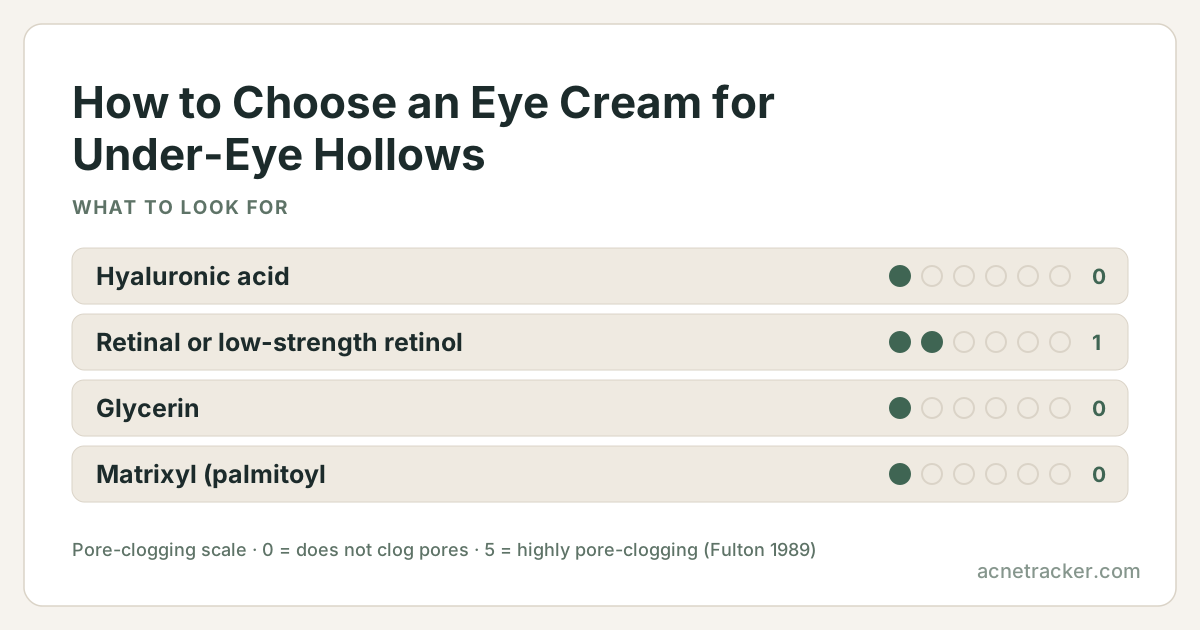
Ingredients to look for
| Ingredient | Why it matters |
|---|---|
| Hyaluronic acid | Draws water into the upper layers and swells the skin a fraction of a millimetre, which softens the edge of the groove very slightly. Honest framing: this changes the shadow's crispness, not its depth. |
| Retinal or low-strength retinol | Over six to twelve months it measurably thickens the dermis. On a hollow, a slightly thicker, less translucent floor makes the shadow read as less dark — a real but small effect. |
| Glycerin | The reliable, unfashionable humectant. Skin that is well hydrated reflects light more evenly, and even light scattering is genuinely what makes a hollow less obvious. |
| Matrixyl (palmitoyl pentapeptide-4) | A signal peptide with modest published support for collagen stimulation. Worth including as part of the skin-quality play; not worth believing as a volume claim. |
| Vitamin C | Supports collagen synthesis and reduces any pigment sitting on top of the shadow. If your hollow has a brown component as well, this addresses the part that is actually treatable. |
Ingredients to avoid
| Ingredient | Why it matters |
|---|---|
| 'Filler in a jar' and 'instant volume' claims | There is no cosmetic ingredient that adds subcutaneous volume through intact skin. Products using this language are selling a hydration effect under a surgical metaphor. |
| Strong film-forming 'instant lift' formulas | They tighten as they dry and can make a hollow look sharper rather than softer, because a tighter surface deepens the groove it is stretched across. |
| Heavy pigmented correctors as a skincare purchase | Colour-correcting a shadow is a legitimate makeup strategy, but it belongs in the makeup budget. Buying it as treatment sets you up to conclude that treatment failed. |
| Over-exfoliating the area in pursuit of brightness | Thinning the skin over a hollow makes the shadow worse, not better, because translucency is one of the things creating it. |
How to choose
Test it before you shop. Look straight ahead in a mirror with a light overhead, then tilt your chin up so the light falls directly into the groove. If the darkness largely vanishes, you have confirmed it is a shadow, and you have also confirmed that a lightening cream is aimed at nothing. Now decide honestly what you are buying. If the goal is genuine volume restoration, the interventions that do that are injectable or surgical, they belong in a consultation with a qualified doctor, and no article should be pushing you toward or away from that decision. If the goal is to make the area look its best without that, then you are buying skin quality: hydration for even light reflection, a slow retinoid for dermal thickness, vitamin C for any pigment overlay, and daily sunscreen so photoageing does not deepen the surrounding laxity. Judged on that basis, a plain good moisturiser with a retinoid at night is roughly the whole rational protocol, and the price of the jar has very little to do with how well it performs.
How to apply
Place product along the orbital rim where the groove actually runs, not across the whole under-eye area, and pat rather than rub — the skin here is tethered and dragging it stresses that attachment. Damp skin helps humectants pull water inward instead of outward. If you use a retinoid, build up from twice weekly, keep it below the groove rather than on the lid, and give it six months before judging. Two more levers cost nothing: sleep on your back so fluid does not exaggerate the surrounding contour overnight, and avoid overhead lighting when you assess yourself.
Frequently asked questions
Can eye cream fill hollow under-eyes?
No. Filling a hollow means adding volume beneath the skin, and no topical crosses that barrier or deposits material there. A hydrating cream can plump the surface enough to soften the transition slightly, which is a cosmetic improvement of a few percent rather than a correction.
Why do my under-eyes look hollow even when I sleep well?
Because it is structure rather than fatigue. The tear trough follows a ligament fixed to the bone, and the volume above it thins with age or was never there in the first place. Sleep affects fluid and vascular darkness; it does not affect where your ligaments attach.
Does hyaluronic acid help tear troughs?
The version in a cream helps a little by hydrating the surface. The version that meaningfully changes a tear trough is a cross-linked gel injected under the skin by a doctor, which is a completely different product with completely different risks. The shared ingredient name causes a lot of confusion.
Do hollow eyes get worse with age?
Usually, gradually. Midface fat descends and diminishes, bone around the orbit remodels and the rim becomes more prominent, so the groove deepens over decades. Sun protection and not smoking slow the skin-quality half of this; they do not stop the anatomical half.
When should hollow eyes be checked by a doctor?
If hollowing appears rapidly rather than over years, affects one side only, follows unexplained weight loss, or comes with drooping, double vision or any change in how the eye moves or sits. Sudden change in the shape or position of an eye is not a cosmetic finding and deserves prompt assessment.
Sources & further reading
There is no single study of this exact question. The guidance here is reasoned from the ingredient profiles below, each of which carries its own references:
- Hyaluronic Acid3 refs
- Retinal3 refs
- Glycerin3 refs
- Matrixyl2 refs
- Vitamin C3 refs
Show every reference behind this page (9)
- PubChem — Hyaluronic acid compound summarycited by Hyaluronic Acid
- European Commission CosIng database — Hyaluronic Acidcited by Hyaluronic Acid, Retinal, Glycerin, Matrixyl, Vitamin C
- DermNet — Moisturisers and humectantscited by Hyaluronic Acid, Glycerin
- PubChem — Retinaldehydecited by Retinal
- Kwon HS et al. Efficacy and safety of retinaldehyde 0.1% and 0.05% creams used to treat photoaged skin: A randomized double-blind controlled trial. J Cosmet Dermatol 2018 Jun (PubMed)cited by Retinal
- PubChem — Glycerol compound summarycited by Glycerin
- PubMed — Peptides: Emerging Candidates for the Prevention and Treatment of Skin Senescence: A Review (Biomolecules, 2025)cited by Matrixyl
- PubChem — Ascorbic Acid compound summarycited by Vitamin C
- DermNet — Topical vitamin Ccited by Vitamin C
Medical disclaimer
Ingredients mentioned on this page
Find your personal acne triggers
Our free Acne Tracker lets you log breakouts, sleep, stress and diet, and shows you which factors correlate with your flare-ups.